|
28.1 #8
|
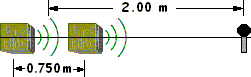
A microphone is located on the line connecting two speakers that are 0.750 m apart and oscillating 180° out of phase. The microphone is 2.00 m from the midpoint of the two speakers. What are the lowest two frequencies that produce an interference maximum at the microphone’s location? Ans: 229 and 6__? |
|||
|
d = ½ λlowest-f 0.75 = ½ λlowest-f λlowest-f = 1.50 m
|
v = flowest λlowest-f 345 = flowest-f 1.5 flowest = 230 Hz
|
d = λ2nd lowest-f 3/2 0.75 = λ2nd lowest-f 3/2 λ2nd lowest-f = 0.5 m
|
v = flowest λ2nd lowest-f 345 = f2nd lowest-f 0.5 f2nd lowest = 690 Hz
|
|
|
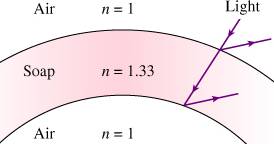
28.3 #32 What is the minimum soap-film thickness (n = 1.33) in air that will produce constructive interference in reflection for red (λ = 652 nm) light? (b) Which visible wavelengths will destructively interfere when reflected from this film? (Refer to Example 25–3 for the range of visible wavelengths.) |
|
|
|
|
x = (m + ½) λ / 2n x = (0 + ½) 652/ 2(1.33) x = 122.6 nm
|
(b) x = m λ / 2 n 122.6 = (m + ½) λ / 2 (1.33) λ = 326 / m so if m = 1 or 2 or 3, etc |
||
|
λ < 326 nm Thus NO visible wavelengths will destructively interfere |
|||
|
Extra Constructive interference is given by x = (m + ½) λ / 2n 122.6 = (0 + ½) λ / 2(1.33) λ = 652 nm is the only visible possible |
|
||
28.6 #62
White light strikes a diffraction grating (760 lines/mm) at normal incidence. What is the longest wavelength that forms a second-order maximum?
|
Picture the Problem: When white light passes through a grating with 760 lines per millimeter, spectra are visible on each side of the central maximum. |
|
|
Strategy: Set the angle equal to 90° in equation 28-16 and solve for the largest wavelength of light that forms a second-order (m = 2) maximum. The slit separation d is equal to the inverse of the number of lines per millimeter N. |
|
|
Solution: Solve equation 28-14 for the wavelength: |
|
|
Insight: Light that has a wavelength longer than 660 nm will have only one maximum. For example, light of wavelength 680 nm has only one maximum at 31°. |
|

28.2 (and 28.4 and 28.6) Double Slit
A laser with wavelength d/8 is shining light on a double slit with slit separation 0.500 mm. This results in an interference pattern on a screen a distance L away from the slits. We wish to shine a second laser, with a different wavelength, through the same slits. What is the wavelength λ2 of the second laser that would place its second maximum at the same location as the fourth minimum of the first laser, if d = 0.500 mm?
Need help understanding? Please click here and fill in the last table
|
d sinθ = m λ
o if you want out of phase (maxima matching to minima), then o m - ½ corresponds to the 1st minima, when m = 2 then 2 - ½ is the 2nd minima, etc.
|
||
|
4th Minima d sinθ = (4 - ½) λ1
|
2nd Maxima d sinθ = 2 λ2
|
2 λ2 = (4 - ½) λ1 2 λ2 = (4 - ½) d/8 λ2 = 0.109 mm |

28.4 and 28.6 A Diffraction Grating Spectrometer
Suppose that you have a reflection diffraction grating with n = 760,000 lines / meter. Light from a sodium lamp passes through the grating and is diffracted onto a distant screen. Two visible lines in the sodium spectrum have wavelengths 498 nm and 569 nm. (a) What is the angular separation Δθ of the first maxima of these spectral lines generated by this diffraction grating?
|
d sin θ = m λ (1/760000)sinθ = 1(498x10-9) θ = 22.24°
|
d sin θ = m λ (1/760000)sinθ = 1(569x10-9) θ = 25.62° |
Δθ = 25.6° – 22.2° Δθ = 3.38°
|
(b) How wide does this grating need to be to allow you to resolve the two lines 589.00 and 589.59 nanometers, which are a well known pair of lines for sodium, in the second order (m = 2)?
|
Chromatic Resolving power, R = λ / Δλ
|
Diffraction Grating Spectrometer, R = m N (where N = # of lines on grating) R = m (width (n)) |
|
λ / Δλ = m (width) n 589 / .59 = 2 (width) (760,000) width = 0.657 mm |
|
|
28.3 Interference from Reflection off a Soap Film What is the thinnest soap (nsoap = 1.33) film that appears black when illuminated with light with a wavelength of 490 nm?
|
|
|
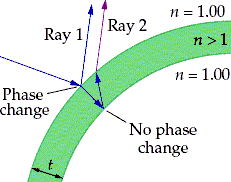
The light reflected off the top of the soap has a half-wave phase shift, while the light that reflects off the bottom has no phase shift. v = c / n v = f λ c / nair = f λair f = c / (nair λair) we also know freq can’t change
|
c / nsoap = f λsoap c / nsoap = c / (nair λair) λsoap 1 / nsoap = 1 / (1 λair) λsoap λsoap = λair / nsoap λsoap = 490nm / 1.33 λsoap = 368 nm |
|
Since the light reflected off the top and bottom of the bubble are 180° out of phase, the thickness of the bubble must correspond to ½ λsoap ½ λsoap = 368/2 ½ λsoap = 184 nm |
|
|
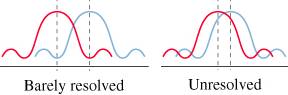
28.5 Rayleigh's criterion Resolving Power
|
If you can read the bottom row of your doctor's eye chart (λlight = 570 nm), your eye has a resolving power of one arcminute, equal to 1/60°. If this resolving power is diffraction-limited, to what effective diameter of your eye's optical system does this correspond? |
|
sinθd = 1.22 λ/D sin(1/60°) = 1.22 570x10-9 / D D = 2.39 mm |
(The factor 1.22 comes from the fact that we are using a circular aperture for the diffraction pattern instead of an infinite slit.) |