Ch 11.1 #3
Two vectors are given by A = -3 i + 4 j and B = 2 i + 3 j. Find (a) AxB and (b) the angle between A & B.
|
i j k -3 4 0 2 3 0 |
(4*0 – 3*0) i - (-3*0 – 2*0) j + (-3*3 – 2*4) k A x B = -17 k |
| A x B | = |A||B|sinq 17 = 5 * Ö13 sin q q = 70.6°
|
Ch 11.2 #12
A 1.50 kg particle moves in the xy plane with a velocity of v = (4.20 i – 3.60 j ) m/s. Determine the angular momentum of the particle when its position vector is r = (1.50 i + 2.20 j ) m.
|
L = r X p L = (m) (r X v) i j k 1.5 2.2 0 4.2 -3.6 0
1.5(-3.6) = -5.4 4.2(2.2) = 9.2 |
+ ( 2.2*0 – (-5.4) * 0 ) i - ( 1.5*0 – 6.3 * 0 ) j + ( 1.5*-3.6 – 4.2 * 2.2 ) k 1.5 (-14.6) = -22
m(r x v) = -22.0 k (kg m2/s) or Joule-sec |
Ch 11.3 #25
A particle of mass 0.4 kg is attached to the 100-cm mark of a meter stick of mass 0.1 kg. The meter stick rotates on a horizontal, frictionless table with an angular speed of 4 rad/sec. Calculate the angular momentum of the system when the stick is pivoted about an axis (a) perpendicular to the table through the 50-cm mark and (b) perpendicular to the table through the 0-cm mark.
|
I = 1/12 m1L2 + m2 0.52 I = 1/12 0.1*12 + 0.4*0.52 I = 0.1083 kg m2 |
L = Iw L = 0.1083*4 L = 0.433 kg m2 /s L = 0.433 J-sec |
(b) I = 1/3 m1L2 + m2 R2 I = 1/3 0.1*12 + 0.4*12 I = 0.433 kg m2 |
L = Iw L = 0.433*4 L = 1.73 kg m2 /s L = 1.73 J-sec |
Ch 11.4 #30
A student sits on a freely rotating stool holding two weights, each of mass 3kg (as demonstrated in class.) When his arms are extended horizontally, the weights are 1 m from the axis of rotation and he rotates with an angular speed of 0.75 rad/sec. The moment of inertia of the student plus the stool is 3 kg m2 and is assumed to be constant. The student pulls the weights inward horizontally to a position 0.3 m from the rotation axis.
(a) Find the new angular speed of the student
(b) Find the kinetic energy of the rotating system before and after he pulls the weights inward.
|
Itotal = 2mr2 + 3 kg m2 Ii = 2*3*12 + 3 kg m2 I = 9 kg m2 |
If = 2*3*0.32 + 3 kg m2 If = 3.54 kg m2
|
Angular momentum is conserved Li = Lf Iiwi = Ifwf 9(.75) = 3.54(wf) wf = 1.91 rad / sec |
|
Ki = ½ Iiwi2 Ki = ½ 9(0.75)2 Ki = 2.53 J |
Kf = ½ Ifwf2 Kf = ½ 3.54(1.91)2 Kf = 6.46 J |
Ch 11.4 #39
Suppose a meteor of mass 3.00 x 10¹³ kg moving at 30.0 km/s relative to the center of the Earth, strikes the Earth. What is the order of magnitude of the maximum possible decrease in the angular speed of the Earth due to this collision? Explain work.
|
We need the mass of the Earth F = G Mm/r2 mg = 6.67 x 10⁻¹¹ MEm/(6.4 x 106)2 ME = 9.81(6.4 x 10⁶)2/6.67 x 10-11 ME = 6x1024 kg |
And angular velocity vT = 2πr / 24 hr v = wr w = 2π / 86,400 sec r = 6.4 x 10⁶ m
ωinit = 7.27 x 10⁻⁵ rad/sec |
|
||
|
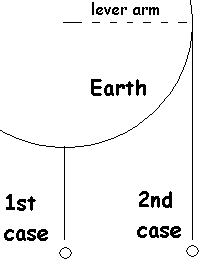
1st case: The object hits the earth dead on…no change of L except due to added mass I ω = If ωf (2/5 mrE2)ω = (2/5 mrE2 + mastrrE2) ωf Iastr is negligible to IEarth |
||||
|
2nd case includes 1st case Plus The object hits the earth on its edge, Torque is maximum, so greatest change of L. |
||||
|
Linit = (2/5 mr2) ω Linit = 9.83x1037 465.4 Linit = 4.6 x 1040
|
L = r X p r = 6.4 x 10⁶ i p = (3x10¹³)3x10⁴ j |
|||
|
i j k 6.4 x 10⁶ 0 0 0 9x10¹⁷ 0 |
∆L = r x p = r (mv) ∆L = 5.76 x1024 |
|||
|
Linit = (2/5 mrE2) ω Lfinal = (2/5 mrE2) ωf – r x p Linit = Lfinal Iearth ω = Iearth ωf – r x p where Iearth = (2/5 mrE2) (ωf - ω)( Iearth) = r x p r is perpendicular to momentum (ωf - ω)( Iearth) = r(p) / ( Iearth) (ωf - ω) = 5.9 x 10⁻¹⁴ rad/sec or about 10-13 rad/sec |
||||
|
Ch 11.6 #42 In the Bohr model of the hydrogen atom, the electron moves in a circular orbit of radius 0.529 Angstroms around the proton. Assuming the orbital angular momentum of the electron is equal to h/2π, calculate. L = Iw |
(a) the orbital speed of the electron ans: 2.19 x 10⁶ m/s (b) the kinetic energy of the electron ans: 2.18 x 10⁻¹⁸ J (c) the angular frequency of the electron’s motion ans: 4.13 x 10¹⁶ rad/s |
|||
|
h = 6.6261 x 10⁻³⁴ m = 9.11 x 10⁻³¹ r = 0.529 x 10⁻¹⁰ |
(a) L = h/2π L = mvr mvr = h / 2π v = 2.19 x 10⁶ m/s |
(b) K = ½ mv2 K = ½9.11x10⁻³¹(2.19x10⁶)2 K = 2.18 x 10⁻¹⁸ Joules |
(c) L = Iw = h/2π h/2π = mr2 w w = 4.13x10¹⁶ rad/sec |
|
Ch 11.1 #8
A particle is located at the vector position r = (i + 3 j) meters and the force acting on it is F = (3 i + 2 j) N. What is the torque about (a) the origin and (b) the point having coordinates (0, 6) meters?
t = r x F i j k
1 3 0
3 2 0
(3*0 – 2*0) i + (1*0 – 3*0) j + (1 * 2 – 3 * 3) k = (-7 Nm) k
(b) the point having coordinates (0, 6) meters?
t = r x F i j k
1 (3-6) 0
3 2 0
(-3*0 – 2*0) i + (1*0 – 3*0) j + (1 * 2 – -3 * 3) k = (11 Nm) k
Ch 11.2 #13
The position vector of a particle of mass 2 kg is given as a function of time r = (6 i + 5t j) meters. Determine the angular momentum of the particle about the origin, as a function of time.
L = r x p p = m v
|
v = dr / dt v = d(6 i + 5t j)/dt v = 5 j m/s |
p = m v p = 2 kg (5j) m/s p = 10j (kg m/s) |
L = r x p L = (6 i + 5t j) x 10 j |
i j k 6 5t 0 0 10 0 |
L = (5t*0 – 10*0) i + (6*0 – 0*0) j + (6 * 10 – 0 * 5t) k
L = (60 Jsec) k
Ch 11.4 #33
A 60 kg woman stands at the rim of a horizontal turntable having a moment of inertia of 500 kg m2 and a radius of 2 m. The turn table is initially at rest and is free to rotate about a frictionless, vertical axle through its center. The woman then starts walking around the rim clockwise (view from above) at a constant speed of 1.5 m/s relative to the Earth.
(a) In what direction and with what angular speed does the turntable rotate?
(b) How much work does the woman do to set herself and the turntable into motion?
|
Iwomanwwoman = -Itablewtable mr2 (vT/r) = 500 wtable wtable = mrv / 500 wtable = 60*2*1.5 / 500 wtable = -0.36 rad / sec |
Work = ΔK + ΔKR Work = ½ mv2 + ½ Iw2 Work = ½ 60 1.52 + ½ 500*0.362 Work = 99.9 Joules
|