Ch 12.1 #3
|
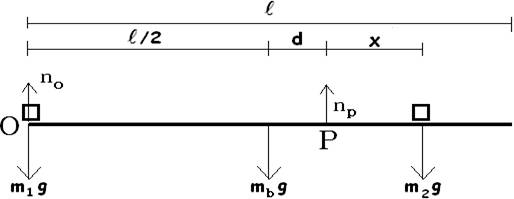
A uniform beam of mass mb and length l supports blocks of masses m1 and m2 at two positions, as shown in the figure. The beam rests on two points. For what value of x will the beam be balanced at P such that the normal force at O is zero? |
|
|
tcw = tccw if it balanced NO (l/2 + d) + m2g (x) = mbg (d) + m1g (l/2 + d) x = [(m1g + mbg) d + m1g l/2] / m2g x = [(m1 + mb) d + m1 l/2] / m2 |
|
Ch 12.3 #13
|
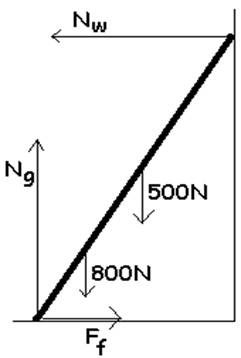
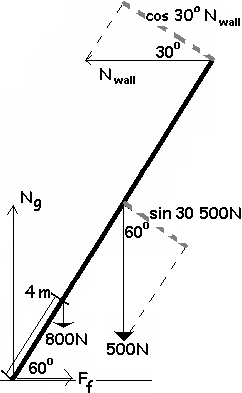
A 15 m uniform ladder weighing 500 N rests against a frictionless wall. The ladder makes a 60° angle with the horizontal. (a) Find the horizontal and vertical forces that the ground exerts on the base of the ladder when an 800 N firefighter is 4 meters from the bottom.
(b) If the ladder is just on the verge of slipping when the firefighter is 9 m up what is the coefficient of static friction between the ladder and the ground? |
|
||
|
a) SFx = 0 (not moving) SFx = Ffriction – Nwall Nw = Ffriction |
SFy = Nground – Wfire - Wladder = 0 Ng = 800 N + 500 N Ng = 1300 Newtons |
||
|
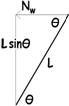
Remember, the lever arm is ALWAYS perpendicular to the force. Torque applied by the ladder, the center of mass of the ladder is at 7.5 meters …so the lever arms is 7.5 (sin q). (I’ve chosen the pivot point at the base of the ladder.) Stccw = Stcw in equilibrium twall = tfirefighter + tladder Nw cos 30° 15 m = 800 N 4 m sin 30° + 500 N 7.5 m sin 30° Nw = 268 N to the left Ff = 268 N to the right Ng = 1300 N up |
|
||
|
b) cos 30° Nw 15 m = 800 N 9 m sin 30° + 500 N 7.5 m sin 30°
|
|||
|
Nw = 421 N to the left Nw = Ff (where Ff = m Ng)m 1300 N = 421 N m = 0.324 |
|
||
Ch 12.3 #24
|
Two identical uniform bricks of length L are placed in a stack over the edge of a horizontal surface with the maximum overhang possible without falling. Find the distance x.
|
|
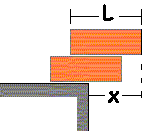
Ch 12.2 Leg: Center of Gravity
|
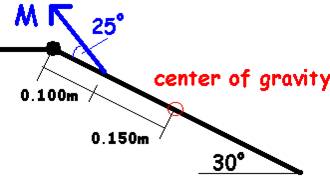
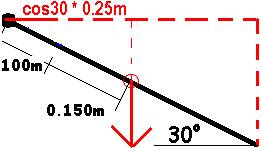
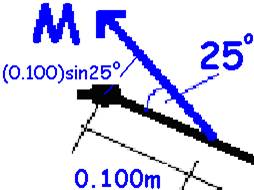
A person is sitting with one leg outstretched so that it makes an angle of 30° with the horizontal, as the drawing indicates. The weight of the leg below the knee is 44.5 N with the center of gravity located below the knee joint. The leg is being held in the position because of the force, M, applied by the quadriceps muscle, which is attached 0.100 m below the knee joint. Obtain the magnitude of M. |
|
|
τleg = FWeight d τleg = 45N * cos30º 0.25 τleg = 9.7428 Nm |
|
|
|
τmuscle = Fmuscle d τmuscle = M * sin25º 0.1 τmuscle = 0.04226*M |
||
|
|
||
|
τleg = τmuscle 9.743 Nm = 0.04226*M M = 230 N |
|
Ch 12.2 #5
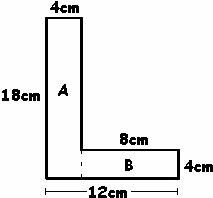
A carpenter’s square has the shape of an L, as in the figure. Locate the center of gravity.
|
Lower left hand corner: (0, 0)
ACM = (2, 9) BCM = (8, 1)
|
xCG = Smixi / Smi xCG = AAxA + ABxB / (AA + AB) xCG = 72 (2) + 48 (8) / (72 + 32) xCG = 3.85 cm |
|
|
|
AA = 18*4 AA = 72 cm2
|
AB = 8*4 AB = 32 cm2 |
yCG = AAyA + AByB / (AA + AB) yCG = 72 (9) + 48 (1) / (72 + 32) yCG = 6.85 cm |
|
|
And since the mass is proportional to area we can use Area instead of mass in the equation for center of gravity |
|||
|
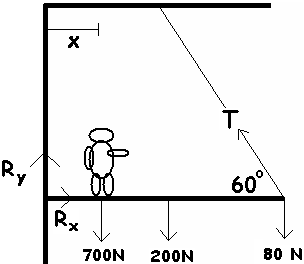
Ch 12.3 #43 A hungry Bear weighing 700 N walks out on a beam in an attempt to retrieve a basket of food hanging at the end of the beam. The beam is uniform, weighs 200 N and is 6 m long; the basket weighs 80 N.
|
|
|
|
(a) Draw a free body diagram for the beam
|
||
|
(b) When the bear is at x = 1 m, find the tension in the wire and the components of the force exerted by the wall on the left end of the beam tcw = tccw if it balanced 700*1 + 200*3 + 80*6 = T sin60° * 6 T = 343 N SFy-down = SFy-up in equilibrium SFx = Rx – T cos60° = 0 Rx = 171 N SFy = Ry + T sin60° - (700+200+80) = 0 Ry = 683 N |
||
|
(c) If the wire can stand a maximum tension of 900 N, what is the maximum distance the bear can walk before the wire breaks?
700*x + 200*3 + 80*6 = 900 sin60° * 6 x = 5.13 m
|
|
Ch 12.3 #44
Old MacDonald had a farm, and on that farm he had a gate. The gate is 3 m wide and 1.8 m high, with hinges attached to the top and the bottom. The guy wire makes an angle of 30˚ with the top of the gate and is tightened by a turn buckle to a tension of 200 N. The mass of the gate is 40 kg
(a) Determine the horizontal force exerted on the gate by the bottom hinge.
(b) Find the horizontal force exerted by the upper hinge
(c) Determine the combined vertical force exerted by both hinges
(d) What must the tension in the guy wire be so that the horizontal force exerted by the upper hinge is zero
Ch 12.2
A 3 kg particle is located on the x-axis at x = -5 m, and a 4 kg particle is located on the x axis at x = 3 m. Find the center of gravity of this two particle system.
Ch 12.2 #8
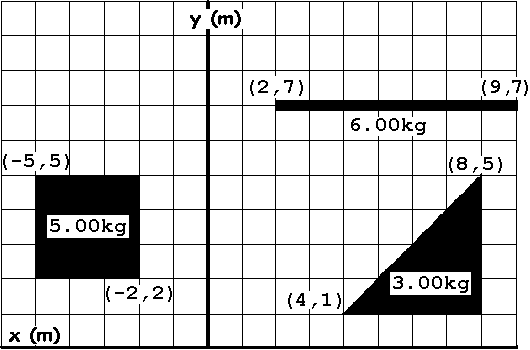
The masses and coordinates of a rod, a right triangle, and a square are given. Determine the center of gravity for the three-object system.
Ch 12.4 #33
If the shear stress in steel exceeds 4.00 x 10⁸ N/m2, the steel ruptures. Determine the shearing force necessary to (a) shear a steel bolt 1.00 cm in diameter and (b) punch a 1.00 cm diameter hole in a steel plate 0.500 cm thick.
Ch 12.4 #35
|
When water freezes, it expands by about 9%. What would be the pressure increase inside your automobile’s engine block if the water in it froze? (Bulk modulus of ice is 2 x 10⁹ N/m2) (Pressure = F/A) |
DP = - B (DV / V) DP = - 2 x 10⁹ (-.09) DP = = 1.8 x 10⁸ N/m2 DP = 26100 lb/in2 |
Ch 12.4 #27
|
A 200 kg load is hung on a wire having a length of 4 meters, a x-sectional area of 2 x 10⁻⁵ m2, and a Young’s Modulus of 8 x 10¹⁰ N/m2. What is its increase in length? |
Young’s M = F/A / DL / L 8 x 10¹⁰ N = 200”g” / 2 x 10⁻⁵ / DL / 4 DL = 0.005 m
|