|
Ch
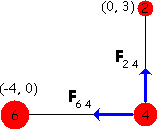
13.1 #5 Three uniform
spheres of mass 2.00 kg, 4.00 kg, and 6.00 kg are placed at the corners of a
right triangle. Calculate the
resultant gravitational force on the 4.00 kg object. |
|
|
||
|
The 4
kg object has two objects attracting it, thus you need to add both objects
individually. F = GMm/r2 |
|||
|
F6:4
= -6.673 x 10⁻¹¹ 6(4)/(42) i F6:4
= -10.0 x 10⁻¹¹ i |
F2:4
= 6.673 x 10⁻¹¹ 6(4)/(42) j F2:4
= 5.93 x 10⁻¹¹ j |
||
|
F2,6:4
= (-10.0 x 10⁻¹¹ i + 5.93 x 10⁻¹¹ j ) |
|||
|
Ch
13.2 Gliese 581 C recently has
marked a milestone in the search for worlds beyond our solar system.
It is the smallest exoplanet ever detected, and the
first to lie within the habitable zone of its parent star, thus raising the
possibility that its surface could sustain liquid water, or even life. It is
50 percent bigger and five times more massive than Earth. |
|
|
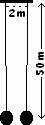
(a) What is the gravity on the surface of this
planet? Ans: 21.8 m/s2 (b)
A student at |
|
|
(a) GMEm/rE2
/ gE
= GMGlim/rGli2 / gGli ME/rE2 / gE = MGli/rGli2 / gGli ME/rE2 / 9.81
= 5ME/1.5rE2 / gGli gGliese = 21.8 m/s2 |
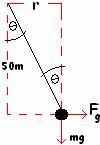
at small angles tanθ ≈ sinθ ≈ θ
|
(b) Distance between objects are 2 m or (2 – 2x) ≈
2 because x << 2m |
||
|
tanθ = x/50 θ = x / 50 |
tanθ =
Fg / mg θ = GM/
r2 / g θ = G
67,700/ g(2-2x)2 |
|||
|
V = 4πR3/3 V = 4π 0.93/3 V =
3.05 |
m = ρ V m = 22,200
(3.05) m =
67,700 kg |
x / 50 =
G 67,700 / 21.8*22 r =
2.59 x 10⁻⁶ meters for each ball |
||
Ch
13.3 #10
The free-fall
acceleration on the surface of the Moon is about one-sixth that on the surface
of the Earth. If the radius of the Moon is
about 0.250 RE, find
the ratio of their average densities ρmoon
/ ρearth . ans 2/3
|
mg = GMm / r2 g = G
M / r2 g = G ρV / r2 g = G ρ(4/3 πr3) / r2 g = 4/3
Gρπr |
gmoon / gearth = 4/3 Gρπrmoon
/ 4/3 Gρπrearth gmoon / gearth = 1 / 6 1 / 6 =
4/3 Gρπrm / 4/3 Gρπre 1 / 6 = ρmrm
/ ρere ρere = 6ρm rm ρere = 6ρm0.25re 2/3ρe
= ρm |
Ch
13.4 #20
Neutron stars are
extremely dense objects that are formed from the remnants of supernova
explosions. Many rotate very
rapidly. Suppose that the mass of a
certain spherical neutron star is twice the mass of the sun and its radius is
10.0 km. Determine the greatest possible
angular speed it can have so that the matter at the surface of the star on its
equator is just held in orbit by the gravitational force.
|
FNeutron:matter = |
Fc = mv2/r |
Show Algebra (ωr)2 = ω =
(G M2xSun / r3)1/2 |
|
FN:m = Fc ω = (6.673x10⁻¹¹ (2*1.991x1030)
/ (104)3)1/2 ω = 16,300 radians per second |
||
|
Ch
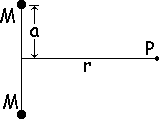
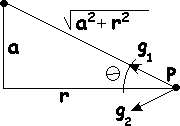
13.5 #25 Compute the
magnitude and direction of the gravitational field at a point P on the
perpendicular bisector of the line joining two objects of equal mass
separated by a distance 2a. ans: g = 2MGr((a2 + r2)-3/2 |
|
|
We know the y
components are equal and opposite and that both x components are pulling at
Point P in the –x direction. |
|
||
|
gy = g1y – g2y = 0 g = g1x
+ g2x g1x =
g2x g = 2g1x (-i ) |
g1x
= cosθ g1 g1x =
r/(a2+r2)1/2
GM/(a2 + r2) g1x
= GMr/(a2+r2)3/2 g = 2 g1x (-i
) g = 2(GMr/(a2+r2)3/2) (-i
) |
cos θ = adj / hyp cos θ = r / (a2 + r2)1/2 mg1 = GMm/r2 g1 = GM/(a2 + r2) |
|
|
Ch
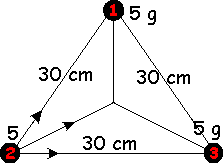
13.6 #31 A system
consists of three particles, each of mass 5.00 g, located at corners of an
equilateral triangle with sides of 30.0 cm.
(a) Calculate the potential energy of the
system (b) If the particles are released simultaneously, where will they
collide? ans: (a) -1.67 x 10⁻¹⁴ Joules,
(b) at the center |
|
|
Utotal = U1:2 + U1:3 + U2:3 U1:2
= U1:3 = U2:3 Utotal = 3 U1:2 |
U1:2
= G M m /
r U1:2
= 6.673x10⁻¹¹(0.005)(0.005)/ 0.3 U1:2
= 5.56 x 10⁻¹⁵ |
Utotal = 3 U1:2 Utotal = 3 * 5.56 x 10-15 Utotal = 16.7 x 10⁻¹⁵ Joules |
Ch
13.7 #40
The planet Uranus
has a mass about 14 times the Earth’s mass, and its radius is equal to about
3.7 Earth radii. (a) By setting up
ratios with the corresponding Earth values, find the free-fall acceleration at
the cloud tops of Uranus. (b) By
ignoring the rotation of the planet, find the minimum escape speed from Uranus.
|
(a) mg = GMm/r2
gUr = 9.8(14 / (3.7)2) gUr =10.0 m/s2 |
(b)
vesc, vesc, |
vesc = √(2GM/RE) vesc,E = 1.12 x 10⁴ m/s |