Ch
14.1 #3
A 50 kg woman
balances on one heel of a pair of high heeled shoes. If the heel is circular and has a radius of
0.500 cm, what pressure does she exert on the floor?
|
P = F/A |
P = m
g / πr2 P = 50kg(9.8m/s2)
/ π(0.005)2 P =
6.24 x 10⁶ Pascals |
|
Ch
14.2 Dam In the example
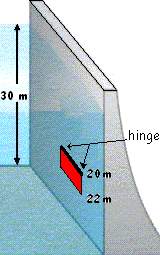
on our class notes, let’s say a hatch 5 meters in width was placed near the
bottom of a 30 meter dam. The hinged
hatch is located 20 to 22 meters below the surface. The hinge is along the top of the hatch at
20 meters. What is the torque exerted
by the water about the hinge? |
|
||
|
dF = P
dA dA = w dh dF = ρgh (5
dh) w = 5 meters F =
5ρg ∫h dh dτ
= F •
(h – 20) dτ
= 5ρg h dh • (h – 20) |
∫dτ
= 5ρg (∫h2 dh - 20∫h dh) τ = 5 1000 9.8 [(h3/3 - 20
h2/2)] τ = 50000 [(223–203)/3
– 10(222–202)] τ = 2,090,000 Nm CCW |
Lever arm is h - 20 dh is from 20 to 22 meters deep. |
|
|
Ch
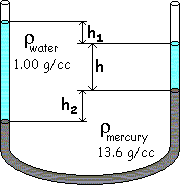
14.3 #20 A U-tube of
uniform cross sectional area, open to the atmosphere, is partially filled
with mercury. Water is then poured
into both arms. If the equilibrium
configuration of the tube is with h2 = 1.00 cm determine the value
of h1. |
|
|
|
Pleft = Pright (Aleft
= Aright) Fleft Aright = Fright Aleft Fleft = Fright ρ g
h = ρ g h +
ρ g h 1“g”(h+h1+h2)
= 1“g”h + 13.6“g”h2 |
1“g”(h+h1+h2)
= 1“g”h + 13.6“g”h2 h1+h2
= 13.6h2 h1 =
12.6h2 h2
= 1.00 cm h1
= 12.6 cm |
|
Ch
14.4 Ball
At the beach by
the ocean, what is the force required to submerge a 30.0
|
FNet = Fdown
+ FW Fdown + mg Fdown + 30 Fdown + 30 |
= FB = msaltwater g = ρ saltwater (V) g = 1030(0.0335) g |
ρ saltwater ≈ 1030 kg/m3 V = (4/3)πr3 V =
(4/3)π(0.2)3 V =
0.0335 m3 |
|
Fdown
= 308 |
||
Ch
14.5 #41
Water flows
through a fire hose of diameter 6.35 cm at a rate of 0.0120 m3/sec. The fire hose ends in a nozzle of inner
diameter (id) of 2.20 cm. What is the
speed with which the water exits the nozzle?
|
We know mass/time is constant…so V1
/ t = V2 / t Initial diameter (and radius) is irrelevant |
A1
Δx1/t = V2
/ t πr2
(v) = 0.0120 m3/s v = 0.012/ π(0.011)2 v = 31.6 m/s |
Ch
14.6 #45
Through a pipe
15.0 cm in diameter, water is pumped from the
|
(a) P
+ ½ρv2 + ρgh
=
P2 + ½ρv22 +
ρ g h2 (1atm + Pg)
+ ½ρv22
+ 0 = 1atm + ½ρv22 + 1000(9.8)(2096-564) (vinit ≈ vfinal…if
10 gpm at one point in the hose…must be 10 gpm at any other point) I’m also
assuming the 564 meter elevation is the bottom so the 2096 meter elevation is
the top, so h2 = (2096-564). (1atm + Pg)
+ 0 + 0 = 1atm
+ 0 + 1000(9.8)(2096-564) P = 1atm + 1000(9.8)(2096-564) P = 1atm + 150 x 105 Pa |
|
|
(b) flow rate =
0.052083 m3/sec flow rate = A
v .052083 = π¼d2 v .052083 =
π¼ .152 v v =
2.95 m/s |
(c) This time we need give
some extra velocity…so (1atm + Pg)
= 1atm + ½ρv22 + 1000(9.8)1532 P = 1 atm + ½ 1000(2.95)2 + 150 x 105 Pa P = 1 atm + 4340 Pa + 150 x 105 Pa P =
1.013 x 10⁵ Pa + 4340 Pa + 150 x 105 Pa P = 151.05
x 105 Pa |
Ch
14.7 #53
A hypodermic
syringe contains water. The barrel of
the syringe has a cross-sectional area of 2.50 x 10⁻⁵ m2,
and the needle has a cross-sectional area of 10-8 m2. In the absence of a force on the plunger, the
pressure everywhere is 1 atm. A force of magnitude 2.00 N acts on the
plunger, making water squirt horizontally from the needle. Determine the speed of the medicine as it
leaves the needle’s tip. ans 12.6m/s
|
A1v1
= A2v2 2.50 x 10⁻⁵ v1 = 10-8 v2 v2 =
2500 v1 So v12 is neglible
(below) |
P + ½ρv2 + ρgh = P2 + ½ρv22 + ρgh2 P-P2 + 0 +
n/a =
+ ½ρv22 + n/a ΔP
= ½ρv2 2/(2.50
x 10-5) = ½ 1000 v2 v =
12.6 m/s |