1,
wave, 19, harmonic, 40, 48
Ch
15.1 #1
A ball dropped from
a height of 4.00 m makes a perfectly elastic collision with the ground. Assuming no mechanical energy is lost due to
air resistance, (a) show that the ensuing motion is periodic and (b) determine
the period of the motion. (c) Is the
motion simple harmonic? Explain.
|
a) Since the collision is elastic, no energy is transferred
out of the system during the rebound.
We always ignore air friction unless told otherwise…thus the ball will
continue to repeat its bounce to 4 meters every bounce. |
b) d = ½at2
t = √(2d/a) tdown = 0.9035 sec T =
1.807 sec |
c) the force is mg not kx…so the force isn’t
dependant upon position, thus not sinusoidal, thus not simple harmonic. |
|
|
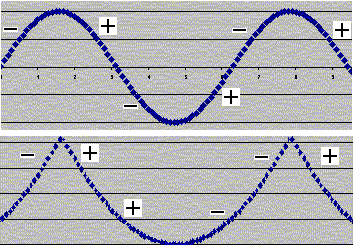
This top diagram
is the displacement of a spring. While
the spring is going AWAY from equilibrium, we have a negative acceleration. A further
explanation of (c). Let’s look at the
restoring force vector (hence acceleration, F = ma) on the position versus
time diagram. This bottom
diagram is a displacement of a ball.
As the ball goes down…it’s accelerating and as it’s going up…it’s
slowing down. |
|
||
Ch
15.2 wave
A particle with an amplitude of 6.00 cm, and a frequency 4.00 Hz is moving
along the x axis in simple harmonic motion.
The particle starts from its equilibrium position, the origin, at t = 0
and moves to the right.
(a) Show that the
position of the particle is given by x = (6.00 cm) sin(8πt)
(b) Determine the
maximum speed and the earliest time (t > 0) at which the particle has this
speed, (c) the maximum acceleration
and the earliest time (t > 0) at which the particle has this acceleration,
and (d) the total distance traveled between
t = 0 and t = 1 second.
|
(a) Is ω
correct? ω
= 2πf ω =
2π(4) ω = 8π
Yes Is
the particle at origin
when t = 0; x(0)=6
sin(8π(0)) x(0) = 0 Yes |
@ t =
0; v is + v
= d x /dt v(0) = d(6sin(ωt))/dt v(0) = 6ω cos(ωt) v(0) =
+6ω Yes thus x(t) =
2 sin(3π t) |
(b) vmax
= A ω vmax
= 6(8π) vmax = 151
cm/s |
peaks occur when derivative = 0 vmax occurs at t = 0 and
every ½T beyond. |
||
|
dv/dt = -A ω2 sin(ωt) 0
= -A ω2 sin(ωt) t
= 0 |
|||||
|
If T = 1/f = 1/4
sec, then next peak is @ ½ T = 1/8 seconds |
|||||
|
(c) a = dv/dt = -6 ω2 sin(ωt) amax
= +6 ω2 amax
= +6 (8π)2 amax =
3790 cm/s2 da/dt = -6 ω3 cos(ωt) peaks occur when 0
= -6 ω3 cos(ωt) derivative
= 0 π/2
= ωt t = 1/16 sec (this is 1st
negative accel peak) t = 1/16 +
1/8 (this is 1st
positive accel peak) t =
3/16 = 0.1875 seconds |
(d) s = A
(4 / T ) * t s = 6cm(4 / (1/8 sec)) 1sec s =
192 cm |
||||
|
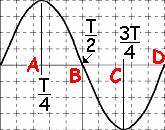
The
wave travels one amplitude every quarter of a period (T/4) ·
(A) 0 amplitude to peak (T/4) ·
(B) peak back to 0 ·
(C) 0 to trough ·
(D) trough back to 0 |
|
||||
Ch
15.3 #19
A 50.0 g object
connected to a spring with a force constant of 35.0 N/m oscillates on a
horizontal, frictionless surface with amplitude of 4.00 cm. Find (a) the total energy of the system and (b)
the speed of the object when the position is 1.00 cm. Find (c) the kinetic energy
and (d) the potential energy when the position is 3.00 cm. ans: 28 mJ
b. 1.02 m/s c. 12.2 mJ d. 15.8 mJ
|
ω2
= k/m ω
= 26.46 rad/s x(t) = A cos(ωt) 0.01 = 0.04cos(26.46t) t =
0.050 sec 0.03 =
0.04cos(26.46t) t =
0.0273 sec |
(a) E = ½kA2 E = ½35(0.04)2 E = 0.028 Joules = 28 mJ (b) v = -A ω
sin(ωt) v =
-.04ωsin(26.46*.05) |v| =
1.02 m/s |
(c) K = ½kA2sin2(ωt) K = ½35(.04)2sin2(26.46*.0273) K = .01225
Joules = 12.3 mJoules (d) U = ½kA2cos2(ωt) U = ½35(.04)2cos2(26.46*.0273) U =
15.8 mJ |
|
Ch
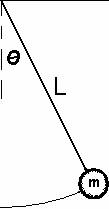
15.5 pendulum A 1.00 kg
pendulum with a length of 2.00 m is released at an angle of 10.0° from the vertical. What is the (a) speed at the bottom and (b) the restoring force
at the extremes by using the simple harmonic motion model? (c) Solve
this problem more precisely by using more general principles of |
|
|
A = r
q A = 2m (10° (p/180°) A =
0.349 m |
ω2
= g /
L ω2
= 9.8 / 2 ω2
= 4.90 rad/sec |
(a) vmax =
A ω vmax = 0.349 * 4.9 vmax = 0.820 m/s |
(b) Fmax =
m amax Fmax
= m A
ω2 Fmax
= 1 (.349)(4.92) Fmax
= 8.38 N |
|||
|
(d)
|
h = r - cosqr h = 0.0341 ½mv2
= mgh v = 0.8176 m/s |
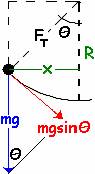
F = ma = mgsinq a = 2.54 m/s2 a = a r a = 2.54 m/s2 |
F = mgsinq F = 0.635 N |
|||
Ch
15.6 #40
Show that the time
rate of change of mechanical energy for a damped, undriven
oscillator is given by dE/dt = –bv2
and hence is always negative. Proceed as follows: Differentiate the expression
for the mechanical energy of an oscillator, E = ½mv2 + ½kx2,
and use equation ma = -kx – bv, where a = d2x/dt2.
|
TE =
½ m v2 + ½ k x2 take
time-derivative dE/dt = mv d2x/dt2 + kx dx/dt dE/dt = v m d2x/dt2 + kx v (Given: m d2x/dt2 = -kx – bv) |
dE/dt = v(-kx – bv) + kx v dE/dt = -vkx – bv2 + kx v dE/dt = – bv2 < 0 |
Ch
15.7 #48
Damping is negligible
for a 0.150 kg object hanging from a light 6.30 N/m spring. A sinusoidal force with amplitude of 1.70 N
drives the system. At what frequency
will the force make the object vibrated with amplitude of 0.440 m? 1.31Hz or
0.641 Hz
|
When b is
neglible the above equation simplifies down to ω2
= k/m ± Fo /(m*A) |
A = (Fo / m) / ± (ω2
- ωo2) ω2
= ωo2
± Fo / (m*A) ω2
= k/m ± Fo /(m*A) ω2
= 6.3/.15 ± 1.7/(.15*.44) ω
= 8.23 or 4.03 rad/sec ω =
2πf f =
1.31 Hz or 0.641 Hz |
 ; ωo2 = k/m