Ch 18 #6, 15,
shoe, sis, 45, 49, guitar
Ch
18.1 #6
Two identical
sinusoidal waves with wavelengths of 3.00 m travel in the same direction at a
speed of 2.00 m/s. The second wave
originates from the same point as the first, but at a later time. Determine the minimum possible time interval
between the starting moments of the two waves if the amplitude of the resultant
wave is the same as that of each of the two initial waves.
|
y = 2Acos(φ/2) sin(kx-wt+φ/2) Given: 2A cos (φ /2) = A |
2 cos (φ /2) = 1 (φ /2) = cos-1(1/2) Phase difference of φ = 120° or 1/3 of a wave |
v = f λ v = 2; λ = 3 f = 2/3 Hz T = 1.5 seconds 1/3 of the
period is ½ seconds |
Ch
18.2 #15
Two speakers are
driven in phase by a common oscillator at 800 Hz and face each other at a
distance of 1.25 m. Locate the points along a line
joining the two speakers where relative minima of sound pressure amplitude
would be expected. (Use v = 343
m/s.)
|
Two antinodes are required for a full wavelength in standing
waves which are produced by the facing speakers: dNtoN
= λ/2 or λ =2dNtoN v = f
λ v = f
2dNtoN 343 = 800(2dNtoN) dNtoN = 0.214 meters If the speakers vibrate in phase, the point halfway between
them is an antinode of pressure at a distance from
either speaker of 1.25 m / 2 =
0.625m |
Then there is a node at 0.625 – ½0.214 = 0.518 m a node at 0.518 – 0.214 = 0.303
m a node at 0.303 – 0.214 = 0.0891
m a node at 0.518 + 0.214 = 0.732
m a node at 0.732 + 0.214 = 0.947
m & a node @ 0.947 + 0.214 = 1.16
m from either speaker. |
Ch
18.3 shoe
A concrete shoe (ρconcrete = 2.50 g/cc) is hung from scale
by a wire, while being completely submerged in water. This wire emits a fundamental frequency of 500
Hz when plucked. The water is replaced
with oil (ρoil = 0.900 g/cc). What is the new fundamental frequency?
|
FT-init
= ρconcreteVg – ρwaterVg
FT-init
= mg - FBouy FT-init
= 2.50Vg – 1.00Vg FT-init
= 1.5Vg FT-final
= ρconcreteVg – ρoilVg FT-final
= 2.5Vg – 0.9Vg FT-final
= 1.6Vg |
f2 λ2 = FT / μ f2 = FT / μλ2 |
finit2
= FT-init / μλ2 ffinal2
= FT-final / μλ2 |
|
finit2 /ffinal2 = FT-init / FT-final 5002
/ffinal2 = 1.5Vg / 1.6Vg ffinal = 516 Hz |
||
Ch
18.4 ”sis”ter and swing
You are pushing
your little sister on a swing. The
center of mass of your sister to the pivot point is 1.6 meters. If your little sister wants to go the
highest, how often should you push?
ω2 = g / L
(2π/T)2
= 9.8/1.6
T
= 2.54 seconds
|
Ch
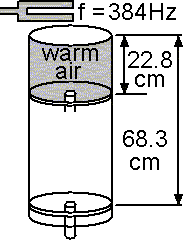
18.5 #45 An air column in
a glass tube is open at one end and closed at the other by a movable piston.
The air in the tube is warmed above room temperature, and a 384-Hz tuning
fork is held at the open end. Resonance is heard when the piston is 22.8 cm
from the open end and again when it is 68.3 cm from the open end. (a) What
speed of sound is implied by these data? (b) How far from the open end will
the piston be when the next resonance is heard? |
|
|||
|
For resonance in a narrow tube open at one end, f = nv / 4L (n = 1, 3, 5…) |
(a) For n = 1 and n = 3 |
(b) f(n=1) = nv
/ 4L 384 = 5(350) / 4L L = 1.14 m |
||
|
f(n=1) = nv
/ 4L 384 = 1(v) / 4(0.228) v = 350 m/s |
f(n=3) = nv
/ 4L 384 = 3(v) / 4(0.683) v = 350 m/s |
|||
Ch
18.6 #49
An aluminum rod
1.60 m long is held at its center. It is stroked with a rosin-coated cloth to
set up a longitudinal vibration. The
speed of sound in a thin rod of aluminum is 5100 m/s. (a) What is the fundamental frequency of the
waves established in the rod? (b) What harmonics are set up in the rod held in
this manner? (c) What If? What
would be the fundamental frequency if the rod were copper, in which the speed
of sound is 3,560 m/s?
|
(a) v =
f λ
v =
f 2L 5100 = f 3.2 f = 1590
Hz
|
A-N-A L = ½λ Rod clamped at center; the center will be a node and each ends
will be antinodes |
(b) The center must always be a node and the
ends, antinodes; so harmonics are odd. 1st: 3rd:
ANANANA (skips 2nd: ANANA) 5th:
ANANANANANA (skips 4th: ANANANA). |
c) v =
f λ
v =
f 2L 3560 = f 3.2 f = 1110
Hz |
Ch
18.7 guitar
You’ve decided to
enhance your guitar. You only use 3 of
the 5 strings, so you are going to replace the remaining two with the same type
of string of the same length (which requires minimal modification). One of the strings will have the frequency of
1000 Hz and a tension of 300 N. What
would lower the tension in the second string if you desire a beat frequency of
10 Hz?
|
f2 λ2 = FT / μ f2 = FT / μλ2 |
finit2
= FT-init / μλ2 ffinal2
= FT-final / μλ2 |
finit2
/ ffinal2 = FT-init/FT-final 10002
/ 9902 = 300 / FT-final FT-final
= 294 N |
|
Note: 1. μ constant since same string 2. λ is constant since identical boundary
conditions (same length) |
||