#1, 7, 17, 22, 46, 51
Ch 1.2 #1
|
A crystalline solid consists of atoms stacked up in a repeating lattice structure. The atoms of a crystal reside at the corners of cubes of side L = 0.200 nm. One piece of evidence for the regular arrangement of atoms comes from the flat surfaces along which a crystal separates, or cleaves, when it is broken. Suppose this crystal cleaves along a face diagonal. Calculate the spacing, d, between two adjacent atomic planes that separate when the crystal cleaves. |
|
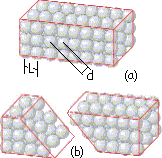
Below are Instructor solutions…if exactly the same…give ½ credit
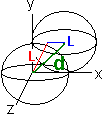
From the figure, we may see that the spacing between
diagonal planes is half the distance between diagonally adjacent atoms on a
flat plane. This diagonal distance may be obtained from the Pythagorean
theorem,  .
Thus, since the atoms are separated by a distance
.
Thus, since the atoms are separated by a distance  , the diagonal planes are separated by
  .
.
|
The figure states that we may see that it’s ½ diagonal distance…this is very difficult to determine from the figure. If the student explains it in detail…then give credit for the ½ term (this is half credit). The other half credit must be explained below d2 = L2 + L2 So the answer is ½ (L2 + L2)1/2 |
|
Ch 1.3 #7
Calculate the mass of an atom of (a) helium (4 amu’s), (b) iron (55.9 amu’s), (c) lead (207 amu’s). Given your answers in grams. An amu is a unit of mass, slightly less than the mass of a proton/neutron.
Hint: look inside the front cover of your book for constants i.e. amu to kg conversion factor.
|
(a) He 4 amu (1.66 e-24 g / amu) 6.64 x 10⁻²⁴ grams |
(b) Fe 55.9 amu (1.66e-24 g / amu) 9.28 x 10⁻²³ grams |
(b) Fe 207 amu (1.66e-24 g / amu) 3.43 x 10⁻²² grams |
Ch 1.4 #17
Newton’s Law of universal gravitation is represented by F = G M m / r2. F is the magnitude of the gravitational force exerted by the objects on each other, M and m are the masses of the objects, and r is the distance between the two objects. Force has the SI units kg m / s2. What are the SI Units of the proportionality constant “G”?
|
F = G M m / r2 kg m / s2 à “G” kg kg / m2 “G” à m3 / (kg s2) |
Often G is shown with the units à N m2 / kg2
|
Ch 1.5 #22
|
An auditorium measures 40.0 m x 20.0 m x 12.0 m. The density of air is 1.2 kg/m3. What are (a) the volume of the room in cubic feet; (b) the weight of air in the room in pounds? |
Back page of your book 1 m = 3.281 ft; 1 lb = 4.448 N “g” = 9.81 m/s2 |
|
V = l w h V = 40*20*12 = 9600 m3 V = 9600 m3 (3.281 ft / 1 m)3 V = 3.39 x 105 ft3
|
m = ρ V (ρ = m / V) m = 1.2 ( 40*20*12) m = 11,520 kg (2.2 lbs / 1 kg) Fw = 25,344 lbs Fw = 25,300 lbs |
Proper method Fweight = m “g” Fw = 11,520 kg * 9.81 m/s2 Fw = 113,011 N Fw = 113,011 N (1 lb / 4.448 N) Fw = 25, 400 lbs |
|
2.2 lb Ξ 1 kg ; NEVER use this equivalence beyond Ch 1 |
||
Ch 1.6 #46
Soft drinks are commonly sold in aluminum containers. To an order of magnitude, how many such containers are thrown away or recycled each year by U.S. consumers? How many tons of aluminum does this represent? In your solution state the quantities you measure or estimate and the values you take for them.
- Each person drinks on average 1 can a day. There are 300 million people in the US.
- Each can is approximately 13 grams or about 0.03 lbs (source www.gk-12.osu.edu/Docs/Technological%20Design.ppt) Also we know entire full can is 355 grams. (This data must be reasonable…no more than 30 grams or less than 5 grams)
300 million people (1 can / person) (0.03 lb / 1 can) (1 ton / 2000 lbs) = 4500 tons/ day
4500 tons / day (365 day / 1 year) = 1.6 million tons per year
Ch 1.7 #51
Significant Figures: The radius of a solid sphere is measured to be 6.50 ± 0.20 cm and its mass is measured to be 1.85 ± 0.02 kg. Determine the density of the sphere in kg / m3 and the uncertainty in the density.
Please see Dr. Mallinckrodt’s Quiz Zero or my Pre-Lab for Measurements and Uncertainties for examples and instructions for propagation of uncertainty.
|
ρ = m / v ρ = 1850 g / (4/3 π 6.53) ρ = 1.61 g/cc ρ = 1.61 x 10³ kg / m3
|
Add fractional uncertainty : (0.02 / 1.85) + 3 (0.2/6.5) = 0.103 (NEVER leave as decimal) = 10.3%
|
= (1.61 ± 10.3%) x 103 kg / m3 = (1.61 ± 1.61 * 10.3%) x 103 kg / m3 = (1.61 ± 0.17) x 103 kg / m3 = (1.6 ± 0.2) x 103 kg / m3
|
Ch 1.4 #15
Which of the following equations are dimensionally correct?
|
a) vf = vi + ax No, ax is m/s2 * m = m2/s2 ≠ m/s
|
b) y = 2 m cos(kx), where k = 2 m-1 Yes, k * x is unit less and y & 2 m both have the same units.
|
Ch 1.5 #31
One gallon of paint covers an area of 25 m2. What is the thickness of the paint on the wall?
One gallon = 0.00378 m3 or 3.78 liters.
|
Volume = thickness x Area |
0.00378 m3 = x * 25 |
x = 151 microns or 0.151 mm |
Ch 1.6 #44
Approximately how many rain drops fall on a one acre lot during a one-inch rainfall? (Explain!)
|
1 acre = 4047 m2 |
1 in = 0.0254 m |
20 drops of water ≈ 1 ml = 1 cc = 10-6 m3 |
|
Volume = 1 acre * 1 inch Volume = 4047 m2 * 0.0254 m V = 102.8 m3
|
V = 102.8 m3 (20 drops / 10-6 m3) V = 2 x 10⁹ drops (now some drops will merge into large drops due to wind, etc…but still about 1 to 2 billion drops) |
|
Ch 1.6 #47
To an order of magnitude, how many piano tuners are in NY city?
(Enrico Fermi asked questions like this on PhD quals., exemplified in problem 45.48)
Hint: you may have to reference the internet, i.e., how many piano tuners are needed for a certain number of pianos?, etc.
- How many pianos?
- How many people are in NY city
- Ratio of people to pianos
- How often needs to be tuned?
- What is the time required to tune a piano? (you may want to find out how much a tuning costs to answer this question)
- How many days does a tuner work every year?
In response to (a),
|
|
The World Gazetteer |

Metropolitan areas with more than one million inhabitants - sorted by size
|
Agglomeration |
Population |
Continent |
Country |
|
Tôkyô |
30 988.1 |
Asia |
Japan |
|
New York |
29 551.3 |
The Americas |
United States of America |
|
Ciudad de México |
19 857.7 |
The Americas |
Mexico |
|
Seoul |
19 624.5 |
Asia |
Korea (South) |
|
Mumbai |
18 566.2 |
Asia |
India |
|
São Paulo |
18 167.2 |
The Americas |
Brazil |
(b) Would be about 1 in 20 to 1 in 30, we’ll use 1 in 30 to make math easy
Thus the answer to #1 is about 1,000,000 pianos
(2) The average piano tuner suggest every time the piano is moved or about once a year.
Some people will tune them more often, and some will only tune them once a generation.
So we’ll make a guess that each piano will on average be tuned once every 2 years.
(3) The amount time to tune a piano is just under an hour. Plus the tuner must make house calls, thus the tuner must drive around. Currently the average price for tuning is $65 to $75 per tuning.
Thus the average tuner will get about 4 to 5 tunings a day.
(4) The average American gets off about 4 to 6 weeks a year (Christmas, vacation time, sick time, Thanksgiving, etc) with a 5 day work week.
That leaves 45 weeks at 5 days a week or a total of 225 days.
So each tuner can handle 225 days * 4 to 5 pianos per day = 1000 pianos per tuner per year
So if each tuner can handle 1000 pianos and 500,000 (1,000,000 * once every two years) pianos need tuning every year; that means there are about 500 piano tuners in NY city.