#5, 17, 28, 53, 67
Problems are from Serway, Jewitt
Ch 3.1 #5
If the rectangular coordinates of a point are given by (2, y) and its polar coordinates are (r, 30°), determine y & r.
|
y = sin 30° r x = cos 30° r
|
2 = cos 30° r r = 2.31 units
|
y = sin 30° r y = sin 30° 2.31 y = 1.15 units |
Ch 3.3 #17
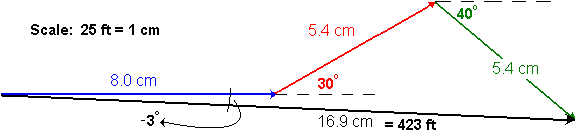
Graphical Techniques: A roller coaster moves 200 ft horizontally and then rises 135 ft at an angle of 30.0° above the horizontal. It then travels 135 ft at an angle of 40.0° downward. What is its displacement from its starting point? 1 cm = 25 feet or larger sketch
Use Protractor and ruler Must record ruler lengths on paper Analytical method receives no credit.
Ch 3.4 #28
Find the magnitude and direction of the resultant of 3 displacements having rectangular components (3, 2), (-5, 3), (6, 1)
|
|
x |
y |
|
||
|
Vector 1 |
3 |
2 |
|||
|
Vector 2 |
-5 |
3 |
|||
|
Vector 3 |
6 |
1 |
|||
|
Resultant |
4 |
6 |
|||
|
åx = 3 + -5 + 6 |
åy = 2 + 3 + 1 |
||||
|
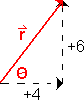
r = (42 + 62)½ r = 7.21 units |
tan q = 6 / 4 q = 56.3° |
Visually we see that it’s in the 1st Quadrant. |
|||
|
Ch 3 #53
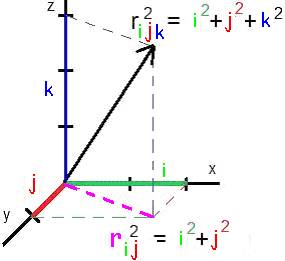
A vector is given by R = 2i + j + 3k. Find (a) the magnitudes of the x, y, and z components, (b) the magnitude of R, and (c) the angles between R & the x, y, & z axes.
Note unit vector bx = (1,0,0), also read as x hat
|
|
|||
|
a) just simply state the coefficients for the x, y, & z components: 2, 1, 3 |
b ) see figure à r2 = i2 + j2 + k2 r = (22 + 12 + 32)1/2 r = 3.74 |
|||
|
c) cos ax = r×bx / |r||b| bx = ( 1, 0, 0 ) cos ax = 2 / |3.74||1| ax = 57.7° |
cos ay = r×by / |r||b| by = ( 0, 1, 0 ) cos ay = 1 / |3.74||1| ay = 74.5° |
cos az = r×bz / |r||b| bz = ( 0, 0, 1 ) cos az = 3 / |3.74||1| az = 36.7° |
||
Ch 3 #67
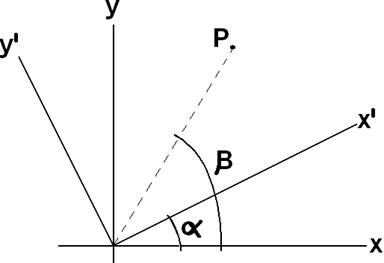
A point P is described by the coordinates (x, y) with respect to the normal Cartesian coordinate system shown in the Figure P3.63. Show that (x’, y’), the coordinates of this point in the rotated coordinate system, are related to (x, y) and the rotation angle a by the expressions
x' = x cos a + y sin a y' = - x sin a + y cos a
Define P in both coordinate systems
|
x = cos β P y = sin β P cos β = x/P sin β = y/P x’ = cos (β-α) P y’ = sin (β-α) P
Expand: cos(β-α) = cosβ cosα + sinβ sinα (Appendix: Table B-3) x’ = cos β cos α P + sin β sin α P x’ = (x/p) cos α P + (y/P) sin α P x’ = x cos α + y sin α
y’ = sin (β-α) P y’ = sinβ cosα P - cosβ sinα P y’ = – x sin α + y cos α |
|
Ch 3 #67 Extra Credit
Take #67 to 3D from 2D.
Ch 3.1 #6
If polar coordinates of the point (x,y) are (r,q), determine the polar coordinates for the points:
(a) (-x, y) (b) (-2x, -2y) (c) (3x, -3y)
|
r = ((-x)2 + y2)1/2 r = (x2 + y2)1/2 q = 180° - tan-1(y / x) |
r = ((-2x)2 + (-2y)2)1/2 r = (4x2 + 4y2)1/2 q = 180° + tan-1(y / x) |
r = ((3x)2 + (-3y)2)1/2 r = (9x2 + 9y2)1/2 q = 360° - tan-1(y / x) |
Ch 3.4 #23
A girl delivering newspapers covers her route by traveling 3 blocks west, 4 north, and 6 east.
a) What is her displacement?
b) What is the total distance she travels?
|
a) Δr = ((3-6)2 + 42)½ Δr = 5 blocks |
tan θ = 4/3 θ = 53.1˚ N of E |
b) d = 3 + 4 + 6 d = 13 blocks |
|
|
|
|
Ch 3.4 #43
Given the displacement vectors A = (3 i – 4 j + 4 k) m and B = (2 i + 3 j – 7 k) m, find the magnitudes of the vectors (a) C = A + B and (b) D = 2A – B, also expressing each in terms of rectangular coordinates. (Show work or no credit)
|
C = (3 + 2) i + (-4 + 3) j + (4 – 7) k C = 5 i - j - 3 k |
D = (2*3-2) i + (-4*2 - 3) j + (2*4 - -7) k D = 4 i - 11 j + 15 k |
|
|C| = (52 + -12 + -32)1/2 |C| = 5.92 m |
|D| = (42 + 112 + 152)1/2 x|D| = 19.0 m |
|
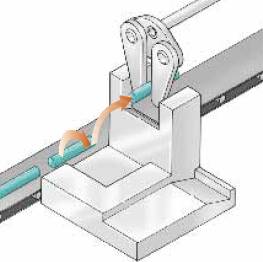
Ch 3.4 #38 In the assembly operation illustrated in Figure P3.38, a robot first lifts an object upward along an arc that forms one quarter of a circle having a radius of 4.8 cm & lying in an east-west vertical plane. The robot then moves the object upward along a second arc that forms one quarter of a circle having a radius of 3.7 cm and lying in a north-south vertical plane. Find (a) the magnitude of the total displacement of the object and (b) the angle of the total displacement makes with the vertical.
|
|
|
|
Calc the x & y components of the arc with radius of 4.8 cm.
Since it’s a half circle the radius is the x & the y vectors
The coordinate system being referenced is positive x is to the left Positive y is up with respect to the paper. Positive z is coming out of the paper.
|
Total x components 4.8 cm
Total y components 4.8 cm + 3.7 cm = 8.5 cm
Total z components 3.7 cm |
|
|
Calculate the magnitude of the resultant vector for the x & y components
The other leg is the z component of 3.7 cm c = (9.762 + 3.72)1/2 c = 10.4 cm |
a2 + b2 = c2 a2 = 4.82 = 23.04 cm2; b2 = 8.52 = 72.25 cm2
c = (a2 + b2)1/2 = 9.76 cm This is one of the two legs for our final vector. |
|
|
OR directly c = (4.82 + 8.52 + 3.72)1/2 = 10.4 cm
|
||
|
Use trig to calculate the final angle of the resultant vector with magnitude of 10.4 cm Please reference p.67 of Serway, Jewitt
|
||
|
cos a = a×b / |a||b| cos a = 8.5 / |10.4||1| a = 35.2°
|
a = 4.8i + 8.5j + 3.7k b = (0, 1, 0) the unit vector corresponding to the vertical
|
|