#7, rope, 23, 26, 44, 68 (Bonus 16)
Ch 5.1-5.6 #7
An electron mass of 9.11 x 10⁻³¹ kg has an initial speed of 3 x 10⁵ m/s. It travels in a straight line, and its speed increases to 7 x 10⁵ m/s in a distance of 5 cm. Assuming the acceleration is constant,
(a) determine the force exerted on the electron
(b) compare this force with the weight of the electron, which was neglected
|
d = ½ at2 + vi t d = ½ (Dv/Dt) t2 + vi t d = ½ Dv t + vi t d = ½ (vf-vi) t + vi t
t = 2d / (vf + vi) t = 10-7 sec |
a = Dv / Dt a = (7-3) x 105 / 10-7 a = 4 x 10¹² m/s2 |
(b) Fw = mg Fw = (9.11 x 10⁻³¹) 10 m/s2 Fw = 9.11 x 10⁻³⁰ m/s2
The weight is more than 1011 times smaller…thus ignore. |
|
(a) F = ma F = (9.11 x 10⁻³¹) 4 x 10¹² F = 3.64 x 10⁻¹⁸ N |
Ch 5.7 #16 (Bonus)
A 3 kg object is moving in a plane with its x & y coordinates given by x = (5t2 – 1) m/s and y = (3t3 + 2) m/s. Find the magnitude of the net force acting on this object at t = 2 sec.
Ans. 112 N
|
v = dx / dt x = 5t2 – 1 y = 3t3 + 2 vx = 10t vy = 9t2
|
a = dv / dt ax = 10 ay = 18t Fx = m ax Fy = m ay Fx = 3 (10) Fy = 3 (18t) |
@ t = 2 sec Fx = 30 N Fy = 108 N F2 = Fx2 + Fy2 F = 112 N |
Ch 5.7 #23
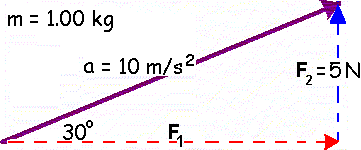
A 1 kg mass is observed to accelerate at 10 m/s2 in a direction 30° north of east. The force F2 acting on the mass has a magnitude of 5 N and is directed north. Determine the magnitude and direction of the force F1 acting on the mass.
|
F = ma F = 1 (10) F = 10 N Fy = 5 N F = (Fx2 + Fy2)1/2 10 = (Fx2 + 52)1/2 Fx = 8.66 N, N of E |
Or Fx = cosθ F Fx = cos 30° (10) Fx = 8.66 N, N of E
|
|
Ch 5.7 #26
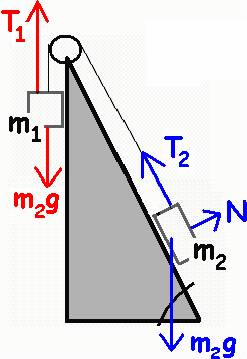
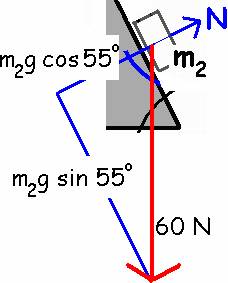
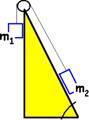
Two objects are connected by a light string that passes over a frictionless pulley. Draw free-body diagrams of both objects. If the incline is frictionless and if m1 = 2.00 kg, m2 = 6.00 kg, and q = 55.0°, find (a) the accelerations of the objects, (b) the tension in the string, and (c) the speed of each object 2.00 s after being released from rest.
|
Free Body Diagram
|
(a) sin 55° = Fin dir /60 N F2 -in dir = 49.1 N
Fnet = F2-in dir – m1g = ma 49.1 N – 20 N = (2 + 6) a a = 3.6 m/s2
(b) T1 = m1 (g + a) T1 = 2 (9.8 + 3.6) T1 = 26.8 N
Or the hard way!!! T2 = m2 (sin 55°g - a) T2 = 6 (sin 55° 9.8 - 3.6) T2 = 26.6 N |
|
|
(c) a = Dv / Dt 3.6 = vf / 2 vf = 7.2 m/s |
Ch 5.8 #44
|
The coef of kinetic friction, fk, between the table and the 1 kg block is 0.350. (a) draw a free body diagram of each object (b) determine the acceleration of each object & direction (c) determine the tension in both cords |
|
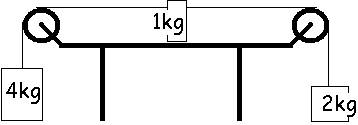
|
Ff = 0.35*1kg*10m/s2 Ff = 3.5 N F4 = 4kg * 10m/s2 F4 = 40 N F2 = 2kg * 10m/s2 F2 = 20 N |
FNet = F4 – F2 – Ff FNet = mtotal a F4 – F2 – Ff = mtotal a 40N – 20N – 3.5N = (4 + 2 + 1) a
a = 2.36 m/s2 |
FT4 = m (g – a) FT4 = 4 * (10 - 2.36) FT4 = 30.6 N FT2 = m (g + a) FT2= 2 * (10 + 2.36) FT2= 24.7 N |
Ch 5 #61
|
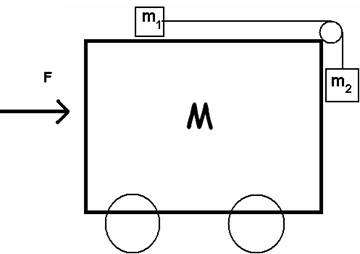
What horizontal force must be applied to the cart of mass M shown below so that the blocks remain stationary relative to the cart? (Frictionless and massless) |
|
|
|
A frictionless stationary pulley means T1 = T2 a2 = a1 |
||
|
T1 = m1a T2 = m2g T1 = T2 m1a1 = m2g a1 = m2 g / m1 |
a2 = a1 a2 = m2 g / m1
F = (M + m1 + m2) ( a2 ) F = (M + m1 + m2) (m2 g / m1) |
|
Ch 5.8 #41
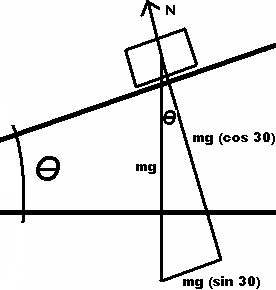
A 3 kg block starts from rest at the top of a 30° incline and slides a distance of 2 m down the incline in 1.5 seconds. Find (a) the magnitude of the acceleration of the block, (b) the coefficient of kinetic friction between block and plane, (c) the frictional force acting on the block and (d) the speed of the block after it has slid 2 m.
|
(a) dx = ½ at2 2 m = ½ a (1.5)2 a = 1.78 m/s2 |
|
|
|
(b) sin 30° = Fin dir /30 N cos 30° = FN / 30 N Fin dir = 15 N FN = 26 N
|
||
|
Fnet = Fin dir - Ff Fin dir - Ff = mtotal a Fnet = 15 N – (mk 26 N) 15 - ms 26 = 3 (1.78) ms = 0.372 |
||
|
(c) Ff = ms FN Ff = 0.372 (26 N) Ff = 9.56 N
|
d = ½ at2 d = ½ (Dv/Dt) t2 d = ½ vf t vf = 2.67 m/s |
|
Ch 5.7 #18
|
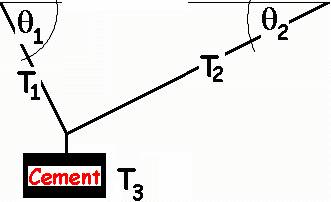
A weight of 325 N bag of cement hangs from three wires. The system is in equilibrium. Two of the wires make angles of q1 = 60° & q2 = 25° with the horizontal. Find the Tension in T1, T2 and T3.
Hint: Since in equilibrium åFy = 0 åFx = 0 Ans: T1 = 296 N, T2 = ? |
|
|
Given: T3 = 325 N Up Forces = Down forces T1 sinq1 + T2 sinq2 = T3 Forces left = Forces right T1 cosq1 = T2 cosq2 Solve for T1 T1 = T2 cosq2 /cosq1 |
T1 sinq1 + T2 sinq2 = T3 T2 cosq2 /cosq1 sinq1 + T2 sinq2 = 325 N T2 1.57 + T2 0.42 = 325 N T2 = 163 N T1 sinq1 + T2 sinq2 = T3 T1 sin60 + 163(sin25) = 325 N T1 = 296 N |
Ch 5.7 #24
|
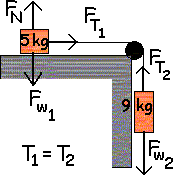
A 5.00 kg object placed on a frictionless, horizontal table is connected to a string that passes over a pulley and then is fastened to a hanging 9.00 kg object. (a) Draw free body diagrams of both objects. (b) Find the acceleration of the two objects and the tension in the string
|
|
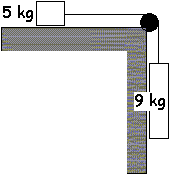
|
(a) |
(b) FNet = mT a Fw2 = (m1+m2) * a 90 N = (5 + 9)kg * a a = 6.43 m/s2
|
The 9 kg block is falling, so if it was in an elevator and starting to go down…it would weight less FT = m (g – a ) FT = 9kg (10 – 6.43) FT = 32.1 N Or FT = m a FT = 5 ( 6.43) FT = 32.1 N |
Ch 5 #68
|
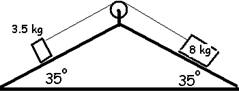
Two blocks of mass 3.50 kg and 8.00 kg are connected by a massless string that passes over a frictionless pulley. The inclines are frictionless. Find (a) the magnitude of the acceleration of each block (b) the tension in the string
For the 8 kg block Fin dir = sin 35° mg = 45.0 N For the 3.5 kg block Fin dir = sin 35° mg = 19.7 N FNet = mtotal a (45 – 19.7) = (8 + 3.5) * a a = 2.2 m/s2
|
|
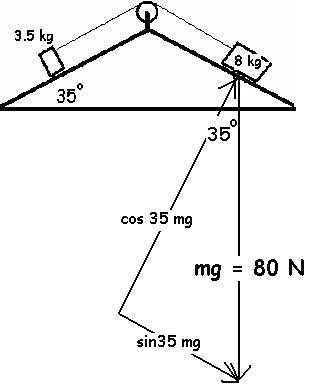
Tensionby 3.5kg = m a = 3.5 kg * (sin 35° g + a) = 3.5 * (7.82) = 27.4 N
Tensionby 8kg = m a = 8 kg * (sin 35° g - a) = 8 * (3.42) = 27.4 N
Ch 5 #69
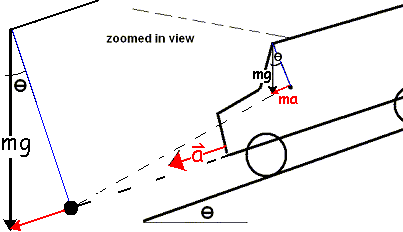
A van accelerates down a hill, going from rest to 30 m/s in 6 sec. During the acceleration, a toy of mass 0.1 kg hangs by a string from the van’s ceiling. The acceleration is such that the string remains perpendicular to the ceiling. Determine a) the angle θ, b) the tension in the string.
|
a) a = Dv / Dt a = (30–0) / 6 a = 5 m/s2 |
sin θ = ma / mg sin θ = 5 / 9.8 θ = 30.7˚ |
|
|
(b) cos θ = T / mg T = 0.84 N |
||
|
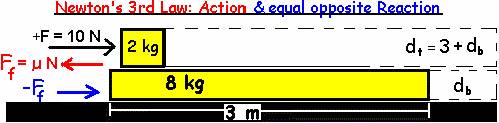
Ch 5 A block of mass m = 2 kg rests on the left edge of a block of larger mass m = 8 kg. |
|
|
The coef of kinetic friction between the two blocks is 0.3, and the surface on which the 8 kg block rests is frictionless. A constant horizontal force of magnitude F = 10 N is applied to the 2 kg block, setting it in motion as shown above. If the length L that the leading edge of the smaller block travels on the larger block is 3 m (a) how long will it take before this block makes it to the right side of the 8 kg block? (b) How far does the 8 kg block move in the process? Answer 2.13s, 1.67m |
|
|
(a) You apply a 10 N force on the 2 kg block. Friction opposes the 10 N applied force. Ff = m N Ff = .3 (mg) Ff = .3 (20N) Ff = 6 N
|
FNet = Fapplied – Ff FNet = m a
FNet = 10 – 6 FNet = 4 N FNet = m atop 4 N = (2kg) atop atop = 2 m/s2
|
Newton’s 3rd law stated that for every action (Frictional force of the bottom block on the top block) there is an equal and opposite reaction (Frictional force of the top block on the bottom block). Fbottom = -Ftop block Fbottom = 6 N to the right
|
|
Fbottom = mbottom abottom 6N = 8 kg abottom abottom = ¾ m/s2 (use b for bottom, t for top)
|
(b) db = ½abt2 + vot + db db = ½ ¾t2 + 0 + 0 db = 3t2/8 db = 3(24/5)/8 db = 1.8m |
(a) dt = ½att2 + vot + do 3 + db = ½2t2 + 0 + 0 3 + 3t2/8 = ½2t2 + 0 + 0 3 = 5t2/8 t = 2.19 sec |
|
(b) a = Dv / Dt 0.75 = Dv / 2.19 s vf = 1.64 m/s |
||
Ch 5 5th edition #77 extra problem
Before 1960 it was believed that the maximum attainable coefficient of static friction for an automobile tire was less than 1. Then about 1962, three companies independently developed racing tires with coefficients of 1.6. Since then, tires have improved, as illustrated in this problem. According to the 1990 Guinness Book of Records, the fasted time in which a piston-engine card initially at rest has covered a distance of ¼ mile is 4.96s. This record was set by Shirley Muldowney in Sept 1989. a) Assuming that the rear wheels nearly lifted the front wheels off the pavement, what minimum value of ms is necessary to achieve the record time?
b) Suppose Muldowney were able to double her engine power, keeping other things equal. How would this change affect the elapsed time?
1 mile = 1609 m (back cover of book)
|
vave = Δx / Δt vave = (¼*1609) / 4.96 ½(vi + vf) = (1609/4) / 4.96 vf = 162.2 m/s |
Ff ms N Ff = ms mg By applying a torque about the back wheels the effective ms can exceed 1 Ff = FNet Ff = ms mg FNet = ma |
ms mg = ma ms g = a ms = 32.7 / 10 ms = 3.27 |
|
a = Dv / Dt a = (162.2 – 0) / 4.96 s a = 32.7 m/s |
b. Any extra power is detrimental (car would flip over backwards, or the wheels would spin) and increase time |