#9,
19, 22, 37, 63, 71, toy
Ch 6.1 #9
|
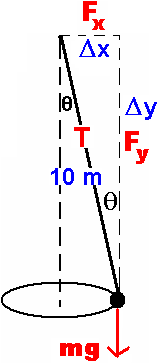
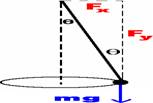
Consider a conical pendulum with an 80 kg bob on a 10 m wire making an angle of q = 5° with the vertical. Determine (a) the horizontal and vertical components of the force exerted b the wire on the pendulum and (b) the radial acceleration of bob. (c) the tangential velocity |
|
|||
|
(a) Fy = mg Fy = 80 kg*9.8 m/s2 Fy = 784 N |
Fx = tan q (mg) Fx = 68.6 N |
(b) Fx = m v2 / r tan q (mg) = ma a = tan q * g a = 0.857 m/s2 |
||
|
FOR FUN lets calc the tangential velocity tan q (mg) = m v2 / r where r = sin q * (10m) tan q (mg) *r / m = v2 tan q sin q 10 * g = v2 (m’s cancelled out) tan 5° sin 5° * 98 = v2 v = .86 m/s |
|
|||
Ch 6.2 #19
A roller-coaster car has a mass of 500 k when fully loaded with passengers. (a) if the call has a speed of 20 m/s at point A, what is the force exerted by the track on the car at this point? (b) what is the maximum speed the car can have at B and still remain on the track?
For the first loop, we have its weight pointing downward which the track must push equally hard back (Newton’s 3rd law), and the track is supplying the centripetal force.
FTotal = mg + mv2 /r
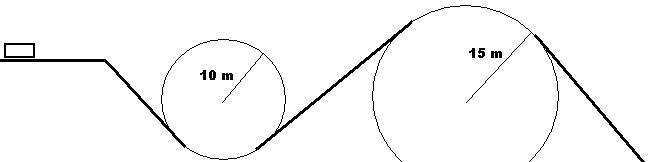 FTotal = 500 (9.8) + 50 (202) / 10
FTotal = 24900 N
FW = FCentrip
mg = mv2/r
v2 = g*r
v = 12.1 m/s
Ch 6.3 #22
The coefficient of static friction between your coffee cup and the horizontal dashboard of your car is μs= 0.800. (a) How fast can you drive on a horizontal roadway around a right turn of radius 30.0 m before the cup starts to slide? (b) If you go too fast, in what direction will the cup slide relative to the dashboard?
|
Ff = μN Fc = mv2/r |
Logic: The frictional force provides the centripetal force towards the center |
μN = mv2/r μmg = mv2/r |
μ = v2/(g*r) μ = 302/(10*30) |
Ch 6.4 #37
A small spherical bead of mass 3 g is released from rest at t = 0 s in a bottle of liquid shampoo. The terminal speed is observed to be vt = 2 cm/s. Find (a) the value of the constant b in Eq 6.4, (b) the time t at which the bead takes to reach 0.632 vterminal, and (c) the value of the resistive force when the bead reaches terminal speed. (a) 1.47 Ns/m (b) 2.04 ms (c) .0294 N Equation 6.4: dv/dt = g – bv/m originates from åFy = mg - bv
|
(a) dv/dt = g – bv/m vterminal: dv/dt is zero g = bv/m; b = gm/v b = 980 (3) / 2 b = 1470 dynes*s/cm b = 1.47 N*s/m
|
(b) t = m/b t = .003/1.47 t = 2.05 ms v = vterminal (1 – e-t/t) 0.632 vterm. = vterm. (1 – e-t/t) 0.632 - 1 = – (e-t/t) ln (1 – 0.632) = ln(e-t/t) -.99967 = - t / 0.00205 s t = 2.04 ms |
(c) At terminal velocity, the resistive force equals the weight FResist = -bv FResist = 1.47 *.02m/s FResist = 0.0294 N FW = mg FW = 0.003 * 9.8 FW = 0.0294 N |
Ch 6 #63
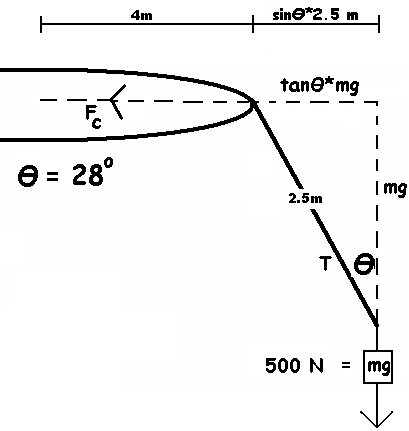
An amusement park ride consists of a rotating circular platform 8m in diameter from which 10 kg seats are suspended at the end of 2.5 m massless chains. When the system rotates, the chains make an angle q = 28°, with the vertical. (a) What is the speed of each seat? (b) Draw a free body diagram of a 40 kg child riding in a seat and find the tension.
|
The radius is ^ to the force (gravity in this case) causing angle r = 4 m + sinq 2.5m
Fcent = mv2/r Fcent = mv2/ (4 m + sinq 2.5m)
Component of gravity parallel to the radius equals the Fcentripetal Fcent = tanq mg
tanq mg = mv2/ (4 + sinq 2.5) tanq g = v2 / (4 + sinq 2.5) v = 5.19 m/s
Tension in the line is cosq = mg / FT FT = 490 / cos 28° FT = 555.0 Newtons |
|
Ch 6 #71
A model airplane of mass 0.75 kg flies in a horizontal circle at the end of a 60 m control wire, with a speed of 35 m/s. Compute the tension in the wire if it makes a constant angle of 20° with the horizontal. The forces exerted on the airplane are the pull of the control wire, its own weight, and aerodynamic lift, which acts at 20 degrees inward from the vertical as shown.
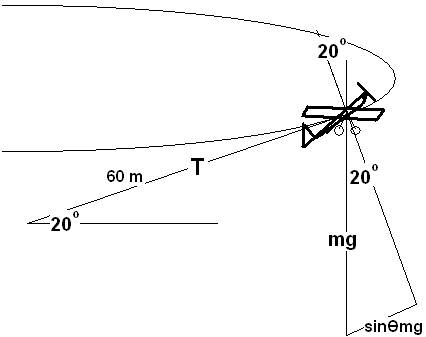
The centripetal force consists of two components:
- tension in the string
- component of gravity
Fc = T + sin 20° mg
Once we identify the centripetal force
we set it equal to
Fc = mv2/r
mv2 / r = T + sin 20° m g
0.75*352/60 = T + sin 20° 0.75*9.8
15.3 N = T + 2.51 N
FTension = 12.8N
Ch 6 Toy (#55 in 5th ed)
|
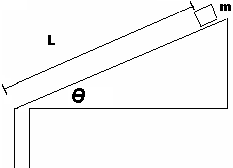
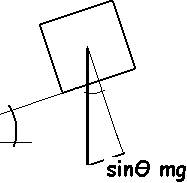
A child’s toy consists of a small wedge that has an acute angle q. The sloping side of the wedge is frictionless, and a mass m on it remains at constant height if the wedge is spun at a certain constant speed. The wedge is spun by rotating a vertical rod that is firmly attached to the wedge at the bottom end. Show that, when the mass sits a distance L up along the sloping side the speed of the mass must be v = (g L sinq)1/2 |
|
|
Fcentripetal is a component of gravity in the direction of the ramp Fcent = sinq mg Fcent = mv2/L
sinq mg = mv2/L
v = (gLsinq)½ |
|
|
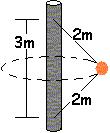
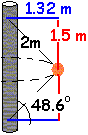
Ch 6.1 #11 A 4.00 kg object is attached to a vertical rod by two strings. The object rotates in a horizontal circle at a constant speed of 6.00 m/s. Find the tension in (a) the upper string and (b) the lower string.
|
|
|
sinθ = 1.5 / 2 θ = 48.6°
|
r = (22 – 1.52)1/2 r = 1.32 m
|
Tx-top + Tx-bottom = mv2/r cosθ Ttop + cosθ Tbottom = mv2/r cosθ[Tbottom+ mg/sinθ] + cosθ Tbottom = mv2/r 2 cosθ Tbottom + cot θ mg = mv2/r Tbottom = ½ (mv2/r - cot θ mg) / cosθ Tbottom = ½(4*62/1.32 - cot48.6 40) / cos48.6 Tbottom = 55.8 N cosθ Ttop + cosθ (55.8 N) = mv2/r Ttop = 109.1 N |
|
|
ΣFy = 0 Ty-top - Ty-bottom - mg = 0 sinθ Ttop - sinθTbottom - mg = 0 solve for Ttop Ttop = Tbottom + mg/ sinθ |
|||
Ch 6.2 #15
|
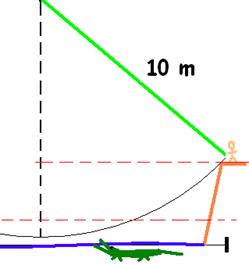
Tarzan (m = 85 kg) tries to cross a river by swing from a vine. The vine is 10 m long. His speed at the bottom of the path (almost touching the water) is 8 m/s.The vine will break at 1,000 N. Does he make it? |
|
|
|
The rope must provide the centripetal force Fc = m(v2/r) Fc = 85(82/10) Fc = 544 N |
The rope must hold up Tarzan’s weight Fw = mg Fw = 85 * 10 m/s2 Fw = 850 N |
|
|
The combined force by the rope exceeds 1000 N. The rope BREAKS and Tarzan doesn’t make it. |
||
Ch 6.3 #23
|
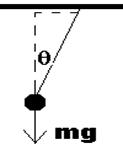
A ½ kg object is suspended from the ceiling of an accelerating boxcar shown to the right (figure 6.13 Ex 6.8). If a = 3 m/s2, find (a) the angle that the string makes with the vertical (b) the tension in the string |
|
||
|
sin θ = ma / mg sin θ = 3 / 9.8 θ = 17° |
cos θ = mg / FTension FTension = mg / cos θ FTension = 5.12 Newtons |
Or FTension = m (32 + 9.82)½ FTension = 5.12 Newtons |
|
 Ch 6.3 #31
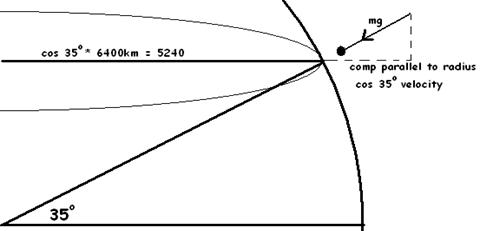
A plumb bob does not hang exactly
along a line directed to the center
of the Earth, because the Earth is
rotating. How much does the plumb
deviate from a radial line
at 35 degrees N?
v = 2pr / t
|
Radius at 35° r = cos 35° (6400km) r = 5240km
v = 2p 5240km 86400 sec v = 380 m/s |
vtangential = cos 35˚ 380 vtangential = 310 m/s (picture above)
sin q = ar / mg (picture to right) sin q = (mv2/r) / mg sin q = v2/ g*r q = 0.0927° |
|
Ch 6.4 #37
A small spherical bead of mass 3 g is released from rest at t = 0 s in a bottle of liquid shampoo. The terminal speed is observed to be vt = 2 cm/s. Find (a) the value of the constant b in Eq 6.4, (b) the time t at which the bead takes to reach 0.632 vterminal, and (c) the value of the resistive force when the bead reaches terminal speed. (a) 1.47 Ns/m (b) 2.04 ms (c) .0294 N
Equation 6.4: dv/dt = g – bv/m originates from åFy = mg - bv
|
(a) dv/dt = g – bv/m vterminal: dv/dt is zero g = bv/m; b = gm/v b = 980 (3) / 2 b = 1470 dynes*s/cm b = 1.47 N*s/m
|
(b) t = m/b t = .003/1.47 t = 2.05 ms v = vterminal (1 – e-t/t) 0.632 vterminal = vterminal (1 – e-t/t) 0.632 - 1 = – (e-t/t) ln (1 – 0.632) = ln(e-t/t) -.99967 = - t / 0.00205 s t = 2.04 ms |
(c) At terminal velocity, the resistive force equals the weight FResist = -bv FResist = 1.47 *.02m/s FResist = 0.0294 N
FW = mg FW = 0.003 * 9.8 FW = 0.0294 N |
Ch 6.4
|
A child is playing with a bottle of salad dressing. The child drops his 5.1 gram marble in the bottle. The marble drops to the bottom at the rate of 2.5 cm/s. Find (a) the value of the resistive coefficient, b, (b) the time t at which the bead takes to reach 50% of vterminal, and (c) the value of the resistive force when the bead reaches terminal speed. |
Hints: åFy = mg – bv ma = mg – bv a = g – v(b/m) dv/dt = g – v(b/m)
Ans: 2 Ns/m, (b) 1.77 ms, (c) .05 N |
||
|
(a) dv/dt = g – bv/m vterminal: a = dv/dt = 0 m/s2
g = bv/m; b = g m / v b = 9.8(0.0051)/0.025 b = 2.00 Ns/m |
(b) t = m / b t = 0.0051 / 2 t = 0.00255 sec v = vterminal (1 – e-t/t) 0.5 vterminal = vterminal (1 – e-t/t) – 0.5 = – (e-t/t) ln (0.5) = ln (e -t / t ) -.693 = - t/ t t = 1.77 ms |
(c) FResist = -b v FResist = 2.00(0.025 m/s) FResist = 0.050 N
Check: At terminal velocity, the resistive force equals the weight FW = 0.0051 kg * 9.8 m/s2 FW = 0.050 N |
|
Ch 6 #58
|
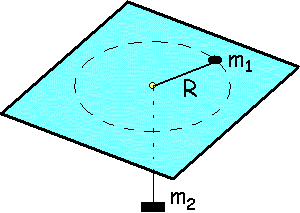
An air puck of mass m1 is tied to a string and allowed to revolve in a circle of radius R on a frictionless horizontal table. The other end of the string passes through a hold in the center of the table, and a counterweight of mass m2 is tied to it. The suspended object remains in equilibrium while the puck on the tabletop revolves. What is (a) the tension in the string? (b) the radial force acting on the puck? (c) the speed of the puck? |
|
|
(a) FT = m2g
|
(b) Fradial = m1v2/R
|
(c) Fradial = FT m2 g = m1v2/R v = (m2 g R / m1)1/2 |
Ch 6 #65
|
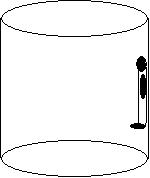
An amusement park ride consists of a large vertical cylinder that spins about its axis fast enough that any person inside is held up against the wall when the floor drops away. The coefficient of static friction between the person and the wall is ms, and the radius of the cylinder is R. (a) Show that the maximum period of revolution necessary to keep the person from falling is T = (4p2Rms/g)½ (b) Obtain a numerical value for T if R is 4 m and ms = 0.4. How many revolutions per minute does the cylinder make? |
|
||
|
Friction with the outer spinning wall provides the centripetal force thus msma must be equal to or greater then the weight to support the weight. msma = mg |
a = v2/r a = (2pr / T)2 / r a = 4p2r / T2
|
msm a = mg msm (4p2r / T2) = mg T = (ms4p2r / g)½ T = 2.54 seconds 1 rev / 2.54 sec * (60 s / 1 min) 23.6 rpm |
|
Ch 6 (Extra Problem #58 in 5th edition)
A penny of mass 3.1 g rests on a small 20 g block supported by a spinning disk with radius of 12 cm. If the coefficients of friction between block and disk are .75 & .64 (static & kinetic), while those for the penny and block are .52 & .45, what is the maximum rate of rotation (rpm) that the disk can have before either the block or the penny starts to slip?
Both objects require friction to supply the centripetal force to prevent them from moving off in a straight line.
Ff = mN = mv2/r
v = (r*g*m)½
v = (.12*9.8*.52)½ = 0.78 m/s
v = 0.78 m/s
w = 0.78 m / s *60 s / 1 min * 1 rev/ 2pr = 62 rpm