Ch 8.1 #3
A person with a remote mountain cabin plans to install her own hydroelectric plant. A nearby stream is 3 m wide and ½ m deep. Water flows at 1.2 m/s over a waterfall of 5 m in height. The manufacturer promises only 25% efficiency in converting the potential energy of the water-Earth system into electric energy. Find the power she can generate.
|
Volume = 1.2(3)½ V/time = 1.8 m3/s
ρwater = 1000 kg / m3 |
ρwater = m / V m = ρ V mg = ρ V g mgh = ρ V g h
|
Power = Work / time ΔKE = ΔPE = mgh
Power = Δmgh / time Power = ρ V g h / time |
Power = Work / time P = (V / t) ρ g h P = (1.8 m3/s) (1000) g h P = 3600 Watts |
Ch 8.2 #5
|
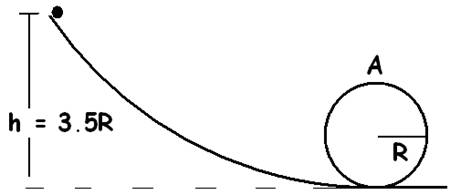
A 5 gram bead slides w/o friction around a loop-the-loop. The bead is released from a height h=3.5R. a) What is the speed at A b) What is the normal force at this point? |
|
|
|
(a) h = hramp – hcircle h = 3.5 R – 2 R h = 1.5 R |
Ug is transferred to K PEloss = ΔKEgain mg h = ½ mvf2 - ½ mvi2 -m g 1.5R = 0 - ½ mvf2 vf2 = 3gR |
(b) FN = maT – mac FN = vf2 / R - mg FN = 3gR/ R – mg FN = 2 m g FN = 0.098 N |
|
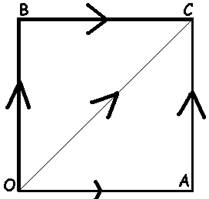
Ch 8.3 #21 A 4 kg particle moves from the origin to the position C, having coordinates x = 5 m & y = 5 m. One force on the particle is the gravitational force acting in the negative y-direction as shown below. Using equation 7.3 (Work = òF dr) to calculate the work done by gravitational force going from 0 to C along Work = òF dr Work = F × Dr = F Dr cos q |
|
|
|
(a) 0AC Fg (OA) cos 90° + Fg (AC) cos 180° 0 + 40 N (5) * (-1) Work = -200 Nm
|
(b) 0BC Fg (OB) cos 180° + Fg (BC) cos 90° mg * (5) * (-1) + 0 Work = -196 J |
|
|
(c) 0C Fg (OC) cos 135° = mg * 5Ö2 * -0.707 Work = -196 Nm Work = -196 J |
(d) Why are results identical? Gravitational forces are conservative (if neglecting air friction with the movement, or if no medium is present) |
|
|
Normally pointing Due East is the 0˚ position but the force due to gravity is pointing down, which is the 0˚ position
You can also say any movement in the x-dir does zero work since no force opposes movement in the x-dir. And any movement (up) opposes gravity, thus the work is negative. So 0 Nm in the x and negative mg(5m) = -200 Nm = -200 J If you use g as 9.8…then -196 Nm = -196 Joules |
||
Ch 8.4 #36
|
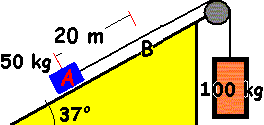
A 50.0 kg block and a 100 kg block are connected by a string. The pulley is frictionless and of negligible mass. The coefficient of kinetic friction between the 50.0 kg block and the incline is 0.250. Determine the change in the kinetic energy of the 50.0 kg block as it moves from A to B, a distance of 20.0 m. |
|
|
|
ΔyA = sin37°(20m) ΔyA = 12.0 m Work = m100gΔy100 – m50gΔy50 – Ff 20m Work = 100kg “g” 20 m – 50kg “g” 12m – 0.250 [50“g”cos37] 20m Work = 20000J – 6000J – 2000 J = ΔK Work = 12,000 J |
12000J = Δ½ mv2 v = 12.65 m/s KA = ½ mv2 KA = ½ 50 12.652 KA = 4,000 J
|
|
|
OR 2/3 of K is with 100 kg mass & 1/3 of K is with 50 kg mass thus 1/3 of 12,000J = 4,000 J |
||
Ch 8 #59
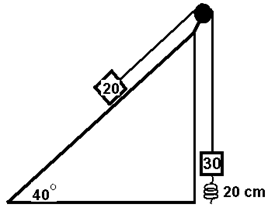
A 20 kg block is connected to a 30 kg block by a string that passes over a frictionless pulley. The 30 kg block is connected to a spring that has negligible mass and a force constant of 250 N/m. The spring is unstretched when the system is shown as below. The 20 kg block is pulled 20 cm down the incline (so the 30 kg block is now 40 cm above the floor) and is released from rest. Find the speed of each block when the 30 kg block is 20 cm above the floor (unstretched)
|
Gravity is causing the blocks to move Workgravity = FNet Δx Workgravity = (30g – sin40° 20g) (0.2m) Workgravity = 33.6 Joules |
|
|
The spring is also causing the blocks to move in same direction as the Net force Workspring = ½ k xi2 - ½ k xf2 Workspring = ½ 250 0.22 - ½ 250 02 Workspring = 5 J |
|
|
Workgravity + Workgspring = ½ m v2 33.6 + 5 = ½ (20+30) v2 v = 1.25 m/s |
Ch 8 #65
|
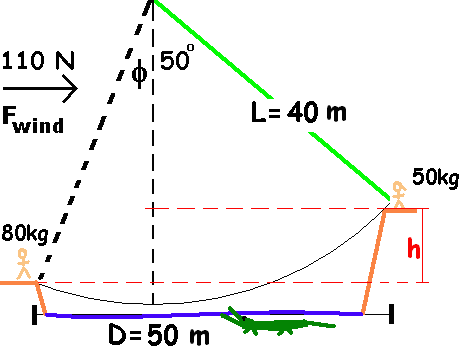
Jane whose mass is 50 kg, needs to swing across a river of width D filled with man-eating crocodiles to save Tarzan (80 kg) from danger (located j° left of the vertical). However, she must swing into a wind exerting a constant horizontal force F on a vine having a length L, and initially making an angle q with the vertical. Taking D = 50 m, F = 110 N L = 40 m q = 50° |
|
|
|
(a) With what minimum speed must Jane begin her swing to just make it to the other side? (b) Once the rescue is complete, Tarzan and Jane must swing back across the river. With what minimum speed must they begin their swing?
|
||
|
Solve for Unknowns D = Lsin50° + Lsinf 50 = 30.64 + 40sinf f = 28.9°
h = (L – Lcos50°) – (L-Lcosf) h = 9.32 m
|
Workgravity - WorkWind = DKE m g h - F Δx = ½ m vf2 - ½ m vi2 50*g*9.32 – 110(50) = 0 - ½ 50 vi2 vi = 6.12 m/s |
|
|
(b) (This time wind aids in crossing the river) WorkWind - Workgravity = DKE F Δx - mgh = ½mvf2 - ½ m vi2 110(50) - (50+80)10(9.3 m) = 0 - ½(50+80) vi2 vi = 9.9 m/s |
||
Ch 8.4 #38
A 75 kg sky surfer is falling straight down with terminal speed of 60 m/s. Determine the rate at which the sky surfer-Earth system is losing mechanical energy.
|
Emech = K + U Emech = m v dv + mg h
dE / dt = mv dv/dt + mg dh/dt dE / dt = 0 + mg (-v) |
Remember F = m a F = m dv / dt (apply the chain rule) F = m dv/dx (dx/dt) F dx = m v dv |
dE / dt = -mgv dE / dt = -750N * 60m/s Thus “loss” of mechanical energy is 45,000 W |