#4, 8, 26, 37, 43, 48 (1.5 i), 51
Ch 9.3 #4
Two blocks of masses M and 3M are placed on a horizontal, frictionless surface. A light spring is attached to one of them, and the blocks are pushed together with the spring between them (figure 9.4). A cord initially holding the blocks together is cut; after this, the block of mass 3M moves to the right with a speed of 2.00 m/s. (a) What is the speed of the block of mass M? (b) Find the original elastic potential energy in the spring if (M = 0.350 kg)
|
(a) pbefore = 0 kg m/s = pafter 0 = Mv + 3M(2 m/s) v = 6 m/s |
(b) Wspring = DK Wspring = ½ mv2 + ½ 3MV2 Wspring = ½M62 + ½ 3M22 |
Wspring = 24M Wspring = 8.4 J
|
Ch 9.3 #8
A ball of mass 0.150 kg is dropped from rest from a height of 1.25 m. It rebounds from the floor to reach a height of 0.960 m. What impulse was given to the ball by the floor?
|
Impulse = Dp We know there was conservative exchange of energy from Ugravity to K |
Impulse = mvbefore – mvafter Impulse = m(2ghbefore)1/2 – m(2ghafter)1/2 Impulse = .15(2(10)1.25)1/2 – .15(2(10).96)1/2 Impulse = 0.75 – .657 Impulse = 0.093 N s |
Ch 9.3 #26
A 7 gram bullet, when fired from a gun into a 1 kg block of wood held in a vise, would penetrate the block to a depth of 8 cm. This block of wood is placed on a frictionless horizontal surface, and a second 7 g bullet is fired from the gun into the block. To what depth will the 2nd bullet penetrate the block?
Ans: 7.94 cm
|
1st Case Wwood = DK F d = Kf – Ki F(.08) = 0 - ½(.007)v2 F = -0.04375 v2 |
2nd Case mv = (M+m+m)vf 0.007 v = 1.014 vf vf = 0.0069v
|
Wwood = DK F d = ½ 1.014 vf2 - ½ 0.007 v2 (-.0437 v2)d = ½ 1.014 (.0069v)2 - ½ 0.007 v2 v’s now cancel d = 0.0794 meters |
Ch 9.4 #36 (Extra Credit) (#72 5th edition)
|
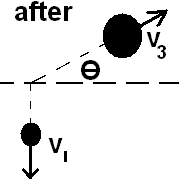
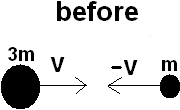
Two particles with masses m & 3m are moving toward each other along the x-axis with the same speeds, v. Particle m is traveling to the left while particle 3m is traveling to the right. They undergo an elastic glancing collision such that particle m is moving downward after the collision at right angles from its initial direction. |
|
|
|
(a) Find the final speeds of the two particles. m: v√2; 3m: v√(2/3) (b) What is the angle that which 3m is scattered from it original direction. 35.3° |
|
|
|
px |
py |
K |
|
|
3mv – mv = 3m v3x v3x = 2v/3 |
0 = 3m v3y - m v1y v1y = 3 v3y |
½3mv2 + ½mv2 = ½3m(v3x2 + v3y2) + ½mv1y2 4 v2 = 3v3x2 + 3v3y2 + v1y2 substitute 4 v2 = 3(2v/3)2 + 3v3y2 + (3 v3y)2 4 v2 = 4v2/3 + 12v3y2 8v2/3 = 12v3y2 v3y = 1/3 v√2 |
|
|
(a) v1y = 3 v3y where v3y = 1/3 v√2 v1 = v√2
v3x = 2v/3 & v3y = v1y /3 v3x = 2v/3 & v3y = v√2 /3 v3 = (v3x2 + v3y2)1/2 v3 = v√(2/3) |
|||
|
(b) θ = tan-1(v3y / v3x) q = 35.3° |
|
||
Ch 9.4 #37
An unstable nucleus of mass 17 x 10-27 kg initially at rest disintegrates in to three particles. One of the particles, of mass 5 x 10-27 kg moves along the y axis with a velocity of 6 x 10⁶ m/s. Another particle of mass 8.4 x 10⁻²⁷ kg moves along the x-axis with a speed of 4 x 10⁶ m/s. Find
(a) the velocity of the third particle pbefore = pafter 0 = p1 + p2 +p3
(b) the total kinetic energy increase in the process.
|
Momentum in the x-axis pbefore = pafter 0 = m1*v1x + m3v3x 0 = (5x10-27)(6x10⁶) + (3.6x10⁻²⁷) v3x v3x = -9.33 x 10⁶ m/s |
Momentum in the y-axis pbefore = pafter 0 = m2*v2x + m3v3y 0 = (8.4x10⁻²⁷)(4x10⁶) + (3.6x10⁻²⁷) v3y v3y = -8.33 x 10⁶ m/s |
|
|
v3 = (-9.33i – 8.33j) x 106 m/s |
||
|
knowns m3rd = mtotal – m1st – m2nd m3rd = (17–5–8.4)x10-27 kg m3rd = 3.6 x 10⁻²⁷ kg |
(b) KE = ½ m1v12 + ½ m2v22 + ½ m3v32 KE = (½5*62 + ½8.4*42 + 3.6 * (9.332 + 8.332)½ ) x 10(-27+2*6) KE = (90 + 67.2 + 281.8) x 10-15 KE = 439 fJ |
|
Ch 9.5 #43
A rod of length of 30 cm has a linear density given by
l = 50 g/m + 20x g/m2 where x is the distance from one end.
(a) What is the mass of the rod?
(b) How far from the x = 0 end is its center of mass?
|
m = ò dm m = ò l dx m = 50ò dx + 20ò x dx m = 50x + 10x2 (x = 0.3m) m = 15.9 grams |
(b) xCM = ò x dm / mT xCM = 1/mT ò x l dx xCM = 1/mT ò x (50 + 20x) dx xCM = 0.153 m |
Ch 9.6 #48 (typo in the new edition: 1.50 i not 150i )
A ball of mass 0.2 kg has a velocity of 1.50 i m/s; a ball of mass 0.3 kg has a velocity of -0.4 i m/s. They meet in a head-on collision.
(a) Find their velocities after the collision. (-.780, 1.12 m/s)
(b) Find the velocity of their center of mass before and after the collision. (0.360 m/s)i
Use relative velocities from section 4.6
If v1 = 5 and v2 = -4 then v1 = 9 + v2
It appears to v1 that v2 is approaching at 9 m/s as if v1 is not moving.
|
m1v1 + m2v2 = m1fv1f + m2fv2f 0.2*1.5 + 0.3*(-.4) = 0.2 * v1f + 0.3v2f Use relative velocities from section 4.6 v2f - v1f = 1.9 m/s v2f = 1.9 m/s + v1f 0.2*1.5 + 0.3*(-.4) = 0.2 * v1f + 0.3(1.9 m/s + v1f) 0.3 - 0.12 = 0.2v1f + 0.57 + 0.3v1f 0.3 - 0.12 = 0.5v1f + 0.57 v1f = -0.78 m/s v2f = 1.12 m/s |
(b) vCM = (m1fv1f + m2fv2f)/ m vCM = 0.2*1.5 + 0.3*(-4) / 5 = +0.36 m/s
This is vCM before the collision…and since momentum is conserved, this is also the vCM after the collision.
|
Ch 9.7 #51
A rocket for use in deep space is to be capable of boosting a total load (payload plus rocket frame and engine) of 3 metric tons to a speed of 10,000 m/s.
(a) It has an engine and fuel designed to produce an exhaust speed of 2,000 m/s. How much fuel plus oxidizer is required? DM = 442 metric tons
(b) If a different fuel and engine design could give an exhaust speed of 5,000 m/s, what amount of fuel and oxidizer would be required for the same task? DM = 19.2 metric tons
|
Mi = ev/ve Mf Mi = e10000/2000(3000) Mi = 445 x 103 kg |
DM = Mf - Mi DM = (3 – 445) x 103 kg DM = -442 metric tons |
(b) DM = e2(3) – 3 DM = 19.2 metric tons |
Ch 9.1 #1
A 3 kg particle has a velocity of (3i – 4j) m/s. (a) Find its x & y comps of momentum.
(b) Find the magnitude and dir of its momentum.
|
px = mvx px = 3kg (3m/s) px = 9 kg m/s |
py = mvy py = 3kg (-4m/s) py = -12 kg m/s |
p = (px2 + py2 )½ p = 15 kg m/s
|
q = tan-1(py / px) q = -53° or 307°
|
Ch 9.2 #7
|
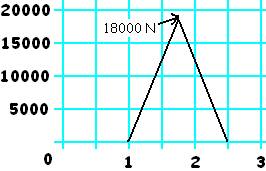
An estimated force-time curve for a baseball struck by a bat is shown below, where the maximum force attained in 18000 N. From this curve, determine (a) the impulse delivered to the ball (b) the average force exerted on the ball (c) the peak force exerted on the ball. |
|
|
Impulse = ∫Fdt Impulse = Aunder curve Impulse = ½1.5x10⁻³s(18000N) Impulse = 13.5 N-s |
(b) Impulse = Favet 13.5 = Fave*0.015 s Fave = 9 kN |
(c) FPeak is given FPeak = 18 kN
|
Ch 9.2 #10
A tennis player receives a shot with the ball (0.06 kg) traveling horizontally at 50 m/s and returns the shot with the ball traveling horizontally at 40 m/s in the opposite direction. (a) What is the impulse delivered to the ball by the racquet? (b) What work does the racquet do on the ball?
|
Impulse = ∫Fdt Impulse = Dmv
|
pbefore = 0.06 (50) pbefore = 0.3 Ns pafter = 0.06 (-40) pafter = -0.24 Ns |
Impulse = Dmv Impulse = –0.24 – 0.3 Impulse = -0.54 Ns
|
Work = DK Work = ½0.06((-40)2 – 502) Work = -27 Joules
|
Ch 9 #57
An 80 kg astronaut is working on the engines of his ship, which is drifting through space with a constant velocity. The astronaut, wishing to get a better view of the Universe, pushes against the ship and much later finds himself 30 m behind the ship and at rest with respect to it. Without a thruster, the only way to return to the ship is to throw his ½ kg wrench directly away from the ship. If he throws the wrench with a speed of 20 m/s relative to the ship, how long does it take the astronaut to reach the ship?
pbefore = pafter 0 = (80vastro – ½ 20) kg m/s vastro = 1/8 m/s
v = dx/ds vave = d / t
1/8 m/s = 30 m / t t = 240 seconds
Ch 9.3 #17
A 10 g bullet is fired and sticks in a stationary block of wood (m = 5 kg). The speed after collision is 0.6 m/s. What was the original speed of the bullet?
mvbullet-i + mblockvblock-i = (m + m2)vf
0.01 vi + 0 = (0.01 + 5)(.6) vbullet-i = 300.6 m/s