|
Chapter 11: Angular Momentum |
|||||||||||||
|
11.1: The Vector Product and Torque: vector product, cross
product
|
11.4: Conservation of Angular Momentum |
||||||||||||
|
11.1 Vector Product & Torque |
|||||||||||||
|
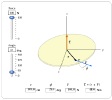
Right Hand rule The vector product A x B is a third vector C having a magnitude AB sinθ equal to the area of the parallelogram described by AxB perpendicular the plane of A x B. |
|
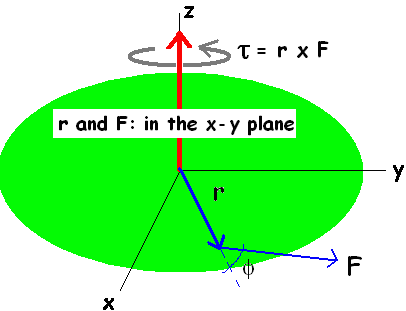
The direction of the Torque will be centered along the axis of
rotation (the +z axis). Of course the rod will accelerate in the general direction of the applied force. |
|||||||||||
|
Example of Cross Product
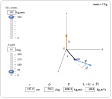
Lets say that a 3 meter rod is oriented in the x-y plane as seen to the right (pointing to the forward and right position so that, r = 2i + 3j + 0k). A 5 Newton force is applied in the same plane, but with only a small component in the x-plane, F = 1i + 4j + 0k. What is the resultant torque where t = r x F?
|
|
|
|||||||||||
|
|
i (+) |
j (-) |
k (+) |
t = +( 3*0 - 4*0 ) i - ( 2*0 - 1*0 ) j + (2*4 - 1*3 ) k t = 0 i - 0j + 5 k t = 5 k (positive means counter clockwise) |
|||||||||
|
r |
2 |
3 |
0 |
||||||||||
|
F |
1 |
4 |
0 |
||||||||||
|
Some Properties of Vector Products 1. A x B = -B x A 2. If A is || to B then A x B = 0 (AxA=0 also) 3. If A is ┴ to B then |A x B| = AB 4. A x (B + C) = A X B + A X C 5. d (A x B) / dt = A x dB/dt + dA/dt x B |
|||||||||||||
|
11.2 Angular Momentum of a Particle |
|||||||||||||
|
Torque = r x F or t = Fd = F sinφ r
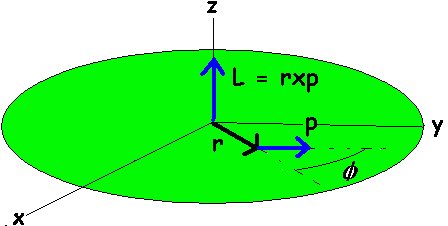
Angular momentum, L, is defined as r x p r x p à off centered momentum will cause rotation L = r x (mv) L
= mv r sinφ Δp = F Δt dp = F dt Thus net force on a particle is the time rate of change of the linear momentum
ΣF = dp / dt Σt = r x ΣF |
Σt = r x dp/dt Let's
add ZERO to the above equation
Let 0 = dr/dt x p dr/dt = v ll p
Σt = r x dp/dt +
dr/dt x p
Σt = d(r x p) / dt
Σt = dL / dt
|
||||||||||||
|
Demo: Fallling Bottle and keys: ME-Q-FB
|
|||||||||||||
|
11.3 Angular Momentum of a Rotating Rigid Object |
|||||||||||||
|
L = r x p L = r x (mv) v = ωr Li
= miri2ω I = mr2 |
If you recall, we introduced this formula previously (Ch 10) and related it to Newton’s 2nd law, we now can see the proof. F = m a Σt = I α |
||||||||||||
|
Example
|
|
mbowlingball ≈ 4 kg rbowlingball ≈ 10 cm Lz = Iω Table 10.2 à I = 2/5 MR2 Lz = 2/5 MR2 ω 60 rpm = 1 rev / sec Lz = 2/5(4)(0.1)2 (1 rev/sec)(2π / rev) Lz = 0.10 Nm2 |
|||||||||||
|
|
|||||||||||||
|
11.4 Conservation of Angular Momentum |
|||||||||||||
|
Σtext = dLtot / dt Σtext = 0
|
|||||||||||||
|
Example
of exploding galaxy (b) 1010 m in diameter? Need
to look up the following information online mstar = 2 x 1030 kg rgalaxy = 50,000 light years = 5x10²⁰ m Tgalaxy = 2x10⁸ years = 6x10¹⁵ sec v = wr = 2pr/T à wf = 2p/T |
I ω = If ωf ½mri2 ω = ½mrf2 2p/T (a) assuming a disk ½m(5x10¹³)2 ω = ½m(5x10²⁰)2 2p/6x1015 ω = (5x10²⁰)2/(5x1013)2 * 2p/6x1015 ω = 1014 * 2p/6x1015 ω = 0.1 rad / sec (b) ω = (5x10²⁰)2/(5x109)2 * 2p/6x1015 ω = 107 rad / sec
|
||||||||||||
|
Example
11.9 The spinning bicycle wheel The wheel is spinning in the horizontal plane, so
L = Linitial by 180°. Now inverted wheel has Linvert = - Linitial |
|
||||||||||||
|
No external torques have been applied (only one torque internal to the system) so Angular momentum should be conserved.
|
The wheel started at +Linit to the inverted -Linit. The student on the stool (the only other thing internal to the system) went from 0 to 2 Li (to conserve angular momentum).
|
||||||||||||
|
Lecture Example During lecture I spin three times around on the platform in 3 seconds. In each arm is a 2 kg mass. These are brought in to the center of my body.
Then I extend my arms in to 1 meters…and now 3 rotations take about 6 seconds. What is my inertia? |
1st point: calc the inertia at the center of rotation and when extended to 1 meter.
Remember I’ve two arms!!!
|
At the center: I = mr2 = (2(0.02m)2 ) Icenter = 0.0008 kg m2
Extended: I = mr2 = 2(1)2 Iextend = 2 kg m2 |
|||||||||||
|
Given: wf = ½w (same angular distance in half the time) I w = If wf (I+ Icenter) w = (I+ Iextend) ½w (I+ 2(0.0008)) w = (I+ 2(2)) ½w 2I ≈ (I+ 4) I ≈ 4 kg m2 |
|||||||||||||
|
11.5 Gyroscopes |
|||||||||||||
|
|
|
||||||||||||
|
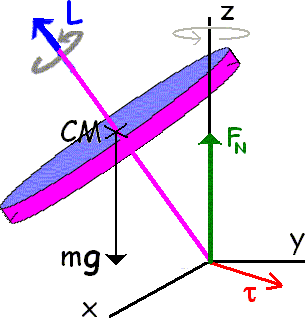
As
a Gyroscope is spinning it wobbles (precesses) at a certain frequency, ω.
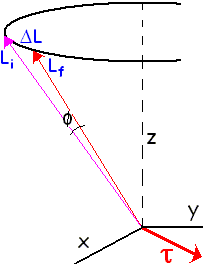
The Torque produces a change in dL in the direction of the Torque, (t = dL / dt). Just like t, dL must also be perpendicular to L.
Since dL is perpendicular to L, we know that dL is independent of L
Note: dL & t only change in the x-y plane. The z component is constant during the rotation |
|
The
gyroscope is precessing about the pivot point with an angular velocity,
ω, so that L = Iω.
sinφ = ΔL / L (φ << 10°) dφ = dL / L dφ = dt dt / L dφ = mgr^ dt / L dφ/dt = mgr^ / I ω d ω = mgr^ / I ω ωprec = mgr^ / I ω |
|||||||||||
|
11.6 Angular Momentum as a Fundamental Quantity |
|||||||||||||
|
L = ħ ħ = 1.0546 x 10⁻³⁴ J s ICMω = ħ ħ = h / 2π ω = ħ /ICM |
|
||||||||||||
|
Example What is the angular velocity of a N2 molecule? mN-atom = 14 amu mamu = 1.66 x 10⁻²⁷ kg
|
ω = ħ / ICM ω = ħ / (mr2 + mr2) (two nitrogen atoms) ω = ħ / 2 m r2 ω = 10-34 / 2 (14)( 1.66x10⁻²⁷) (1.7 x 10⁻¹⁰)2 ω = 7.7 x 10¹⁰ rad / sec |
||||||||||||
|
|
|
||||||||||||