|
Chapter 4: Motion in Two Dimensions |
|||||||||||||||
|
4.1 Position, Velocity, Acceleration Vectors 4.2 2D Motion w/Constant Acceleration 4.3 Projectile Motion |
4.4 Uniform Circular Motion 4.5 Tangential Radial Acceleration 4.6 Relative Velocity and Acceleration
|
||||||||||||||
|
4.1 Position, Velocity, Acceleration Vectors |
|||||||||||||||
|
|
|||||||||||||||
|
4.2 Motion w/Constant Acceleration |
|||||||||||||||
|
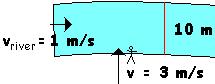
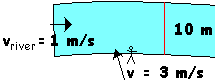
An Olympic swimmer crosses a river by attempting to swim straight across. A 1 m/s current is pushing the swimmer downstream as the swimmer crosses the 10 meter river. a) How much time is required for the swimmer to cross? b) What is the final position of the swimmer on the other side? Write the known’s · vy = 3 m/s · vx = 1 m/s · Δy = 10 meters
|
|
or
|
|
||||||||||||
|
a) 3 m/s = 10m/Δt Δt = 3 1/3 sec. |
b) 1 m/s = Δx/3.33 Δx = 3 1/3 m |
r2 = rx2 + ry2 r2 = 3.332 + 102 r = 10.5 meters tan θ = rx / ry tan θ = 3.33 / 10 θ = 18.4° |
|||||||||||||
|
Later in the term we get to write the resultant position as r = 3.33 i + 10 j But until we complete our Mid-Term we calculate the magnitude of the resultant with angle. |
10.5 meters & 18.4° downstream (3.33 meters downstream) |
||||||||||||||
|
This time the swimmer desires to go directly across the river and compensate for the current. a) Which direction should the swimmer point so that the swimmer will reach the other side directly across from the start point? b) How much time is required?
|
vy = v (cos θ);
vx = v (sin θ); |
|
|
b)
v (cos θ) = Δy / Δt 3 (cos θ) = 10 / Δt Δt = 3.33 / cos θ
Δt = 3.33 / cos 19.5° Δt =3.54 seconds |
|||||||||||
|
If Δx is zero then vx of the swimmer must equal vx of the river |
|||||||||||||||
|
a) vx-swimmer = vx-river v (sin θ) = 1 m/s 3 (sin θ) = 1 m/s θ = 19.5° upstream |
|||||||||||||||
|
4.3 Projectile Motion |
|||||||||||||||
|
Key points to emphasize · Always break a vector into its horizontal and vertical (x & y) components IMMEDIATELY! · x & y components are independent · gravity (“g” = 9.8 m/s2 ≈ 10 m/s2) ONLY affects the y-component Ø Thus the y-component determines the time an object is in the air. ·
If
gravity is the only force involved then vx,initial equals
vx,final equals vx,average à
|
|||||||||||||||
|
Example:
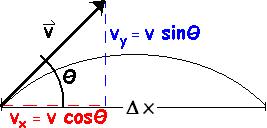
An USC punter kicks the ball with an initial velocity of 30 m/s at a 50° angle, (so that the vy,i = 23 m/s and vx,i = 19.3 m/s). What distance does the football travel?
|
sin θ = oppo / hyp sin θ = vy / v vy = v sin θ vy = 30 sin 50° vy = 23.0 m/s |
cos θ = adj / hyp cos θ = vx / v vx = v cos θ vx = 30 cos 50° vx = 19.3 m/s |
2nd: Time to the top of path is same as time to the bottom of path, so ttotal = ttop + tbottom
ttotal = 2.3 + 2.3 ttotal = 4.6 seconds.
vave = Δx /Δttotal 19.3 = Δx /4.6 Δx = 88.8 meters
|
||||||||||||
|
1st: Determine time to top of path. The y-comp of the velocity at the top of the path will be 0 m/s.
ay = Δvy / Δt ay = (vf – vi) / Δt 10 = (0 – 23.0) / Δt Δt = 2.3 seconds
Note: Is this the time to the top of the path or the time from the top to the bottom?
|
|||||||||||||||
|
The Range Formula The range formula is a useful derivation for determining the distance traveled by objects on level ground. Below is the derivation. The above sketch is referred during the derivation. |
|||||||||||||||
|
ay
= Δvy / Δt |
ttop = tbottom
ttotal
= 2ttop |
Level ground If the only force on the object is gravity; the time it takes to the top of the path is equal to the time it takes from the top of the path back to ground level.
|
Δx = vx-ave ( Δttotal ) Δx
= v*cosθ (2 v sinθ/g) |
||||||||||||
|
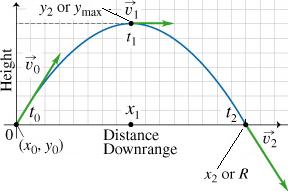
Example The figure shows the trajectory of a ball undergoing projectile motion over level ground. How do the speeds v0, v1, and v2 compare?
|
|
(a) v0 = v1 = v2 > 0 (b) v0 = v1 > v2 = 0 (c) v0 = v1 > v2 > 0 (d) v0 > v1 > v2 > 0 (e) v0 > v1 > v2 = 0
|
|||||||||||||
|
If the figure is to scale, which component of the velocity vector is greater, vo,x and vo,y?
What are the values of the initial acceleration vector components, ao,x and ao,y? |
|
What are the values of the velocity vector components, v1,x and v1,y as well as the acceleration vector components, a1,x and a1,y and (both m/s and m/s2)?
|
|||||||||||||
|
What is Δx? |
|
||||||||||||||
|
Monkey Gun, Large Demo: ME-D-ML
|
|||||||||||||||
|
Example
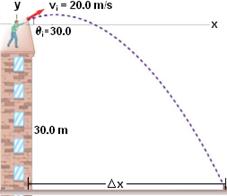
A 2.00 kg ball is thrown upward with an initial speed of 20.0 m/s from the edge of a 40.0 m high cliff. At the instant the ball is thrown, a girl starts running away from the base of the cliff with a constant speed of 4.00 m/s. The girl runs in a straight line on level ground. Ignore air resistance.
|
|||||||||||||||
|
(a) At what angle above the horizontal should the ball be thrown so that the runner will catch it just before it hits the ground?
|
xBall = ½at2 + vo t + xo xBall = 0 + cosθ 20 t + 0 |
xGirl = ½at2 + vo t + xo xGirl = 0 + 4 t + 0
|
|||||||||||||
|
xBall = xGirl vo-ball t = vo-girl t cosθ 20 t = 4 t θ = 78.5° |
As we set the x-components equal to each other, this will give us the angle where the x-comps of both velocities will be equal to each other. |
||||||||||||||
|
(b) What distance from the cliff does the girl catch the ball? |
|||||||||||||||
|
yBall = ½ a t2 + vo t + yo 0 = ½(-10)t2 + sin78.5°20 t + 40 5t2 – 19.6 t = 40 t2 – 3.92 t = 8 (completing the squares, ½ 3.92 = 1.96) (t–1.96)2 = 8 + (1.96)2 t – 1.96 = ±3.44 t = 1.96 ± 3.44 t = 5.40 seconds |
So the ball falls to 40 meters below the cliff top 5.40 seconds after being thrown.
|
||||||||||||||
|
xGirl = 3.47 t xGirl = 3.47 m/s (6.82sec) xGirl = 23.7 meters |
|||||||||||||||





|
4.4 Uniform Circular Motion |
|||||||||
|
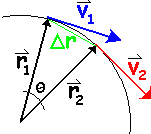
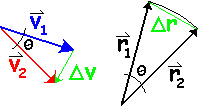
With this as a base let’s follow a few steps: v Draw in two radii vectors, r1 & r2 at an angular displacement of θ v Draw in change of position of the radii vectors, Δr v At the position of radii vectors r1 & r2, let draw in velocity vectors v1 & v2 v Next, displace so that velocity vector tails so that they are adjacent to each other. o Since vector v1 is perpendicular to r1 & v2 is perpendicular to r2 the angle, θ, between r1 & r2 must be the same as the angle between v1 & v2
v Since the two triangles are “similar” and follow all the rules of similar triangles and |v1| = |v2| (so we can write v1 or v2 as simply v) we write the following equation o
|
|
||||||||
|
At this point let’s substitute back into a = Δv /Δt
|
|||||||||
|
Question: If a vehicle is in a turn of radius 30.0 meters and is traveling at 20.0 m/s what is the centripetal acceleration required for this car to remain in this turn? |
Ac = v2 / r ac = 20.02 / 30.0 ac = 13.3 m/s2 |
||||||||
|
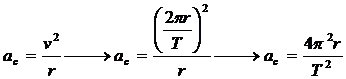
At this we need to introduce the period T, the amount of time for one complete revolution (or iteration, process, etc). If an object is in a circular path the amount of time to complete path of one revolution is the period and the distance to complete the same revolution is 2πr.
|
An alternate method to write centripetal acceleration is
|
||||||||
|
Results of this discussion: · An object with constant speed (remember speed is magnitude only) while traveling in a circle has a constant centripetal acceleration. · Does this mean you slow down much more rapidly in a circular path in your vehicle? Try it some time…release your gas pedal on a flat surface and note your rate of “deceleration” (negative acceleration) Then compare this to your rate of negative acceleration when you are in a turn. Ans: You will notice your car slows down much more rapidly in a turn due to centripetal acceleration So to maintain your constant speed in a circle you must press down more so (or positively accelerate) on your accelerator to maintain a constant speed shown by your speedometer
|
|||||||||
|
|
|||||||||
|
4.5 Tangential and Radial Acceleration |
|||||||||
|
Key Point to this section Radial
Unit Vector,
|
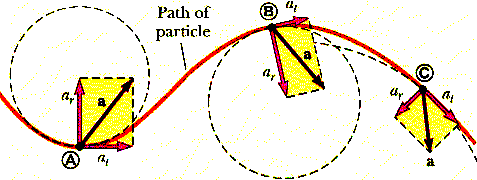
The radial acceleration component arises from the change in direction of the velocity vectors as shown above.
Since centripetal means “Towards” the center (as opposed to centrifugal which is “Away” from the center) we know the radial component of acceleration is the centripetal acceleration.
Ar = -ac = -v2/r The
negative “-“sign represents the opposing direction of the centripetal
acceleration (toward the center) to the radial unit vector,
|
||||||||
|
Results of this discussion ac is toward the center ar is toward the center
|
|||||||||
|
Think About It
If you release (remove the centripetal force) an object that traveling in a circular path, the object goes off in a straight line which is tangent to the circle at that point. (Demonstration in lecture)
|
Tangential Acceleration: As the name indicates tangential acceleration is an acceleration tangent to the radius.
If an object has a tangential acceleration component vector, then the tangential velocity will increase with respect to time. This will result in an object “speeding up/slowing down”. |
||||||||
|
Results of this discussion |
|||||||||
|
1. If the object is in a circular path and has a tangential acceleration, this means the object does NOT have a constant speed.
|
2. If the object has a constant centripetal acceleration and a ZERO tangential acceleration, the object maintains a constant speed.
|
||||||||
|
Equation
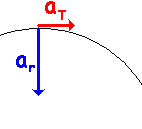
a2 = ar2 + aT2 |
|
Example What is the acceleration of the object in the picture the left if aT = 3.0 m/s2 and ar = 8.0 m/s2? |
Ans: a2 = ar2 + aT2 a2 = 82 + 32 |a| = 8.5 m/s2 @ tan q = 3 / 8 q = 20.6° off center
|
|
|||||
|
|
|||||||||
|
4.6 Relative Velocity and Acceleration |
|||||||||
|
Reference frames!!! Let’s pretend you are back in 7th grade. You are on the bus coming to your favorite place…SCHOOL!!!
As you get close to school you pass the kids that are walking to school. One of these kids loves to throw his baseball up and down will walking.
What do you see?
You see a ball that rises as you approach it…and you pass the ball…it recedes in the distance on it’s way down.
The ball follows a parabolic path to you.
|
To the student walking it appears to go straight up and down.
Which is true?
Both, depending on your reference frame.
r’ = r + vot
r is the reference frame of the walker r’ is the reference from of the bus with vo busing the velocity of the bus. |
||||||||

 which can be rewritten
as
which can be rewritten
as 


 ; but we know
  ; so that



 .
.

|
Copied from 3.7 Relative Motion |
|||||
|
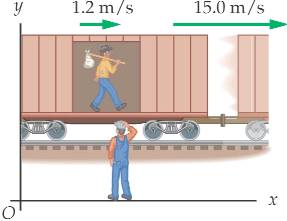
15 + 1.2 = 16.2 m/s
It appears the hobo in the train car is moving +16.2 m/s from the train engineer’s perspective |
|
||||
|
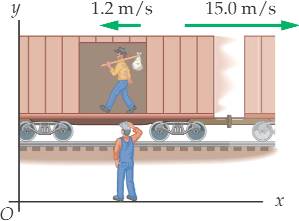
15 – 1.2 = 13.8 m/s
It appears the hobo in the train car is moving +13.8 m/s from the train engineer’s perspective |
|
||||
|
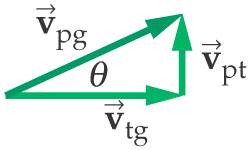
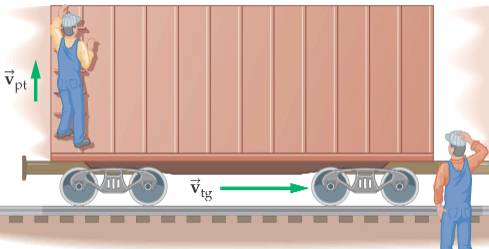
a2 + b2 = c2
or vtg2 + vpt2 = vpg2 |
|
||||
|
Example A ball of mass 0.2 kg has a velocity of 1.50 i m/s; a ball of mass 0.3 kg has a velocity of -0.4 i m/s. They meet in a head-on collision. (a) Find their velocities after the collision. (b) Find the velocity of their center of mass before and after the collision.
|
|||||
|
Use relative velocities from ch 4
If v1 = 1.5 and v2 = -0.4 then It appears to v1 that v2 is approaching at 1.9 m/s as if v1 is not moving.
|
|
v1 - 1.5 = 0 v2 + 0.4 = 0 (subtract the two equations) v1 - v2 -1.9 = 0 or v1 = 1.9 + v2 This is before collision After the collision, it is reversed v2f = 1.9 + v1f |
|||
|
m1 v1 + m2 v2 = m1f v1f + m2f v2f 0.2*1.5 + 0.3*(-.4) = 0.2 * v1f + 0.3 v2f
Use relative velocities from section 4.6 v1-init = 1.9 + v2-init then v2f = 1.9 m/s + v1f
0.2*1.5 + 0.3*(-.4) = 0.2 * v1f + 0.3(1.9 m/s + v1f) 0.3 - 0.12 = 0.2v1f + 0.57 + 0.3v1f 0.3 - 0.12 = 0.5v1f + 0.57 v1f = -0.78 m/s v2f = 1.12 m/s
This gives you a hint of the fun we will be encountering in Chapter 9 |
(b) vCM = (m1fv1f + m2fv2f) / m vCM = 0.2*1.5 + 0.3*(-4)/5 vCM = +0.36 m/s
This is vCM before the collision…and since momentum is conserved, this is also the vCM after the collision.
|
||||