|
Chapter 5: Laws of Motion including friction |
||||||||||||
|
5.1 The Concept of Force (external force, equilibrium) 5.2 Newton's First Law and Inertial Frames 5.3 Mass 5.4 Newton's Second Law
|
5.5 The Gravitational Force and Weight 5.6 Newton's Third Law 5.7
Some Applications of Newton's Laws (tension,
equilibrium) |
|||||||||||
|
5.1 The Concept of Force |
||||||||||||
|
Net force is the summation of all forces on an object If net force is zero…then acceleration is zero. If mass increases…and net force is zero, then acceleration decreases.
Gottfried Leibniz (calculus) was born on 1646 on July 1st, published his finding on calculus in 1684. Sir Isaac Newton developed calculus in 1665, 19 years earlier than Leibniz, but didn’t publish results until 1687. Source www.prenhall.com/physics Physics 3/E daily calendar by James S. Walker
|
|
|||||||||||
|
5.2 Newton's First Law and Inertial Frames |
||||||||||||
|
Newton's 1st Law If an object doesn't interact with other objects, it's possible to identify a reference frame in which the object has zero acceleration |
||||||||||||
|
Inertial Frames Have you ever been at a red light and thought the driver next to you was moving very slowly backwards? And it turned out your foot had moved ever so slightly off the break.
Since it was such a small acceleration your body notice, thus didn’t signal your brain that you were moving forward, thus you thought the car (or sign, etc) was moving backwards.
|
||||||||||||
|
|
||||||||||||
|
Example 1: A boy in the back seat of a moving SUV throws a ball straight up. For the observer who is at a bus stop, which the SUV passes, the ball appears to travel in a ballistic path. |
Explanation
Once
again you throw a ball up (vi = 4 m/s) in the moving car (vcar
= 20 m/s) One
interesting note. |
|||||||||||
|
The x-component of the velocity was constant (no forces acting upon it). * If the vx has no net forces acting upon it, vx will be constant. This holds true for low velocities for most
objects when air friction is neglible. * Exposed surface area * shape * ρair (density) * ò v dv = ½v² Important to remember: must use SI units (mks) (or be consistant; i.e. cgs, english, etc).
|
||||||||||||
|
Demo: Newtonian Table Cloth: ME-F-NT
|
||||||||||||
|
5.3 Mass |
||||||||||||
|
Mass is a property of the object, just like density or volume. What a coincidence…there is even a formula linking these three properties together. |
r = m / V
|
|||||||||||
|
Since mass is a property of a material and changes as easily as the volume (thus not easy), mass is essentially a constant over a limited amount of time (at non-relativistic speeds)
So…you weigh 100 kg. You jump on the space shuttle…and in orbit you are weightless, so you weigh 0 kg. Hmmm…interesting. How can 100 kg = 0 kg?
So if you ever tell someone you weight 100 kg…then you are saying that you can substitute 0 in any equation where there is a value of 100. Result…can ANYONE weight 100 kg? Ans: NO… kilograms is a unit of mass, which is a property of the body.
Gravity gives an object weight. So weight can only be measured in Newtons, pounds, dynes, or other force units. |
||||||||||||
|
|
||||||||||||
|
5.4 Newton's Second Law |
||||||||||||
|
Newton's 2nd Law (when viewed from a inertial reference frame) |
||||||||||||
|
Demo: Rope and 3 Students: ME-J-RS
|
||||||||||||
|
5.5 The Gravitational Force and Weight |
||||||||||||
|
F = ma FW = m ag FW = mg So weight is mg |
(g is the local acceleration due to gravity, about 9.8 m/s2 for earth…about 1.6 m/s2 for the moon) |
|||||||||||
|
5.6 Newton's Third Law |
||||||||||||
|
Newton's 3rd Law · No isolated force can exist. Forces Always occur in pairs. |
||||||||||||
|
|
|
|||||||||||
|
|
|
|||||||||||
|
|
||||||||||||
|
5.7 Some Applications of Newton's Laws (tension, equilibrium) |
||||||||||||
|
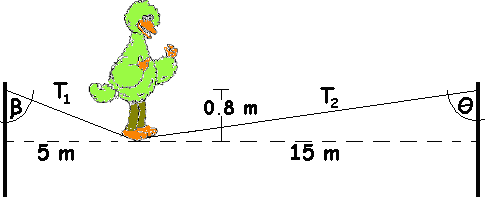
Example: A Big Bird walking a tight rope A
bird likes to walk on a tight rope. This is a very large bird, about 60 kg.
|
Since the tight rope stationary at any instance between steps we know: Fx = 0 and
ΣFy = 0 Σ
Fx = 0 N T2 = 600 N / (cotβ sinθ + cosθ) |
|||||||||||
|
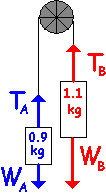
Atwoods Machine In the Atwoods Machine two masses are attached on both ends of the end of a string which is stretched over a pulley. If the pulley if Frictionless, the tension in both sides MUST be EQUAL (it’s the same string and no force is applied at the pulley).
Let’s calculate the tension caused by block A and by block B IF THE pulley is held stationary.
|
|
|||||||||||
|
You enter an elevator. The elevator begins to rise. You “feel” heavier… Next…you enter an elevator…and it begins its descent. During initial 1 to 2 seconds during descent you “feel” lighter.
What’s going on? You are accelerating in the same direction of gravity or you’re accelerating in a direction opposing gravity.
· If “g” = 10 m/s2 and you accelerate in the direction of gravity…at 1 m/s2 you will feel 10% lighter · And at 3 m/s2 you will feel 30% lighter · If you accelerate down (in the direction of gravity) at a rate of 10 m/s2 you will feel 100% lighter, which is called “free fall”. We’ll use this concept to calculate the tension in the elevator cable for this problem. |
TA = m1 g |
TB = m2 g |
||||||||||
|
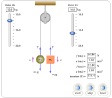
Next the now Frictionless pulley is released. Thus the tension in both sides MUST BE EQUAL.
We also know the heavier side accelerates down and the lighter side accelerates up. |
||||||||||||
|
Important
note I prefer Fweight = mg |
||||||||||||
|
So
you noticed when the pulley was stopped the tension in the lines was not equal,
but what happens when you release the pulley so that the weights fall toward
the side of Fnet. 0.2 + = 0.2 kg * a Now calculate the tension
for both sides
|
Check Does
T1 = T2? Yes, so you know the results are correct. |
|||||||||||
|
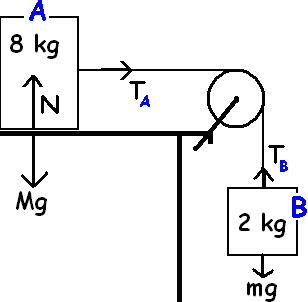
Box Pulled by weight over Pulley
Apply
the same logic as in Atwoods Machine example
|
|
|||||||||||
|
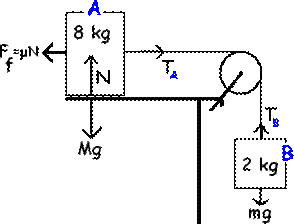
Boxed Pulled by weight over Pulley w/Friction Remember this... Friction is F=μN Ffriction
= μ FNormal Fnet = mg -
μMg
|
|
|||||||||||
|
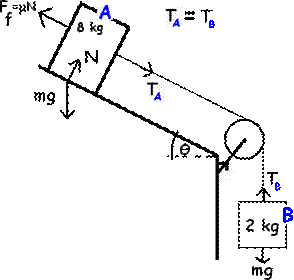
Downhill ramp (w/Friction) while weight hangs over a Pulley Coefficient of kinetic friction = 0.6
It's
actually better to show the normal force originating at the table top (ramp)
and rising perpendicular to the surface of the ramp. (instead of below as
shown) |
|
|||||||||||
|
Tension Between Block with Friction and Weight Over Pulley |
||||||||||||
|
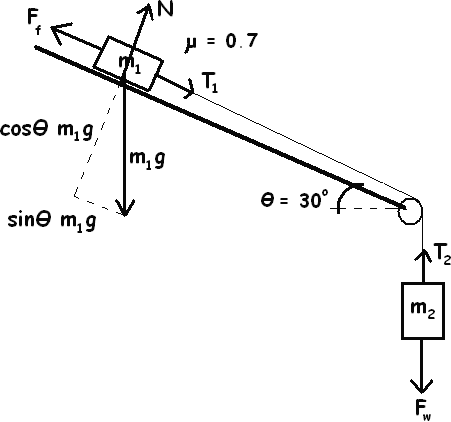
One question: what is the tension in the line of a block on an incline attached to a weight suspended by a pulley
where Ff
= μ N & N = cos30°(4kg)10m/s² = 34.6 N Fnet
= mtotala
And
you were asked to calculate the tension in T1
|
|
|||||||||||
|
T1
= T2 = m2*(g-a) = 2kg*(10-2.6) = 14.8 N |
||||||||||||
|
|
||||||||||||
|
5.8 Forces of Friction |
||||||||||||
|
Static (not sliding) and Kinetic (moving/sliding) Friction Demo: Static Equilibrium Balls: ME-K-SE
Demo: Static vs Kinetic Incline Plane: ME-K-SK
·
The work you do is the force you apply to an object through a displacement |
||||||||||||