|
Chapter 6 Outline: Circular Motion (w/Newton’s Laws)
|
|
6.1
Newton's Second Law Applied to Uniform Circular Motion
6.2
Non-uniform Circular Motion
|
6.3
Motion in Accelerated Frames
6.4
Motion in the Presence of Resistive Forces
6.5:
Numerical Modeling in Particle Dynamics
|
|
6.1 Newton's Second Law
Applied to Uniform Circular Motion
|
|
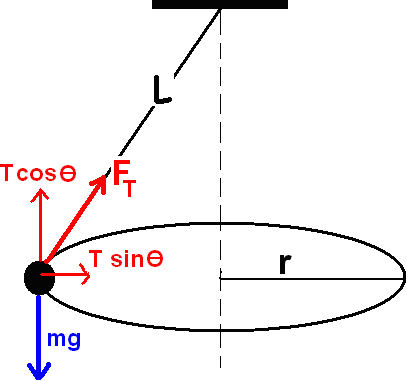
A Swinging Circular
Pendulum (Example 6.2)
Note: equations for sum of all x components and
sum of all y-comp are written.
ΣFx = m v²/r = T sinθ
ΣFy = m g = T cosθ
In the example these two equations are divided, but can just as easily solve
for T and substitute into the other equation to result in
tanθ = v²/ rg; where r = L sinθ
v = (L g sinθ tanθ)½
|
|
|
Cup Supplying Centripetal
Force on the water (horizontal plane)
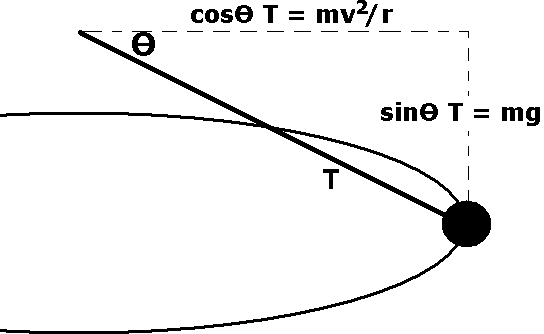
During lecture a cup of water was swung over my head in several different
planes. How can you tell the tension in the string in this case?
The key is to relate the y-comp and the x-comp of the Tension and set them
equal.
FT-x
= mv²/cosθr FT-y = mg/sinθ
mv²/cosθr =
mg/sinθ
v = (g cotanθ/r)½
|
|
Demo:
Centrifugal Hoops: ME-D-CH
Demo:
Rotating Candles: ME-D-RC
|
|
|
|
|
6.2 Non-uniform Circular
Motion
|
|
Demo:
Pail of Water: ME-D-PW
|
|
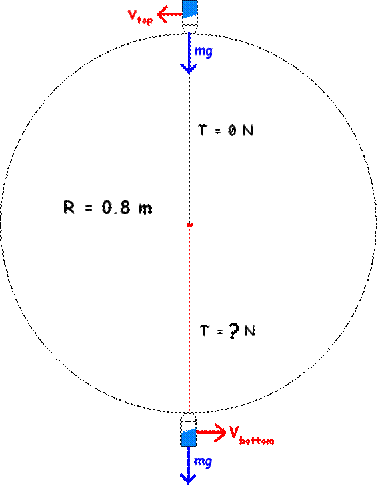
Cup Supplying
Centripetal Force on the water (verticle plane)
When I was swinging the cup of colored water I also spun the water in the
vertical direction. How fast would the cup be moving if the tension went to a
minimum at the top of it's path, Ttop = 0; where if any slower it
wouldn't quite make it to the top of the path.
Normally near the top the Fcentrip = mg + T = mv²/r, except this
time the Tension = 0 N, thus mg = mv²/r
Thus velocity for the cup with blue water at the top of the path was (rg)½
= 2.8 m/s or about 6 mph.
|
|
|
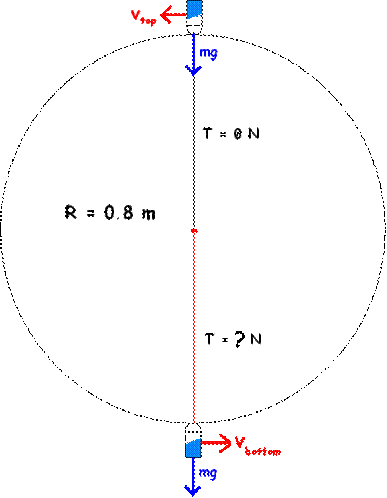
Rotating Cup with Water,
Tension at Bottom
When
I was swinging the cup of colored water I also spun the water in the vertical
direction. How fast would the cup be moving (tangential velocity) at the
bottom of the path if the tension went to a minimum at the top of it's path,
Ttop = 0;
In the earlier example at the top of its path T = 0 N , so mv²/r = mg but at
the bottom of the path Fcentrip = T = mv²/r + mg,
Thus velocity for the cup with blue water at the bottom of the path would be
dependant upon the velocity at the top of the path and the work done upon the
cup by gravity.
So the Work = Δ ½mv² will give the addition velocity, and thus we can
determine the Tension on the string.
mg(hmax - hmin) = Δ ½mv²
g (1.6 m) = ½ (vf² - vi²)
32 m²/s² = (vf² - (2.8 m/s)²)
vf = 6.3 m/s
T = mv²/r + mg = (60 * mass) N
or you could say, 6 "g's" on the cup of water
|
|
|
6.3 Motion in
Accelerated Frames
|
|
Accelerating
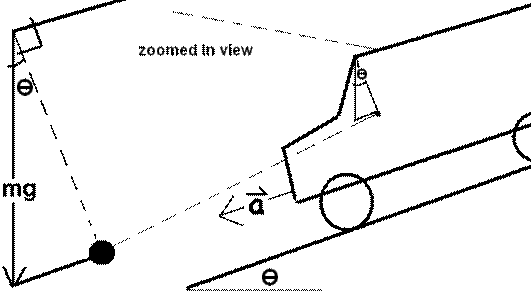
Van with Fuzzy Dice Perpendicular to Plane of the Ramp
|
|
What
is the angle of the ramp if a van was accelerating down the ramp at the rate
of 5 m/s² and fuzzy dice were hanging down perpendicular to the ceiling?
As you can see in the picture below. The force caused by the acceleration of
the van was 5m and and gravity exerted a force of 10m. Thus the angle was
sin θ = ma / mg
θ = 30°
|
|
Accelerating Cart Equals
Accelerating Box-Block system
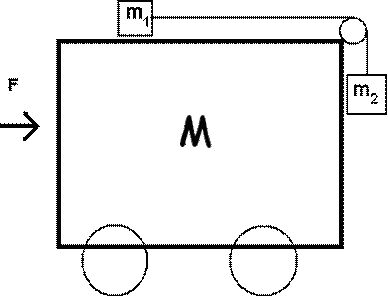
A cart was being accelerated with a force, F. On the cart was two blocks
connected with a string. One block was hanging over the front of the cart as
seen below. What is the force applied if the blocks do not move wrt to the
cart. Thus the acceleration caused by this force must equal the acceleration
of the block system so that T1 = T2
|
|
|
Since
we have a free moving pulley…T1 = T2
(and since the pulley isn’t moving)
T1 = m1a
T2 = m2g
m1a = m2g
Thus a1 = m2 g / m1
|
F
= (M + m1 + m2) a2
But a2 must equal a1 for the pulley (same string) so a2
= a1 = m2 g / m1
F = (M + m1 + m2)* m2 g / m1
|
|
Today we finally officially introduced Chapter 7 & 8 with
the formal derivation of
Work = Δ Kinetic Energy
|
|
|
|
6.4 Motion in the
Presence of Resistive Forces
|
|
AIR Friction
We've already briefly mentioned that the
resistive force in a medium like air is proportional to the square of the
velocity.
This maximum velocity is obviously dependant upon surface area exposed to the
air (sky diver accelerates by diving), the density of the medium, and the
shape of the object (sky spread out arms instead of pulling arms in to
his/her sides).
Thus giving us R = ½DρAv²
where D vary's from 0.5 to 2 depending on shape.
We know that at terminal velocity
mg = ½ DρAv² and solving for terminal velocity yields vT =
(2mg / DρA)½
Let's calculate the approximate vT for a sky diver of 80 kg in air
with density of 1.29 kg/m³ with surface area of 0.65 m². As usual you can use
10 m/s² instead of 9.8 m/s² for accel due to gravity
vT = (2mg / D ρ A)½
vT = (2*80*10 / 0.9*1.29*0.65)½
vT = = 52.3 m/s
Remember on the first day of class where we made a general rule of
thumb...about 2 mph is about 1 m/s

This means that the approximate vT of a sky diver is about 110 mph
|
|
|
|
|
|
|
|
|
|
|
|
|
|
|
FResist = -b v
Terminal Velocity
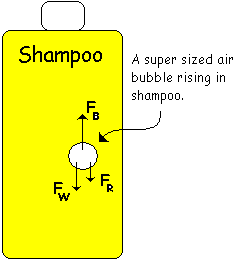
An dropping (or
rising must include buoyant force, which is covered in a later chapter, see
to the right)
object's maximum velocity due to a resistance force by a particular medium
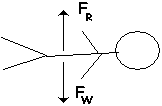
FW = -FR
mg = -bv
The
above force diagram shows that the weight vector is equal and in the opposite
direction of the resistive force.
The
rate of acceleration continually decreases as time progresses and an object
approaches terminal velocity.
|
Something to look forward to for next term
|
|
FNet
= ma
|
FNet
= mg - bv
|
t = m/b, which the time
constant which is the amount of time required for the object to achieve 63%
of it's maximum speed...(ask during class if not clear).
|
|
ma =
mg - bv
ma = mg - bv
As
v increases, acceleration decreases.
a
= g - bv/m where a = dv / dt
dv/dt = g - bv/m Integrate
v = (mg/b) (1 - e-bt/m)
v = (mg/b) (1 - e-t / t)
|
|
|
|
|
|
|
|
|
|
|
|