|
Chapter 8: Potential Energy |
|||||||||||||
|
8.1: Potential Energy of a System |
|||||||||||||
|
There are many types of stored potential energy; below are some examples. 1. Compressed energy (an inflated balloon that escapes your hand before tying, compressed springs, etc) 2. Chemical energy (batteries) 3. Electrostatic (in the form of charges, or capacitors) 4. Magnetic fields (inductors) 5. Nuclear binding energy (weak and strong forces in the nucleus).
This chapter deals primarily with gravitational potential energy of Energy of (vertical) Position.
We know if we exert energy to raise a 100 N dog to a height of 1 meter above the floor, we have done 100 Nm of work on the dog (at the same time gravity has done -100 Nm on the object which means NO net wok is done.)
Then if we drop this dog from the height of 1 meter, the dog will accelerate (down) through one meter and will delivery 100 Nm of energy to the floor.
Immediately before the dog lands on the floor the dog will be moving at maximum speed.
In other words the energy of POSITION has now transferred to energy of MOTION.
Why did I use a dog for an example? Do you think that a 100 Newton rock will damage the ground more than a 100 Newton dog? This is actually an introduction for Ch 9…we’ll revisit this example in Chapter 9.
|
|||||||||||||
|
8.2: The Isolated System |
|||||||||||||
|
Lecture book Examples: 8.2 Ball in Free Fall - Conservation of mechanical energy, isolated system, elastic potential energy
|
|
8.3 The Pendulum |
|||||||||||
|
How fast is the dog moving immediately before impact? I applied a 100 N force through 1 meter, so I did 100 Nm of work to raise the dog. Gravity did -100 Nm of work.
The 100N dog is now 1 meter above the floor. The energy of position is 100 Nm: weight of dog (mg) time distance the dog will fall before reaching the floor.
If no non-conservative forces are acting during this time, we know that ALL of the energy of Position has transferred to energy of Motion.
|
What is a non-conservative force? Friction is generally the most common non-conservative force. At the beginning of the class (several weeks ago) we discussed when air friction on a car really comes into play…we decided that was between 40 and 60 mph (or 20 to 30 m/s).
Do you think the dog will be traveling 60 mph before hitting the ground if I drop him from one meter? Obviously not…so we can easily ignore air friction in this problem.
As discussed in Chapter 5…we always ignore air friction in the class unless otherwise instructed. |
||||||||||||
|
Review F = m a F = m dv/dt Apply chain rule F = m dv/dx (dx/dt) F = m dv/dx v ∫Fdx = m ∫v dv if F not dependant on position F(xf – xi) = m ½(vf2 – vi2) FΔx = Δ½mv2 Work = ΔKE
|
Why do we know it’s Kinetic Energy?
Ans: we know the units of work and energy is Nm {Newton meters (or a Joule)} and so it must be energy of motion since it’s velocity squared term.
T à TE or Total Energy K à KE or Kinetic Energy U à Potential Energy |
||||||||||||
|
So if all of the energy of position has converted to energy of motion with no losses then mghmax = ½mvmax2 v2 = 2gh vdog2 = 2(10m/s2)(1 m) vdog = 4.5 m/s
|
|
Energy losses are simply energy transferred out of the system and are unusable for the system |
|||||||||||
|
Work = ∫-kx dx Work = -k∫x dx Work = -k ½(xf2 – xi2) Wspring = ½kxi2 – ½kxf2
|
What if F is dependant on position? Work = ∫F dx for example Hooke’s Law: F = -kx
|
||||||||||||
|
Example A spring requires 0.09 Nm of work to pull it back 3 cm. You pull the spring back 10 cm. What is the exit velocity of a 50 gram block from this horizontal spring? |
Work = ½kxi2 - ½kxf2 0.09 = ½ k .032 k = 200 N/m
|
Wsping = ΔKE ½ k(0)2 - ½ k(.1)2 = ΔKE 0 - ½k(.1)2 = -½ mv2 0 -½ 200(.1)2 = -½ .05 v2 v = (40)½ v = 6.3 m/s |
|||||||||||
|
Demo:
Hopper Popper: ME-H-AR
Demo: Track, Conservation of Energy: ME-M-TC
|
(A) So how much Elastic Potential energy is stored in the Hopper Popper (A-ans) Should
we use Us = ½kx²? This
isn't exactly a spring so we don't know if this is valid...especially since
"x" would be very difficult to measure. So how do we measure it?
I'm estimating the mass of the Popper to be about 35 grams.
Work = 0.035kg*9.8m/s²*2.4m Work = 0.84 Nm Work = 0.84 Joules
|
||||||||||||
|
8.3: Conservative and Non-Conservative Forces |
|||||||||||||
|
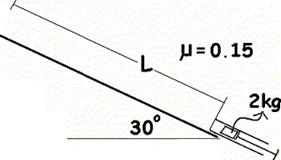
Below, the spring (k = 10,000 N/m) is stretched by 10 cm and the
2kg mass is propelled up the ramp. “L” is the point at which the 2kg object
stops. If μ = 0.15, what is the length of L? |
|
The spring propels the block up the ramp. As the block leaves the spring KEmax is achieved. The KE is transferred to PEgrav and is reduced by friction as it rises up the ramp? NOTE: Ff through a distance reduces KE
|
|||||||||||
|
Wspring = ½kxi2 – ½kxf2 Wspring = ΔK ΔK – Ff d = mgh ½kx2 - μ cos 30°mg L = mg L sin 30° ½10000(.1)2 – 0.15 0.866 (2)(1)10 L = 2(10) L ½ 50 – 2.6 L = 10 L L = 4.0 m |
Ff = μ N Ff = μ cos 30°mg
sin 30° = h / L h = L sin 30°
|
||||||||||||
|
|
|||||||||||||
|
Demo: Pendulum, Bowling Ball: ME-M-PB
|
|||||||||||||
|
8.4: Changes in Mechanical Energy for Non-Conservative Forces |
|||||||||||||
|
Key
Concepts: Change in mechanical energy of a system, due to friction within the
system |
|
||||||||||||
|
|
|
||||||||||||
|
8.5: Relationship Between Conservative Forces and Potential Energy |
|||||||||||||
|
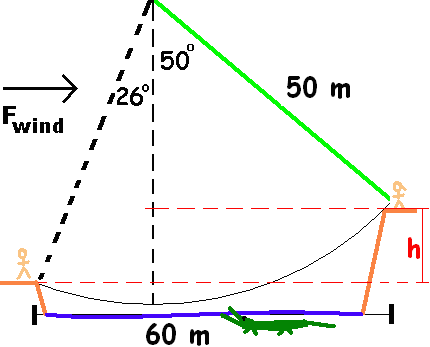
Tarzan & Jane Jane whose mass is 40 kg, needs to swing across a river of width 60 meters filled with man-eating crocodiles to save Tarzan (70 kg) from danger. However, she must swing into a wind exerting a constant horizontal force F on a vine having a length 50 meters, and initially making an angle 50° with the vertical. (a) with what minimum speed must Jane begin her swing to just make it to the other side? (b) Once the rescue is complete, Tarzan and Jane must swing back across the river. With what minimum speed must they begin their swing? |
|
||||||||||||
|
Workgravity
- Workwind = ΔKE
|
Workgravity = m g h = mg (50 cos26° – 50 cos50°) = mg(44.9 - 32.1) = 5000 Nm Workwind = Fwind ∫dr = 6000 Nm |
||||||||||||
|
(b)
This time Air is aiding Jane and Tarzan's crossing |
|||||||||||||
|
8.6: Energy Diagrams and Equilibrium of a System
|
|||||||||||||
|
stable equilibrium, unstable equilibrium, neutral equilibrium
Examples: |
|||||||||||||
|
|
|
|
|||||||||||