|
Ch 13 - Universal
Gravitation |
||||||||||||||||||||||||||||||||||||||
|
|
||||||||||||||||||||||||||||||||||||||
|
In
Ch 1, you are introduced to the formula F
= G Mm/r2 for use in unit analysis. Now that you know force is also measured in |
Using
the force that the Earth exerts on a apple and on the moon, As you see below…the required centripetal acceleration required
to keep the moon in orbit about the earth corresponds with the Force due to
gravity caused by the Earth-Moon system |
|||||||||||||||||||||||||||||||||||||
|
F = “G” M m / r2
N = “G” kg kg /m2 “G” = N m2/ kg2 à G = 6.673 x 10⁻¹¹ Nm2/kg2 Let’s
apply Ch 6, If the Earth exerts a force of, F, on the moon, how much force
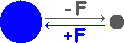
does the moon exert on the Earth? +FEarthOnMoon = -FMoonOnEarth
|
ac = 2.75 x 10⁻³ m/s2 where mac is a centripetal force
since we know the moon orbits the Earth and doesn’t fly off in a straight
line
|
We also know the period of the moon Tmoon
= 27.4day(24hr/day)*(3600s/day) ac
= v2 / r ac
= (2πr/T)2 / r ac
= 4π2r/T2 ac
= 4π23.84 x 10⁸ /(2.36x106)2
ac = 2.72 x 10⁻³ m/s2 |
||||||||||||||||||||||||||||||||||||
|
Example
(13.1 and 13.3) Let’s
calculate the mass of the Earth. m g
= G Mm /
r2 9.79
= 6.673x10⁻¹¹ M / (6.4x10⁶)2 M
= 6 x 1024 kg |
||||||||||||||||||||||||||||||||||||||
|
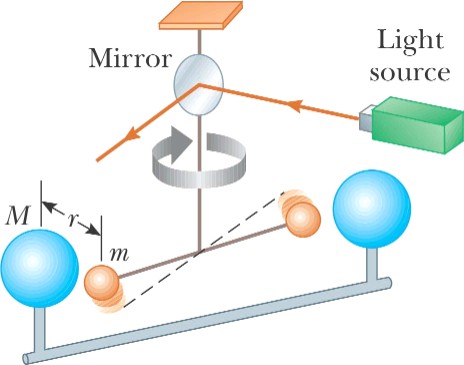
Measuring
the Gravitational Constant |
||||||||||||||||||||||||||||||||||||||
|
By
varying the distance of the large black bar bell and varying the masses and
measuring the induced force using the twist of the wire, “G” was able to be
calculated in 1798. |
|
|||||||||||||||||||||||||||||||||||||
|
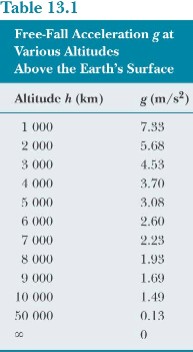
Free-Fall
Acceleration and the Gravitational Force |
||||||||||||||||||||||||||||||||||||||
|
|
||||||||||||||||||||||||||||||||||||||
|
Kepler’s Laws and the Motions of Planets |
||||||||||||||||||||||||||||||||||||||
|
1st Law: All planets move in elliptical
orbits with the sun at one focus |
||||||||||||||||||||||||||||||||||||||
|
How
to make an ellipse? |
|
|||||||||||||||||||||||||||||||||||||
|
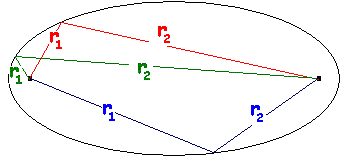
Ø
Choose any two points, called foci Ø
Attach both ends of a long string at the foci Ø
Take a pencil and draw on the inside while keeping the
string taut Any corresponding r1
+ r2 are constant. Notes:
The
elliptical shape is a direct result of the inverse square law |
||||||||||||||||||||||||||||||||||||||
|
Measurements
of ellipse |
|
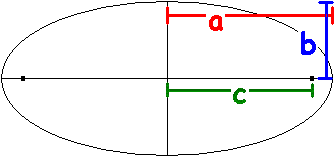
Eccentricity à e e
= c / a important
notes: As
c à 0; e = 0 When
e = 0 the ellipse is a circle |
||||||||||||||||||||||||||||||||||||
|
a à semi major axis 2a à major axis b à semi minor axis 2b à minor axis c à used to measure eccentricity |
||||||||||||||||||||||||||||||||||||||
|
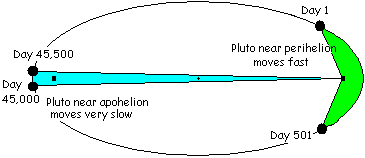
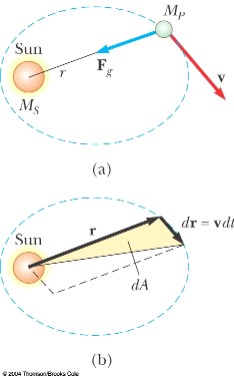
2nd Law: The radii vector sweeps out
equal areas in equal times |
||||||||||||||||||||||||||||||||||||||
|
|
See
below for better sketch |
|
|
|||||||||||||||||||||||||||||||||||
|
average
velocity vave = Δx/Δt vave = Δr/Δt
Δr = vave
Δt |
instantaneous
v v = dx / dt v = dr / dt dr = v dt |
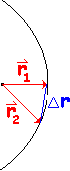
As
we can see in the sketch to the right, the force vector is parallel to the
radii vector. Recall
from Ch 11 à t = r x F Since
r || F, then t = 0 Nm (rules
of cross products) |
||||||||||||||||||||||||||||||||||||
|
Area
of triangle is ½ base x height if
angle between r1 & r2 is infinitely small, then Δr à dr and Area
of triangle is dA = ½ r x dr dA = ½ r x v dt dA = ½ r x v dt (m/m) dA = ½ (
L ) dt / m dA = L dt / 2m |
Recall
from Ch 11 à t = dL / dt Another way to look at this… the more time you apply a torque, the greater the angular
momentum dt t = dL Since
t = 0 Nm we know that
angular momentum is conserved Recall
from Ch 11 à L = r x p L
= r x p L
= r x mv dA / dt = L / 2m since L is conserved; m is a
constant dA / dt = L / 2m =
constant |
|||||||||||||||||||||||||||||||||||||
|
Since dA / dt = constant, we get
Equal Areas in Equal Times à this is the proof for Kepler’s 2nd law |
||||||||||||||||||||||||||||||||||||||
|
3rd
Law: The square of the Period, T, is proportional to the semi-major axis of
the elliptical orbit or simply 3rd
Law: T2 = k a3 (k is constant and changes for each
body) |
||||||||||||||||||||||||||||||||||||||
|
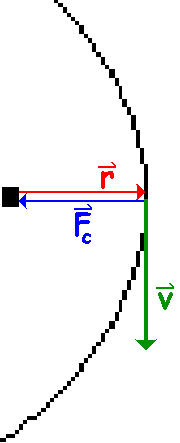
F
= GMm/r2 Fc = mv2/r Since
gravitational attracting is supplying the centripetal force |
a
= r, for circular orbits for
elliptical T2/a3 = ksun Kupiter belt objects: Pluto 30
to 50 Au |
|||||||||||||||||||||||||||||||||||||
|
GMm/r2
= mv2/r GM/r
= v2
where
(v = 2πr/T) GM/r
= (2πr/T)2 GM/r
= 4π2r2/T2 T2/r3
= 4π2/GM T2/r3 = kobject |
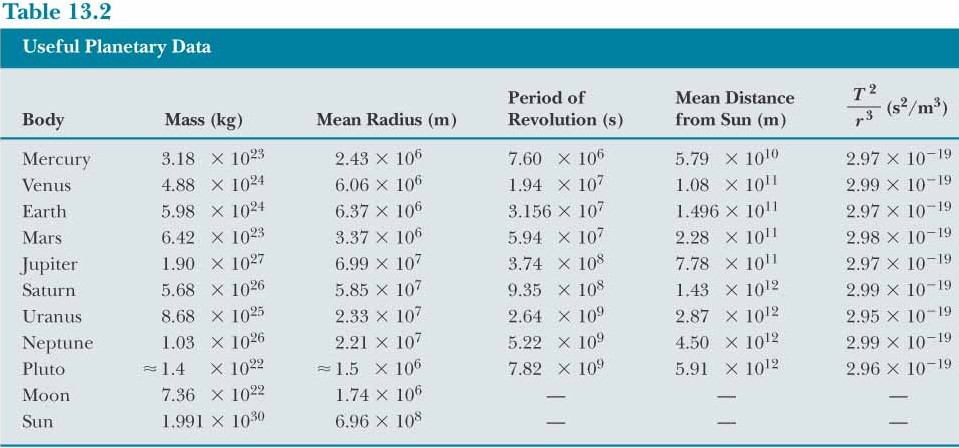
ksun = 4π2/GMsun kearth = 4π2/GMearth use
mass of sun and ksun = 2.97 x
10-19 s2/m3 |
|||||||||||||||||||||||||||||||||||||
|
Example As thermonuclear fusion
proceeds in its core, the Sun loses mass at a rate of 3.64 ´ 109 kg/s.
During the 5000 year period of recorded history, by how much has the
length of the year changed due to the loss of mass from the Sun? |
F = m(v2/r) v = 2πr/T F = m((2πr/T)2/r) F = 4m π2r/T2
F = GMm/r2 |
The rate of change is (derivative) GM(½T-1/2dT/dt)
+ GT1/2 dM/dt = 0 dT/dt = -dM/dt (2 T / M) ∆T/∆t
≈ -dM/dt
(2
T / M) ∆T
≈ - ∆t (dM/dt) (2 T / M) ∆T
≈-5000(3.64´109)(2(1)/1.991x1030) ∆T
≈ 1.83 x 10⁻¹⁷ yr2/sec 3.16x10⁷ sec in one year ∆T ≈ 0.0183 sec |
L = r x p L = r x mv r ≈ ┴ p L = mvr
L = m(2πr/T)r L = 2m π r2/T r2 =
LT/2mπ |
|||||||||||||||||||||||||||||||||||
|
The
Gravitational Field |
||||||||||||||||||||||||||||||||||||||
|
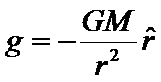
F = mg |
F
= GMm/r2 |
from
Earth’s point of view |
Every object creates a gravitational field surrounding it, which
all other objects are attracted. |
|||||||||||||||||||||||||||||||||||
|
mg = GMm/r2 Since
gravitational attracting is supplying the gravitational force |
||||||||||||||||||||||||||||||||||||||
|
Gravitational
Potential Energy |
||||||||||||||||||||||||||||||||||||||
|
If
you raise an object, you do work on the object, but gravity also does work on the object
in the opposite direction. |
Workgravity = - F Δr Workgravity = -GMm/r2 dr Workgravity = -GMm
ò
1/r2 dr Workgravity = D GMm/r Workgravity = GMm(1/rfinal
–1/rinit) rfinal
= ¥ Workgravity = -GMm(1/r) |
|||||||||||||||||||||||||||||||||||||
|
You
raise an 1 kg object one meter in the air, you do 10 Nm of work raising the
object Work
= mg * Δy Work
= 10 N * 1 m Workgravity = negative of you Workgravity = -10 Nm |
But
what if the object is raised
106 meters. Gravity
varies in this range. Thus
the force varies (not
constant) |
|||||||||||||||||||||||||||||||||||||
|
30 AU’s past the Kupiter
belt we are on a iron mining expedition and find an almost formed
asteroid. It’s still in 3 roughly
spherical pieces, each of 108 kg.
About how much energy must be expended to move them to 1000 meter
equilateral triangle positions? ρiron-rock = 5000 kg/m3 |
Utotal = U12 + U23
+ U13 Utotal = -G(m1m2/r12
+ m2m3/r23 + m1m3/r13) Utotal = -3G(m2/r) (m1 = m2
= m3; r1 = r2 = r3) |
V = m/ρ
= 108/5000 20000 =
4/3πr3 r = 36 m |
||||||||||||||||||||||||||||||||||||
|
Utotal = -3G(m2/r) ¥ to 36 m U@36m
= -3(6.7x10⁻¹¹)(108*2/36) U@36m = -55,800 Joules |
Utotal = -3G(m2/r) from ¥ to 1000 Uto1000
= -3(6.7x10⁻¹¹)(108*2/103) Uto1000 = -2010 Joules |
|||||||||||||||||||||||||||||||||||||
|
So it takes about 53790 Joules of energy to pull them apart |
||||||||||||||||||||||||||||||||||||||
|
13.7
Energy Considerations in Planetary and Satellite Motion |
||||||||||||||||||||||||||||||||||||||
|
The
total kinetic and gravitational potential energy of an object is ½mv2
+ Workgravity to raise it to it’s
current position |
||||||||||||||||||||||||||||||||||||||
|
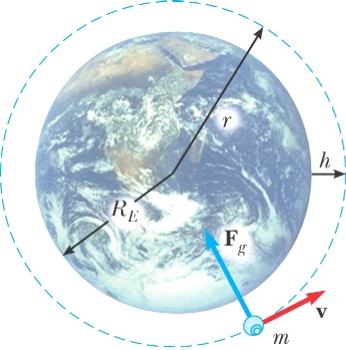
For an object in orbit, what supplies the inward (centripetal)
force? Ans: Gravity |
E
is total energy E
= U +
K E = -GMm/r+½GMm/r E = -½ GMm/r in circular orbits E = -½ GMm/a in elliptical orbits |
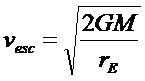
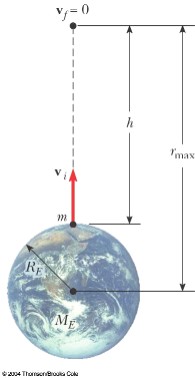
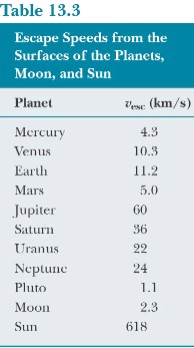
To
calculate escape velocity, vesc, our
initial kinetic energy must be enough to transfer to raise the object to
desired height…once achieved the KE at the top of the path will be zero. Ubottom + Kbottom = Utop + Ktop -GMm/rEarth + ½mvesc2 = -GMm/rmax+ 0 vesc2
= 2GM/rEarth
- 2GM/rmax vesc2
= 2GM(1/rEarth
- 1/rmax) We
know that rmax is essentially ¥, so the 1/rmax =
0 and the equation simplifies to
|
||||||||||||||||||||||||||||||||||||
|
mv2/r
= GMm/r2 mv2/r(½r)
= GMm/r2 (½r) ½
mv2 = ½ GMm/r K = ½ GMm/r Note
K = ½ of Potential energy U = -GMm/r (from 13.6, above) |
||||||||||||||||||||||||||||||||||||||
|
Extra
pictures |
||||||||||||||||||||||||||||||||||||||
|
|
|
|
|
|||||||||||||||||||||||||||||||||||
|
|
||||||||||||||||||||||||||||||||||||||