|
Ch 15 – Fluid Mechanics |
|||||||||||||||||||||||||
|
Pressure |
|||||||||||||||||||||||||
|
P
= | F / A | or P dA = dF |
Some common densities |
Important
Note: If you notice, air (and other gasses) are
approximately 1000 times less dense than liquids and solids |
|||||||||||||||||||||||
|
material |
cgs |
mks |
|||||||||||||||||||||||
|
Water |
1 |
1000 |
|||||||||||||||||||||||
|
SI
units of Pressure is the Pascal 1
Pascal = 1 N / m2 Reminder: density (ρ is rho) ρ = m / V |
Ice |
0.917 |
917 |
||||||||||||||||||||||
|
Air |
0.00129 |
1.29 |
|||||||||||||||||||||||
|
Helium
(He) |
0.000179 |
0.179 |
That
means the spacing between molecules is 10 times greater in all three
dimensions (lxwxh) à (10x10x10=1000) |
||||||||||||||||||||||
|
Copper
(Cu) |
8.96 |
8960 |
|||||||||||||||||||||||
|
Gold (Au) |
19.3 |
19300 |
|||||||||||||||||||||||
|
Aluminum |
2.7 |
2700 |
|||||||||||||||||||||||
|
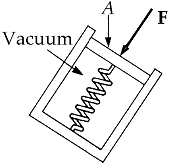
The spring constant of the pressure gauge
is 1000 N/m, and the piston has a diameter of 2.00 cm. As the gauge is lowered into water, what
change in depth causes the piston to move in by 0.500 cm? |
F
= -kx; P = F/A;
P = ρgh kx = ρghA h
= k x
/ ρ
g A h
= (1000*0.005) / (1000*9.8*π*0.012) h = 1.62
meters |
|
|||||||||||||||||||||||
|
Variation
of Pressure with Depth |
|||||||||||||||||||||||||
|
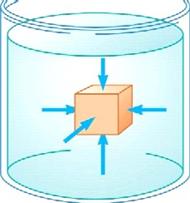
Pascal’s Law A change in pressure to a fluid is transmitted undiminished to
every point of the fluid and to the wall of the container See bottom of
page |
|||||||||||||||||||||||||
|
P1
=
P2 F1
/A1 = F2 / A2 F1 A2 =
F2 A1 Pressure
below a surface must include atmospheric pressure, Fweight = m g ρ =m/V; m = ρV Fw = ρ V g Fw = ρ(Ah)g Fw = ρ A h g Fw/A = ρ A h g /A Pliq = ρ g h h = depth of liquid P = |
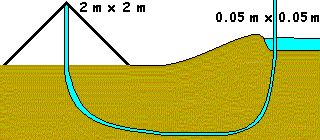
Application Pyramids of P1 = P2 F1 /A1 =
F2 / A2 ρstone
hstone g =
ρH20 h g 2500 (2) g =
1000 h g h =
5 meters So the water column must remain 5 meters higher than the stone
block |
Tubes have been found below the pyramids of If this is the case, one method to raise large stone blocks
[(2x2x2) meters] is application of Pascal’s Law |
|||||||||||||||||||||||
|
|
|||||||||||||||||||||||||
|
Example:
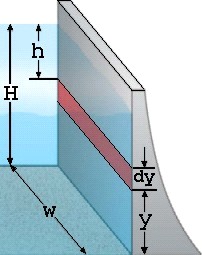
Force on a dam with depth dF =
P dA P =
ρ g h dF = ρ g (H-y) wdy dA = width * dy F
= ρgwH∫dy – ρgw∫ydy
from 0 to H F
= ρgwH(H) – ρgw(H2/2) F = ½ ρgwH2 |
|
||||||||||||||||||||||||
|
Pressure Measurements |
|||||||||||||||||||||||||
|
Pressure
readings referenced in every day usage generally is commonly referred to as
gauge pressure. (i.e. 32 pounds / in2 in our car tires. This is 32 lb/in2 beyond
atmospheric pressure) Absolute
pressure (P) is atmospheric pressure ( P = |
|
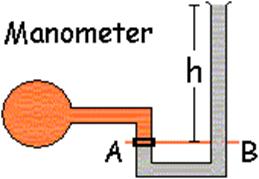
The
key to the manometer is that the place of attachment, point A, is at the same
level of the beginning measurement of h. Points
A & B must be at same pressure, (at same level), so ρgh
is the gauge pressure. |
|||||||||||||||||||||||
|
Common units of pressure |
Compared to |
|
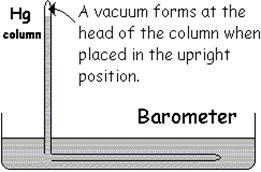
If
the outside pressure goes higher … the surface of the Hg is pushed down even
more…so the Hg in the column is pushed up in the column more. Vise versa if the outside pressure goes
down. |
||||||||||||||||||||||
|
Atmosphere |
1 atm |
||||||||||||||||||||||||
|
Hg column |
760 mm |
||||||||||||||||||||||||
|
Torr |
760 torr |
||||||||||||||||||||||||
|
Pascal |
1.013 x
105 Pa |
||||||||||||||||||||||||
|
Bar |
1.013 bar |
||||||||||||||||||||||||
|
Mbar |
1013 mbar |
||||||||||||||||||||||||
|
lb/in2 |
14.7 lb/in2 |
||||||||||||||||||||||||
|
The above Mercury column experiment is a very powerful demo. But we don’t perform this demo because Hg
is a hazardous chemical. So we instead
we decide to use water. Is this
feasible in our classroom? |
P + ρgh = 0
+ ρgh = ρgh =
h = h = 1.013x10⁵ / (1000)
(9.8) h = 10.3 meters |
||||||||||||||||||||||||
|
Buoyant Forces and
Archimedes’s Principle |
|||||||||||||||||||||||||
|
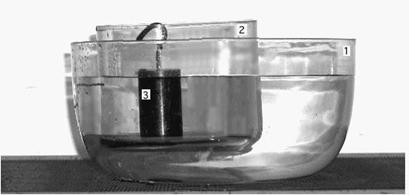
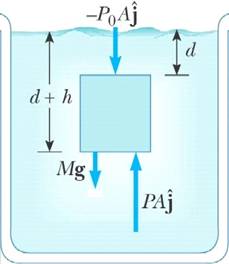
The buoyant
force on an object is equal to the weight of the displaced fluid |
|||||||||||||||||||||||||
|
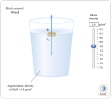
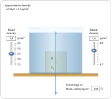
Everyone should cover this subject during lab class. After all labs are complete, we will review this subject. Common topics usually covered during lab class are
|
The
volume of the displace fluid is V If
the displace fluid is water then the weight of the displaced water is m
g = (ρH2OV) g à so FB = (ρH2OV) g So
if a crown displaces 30 cc’s of water (cc = cm3, also cc = ml and
1 cc of water has the mass of 1 gram) FB = ( ρH2O
* V
) g FB = (1 g/cc * 30cc) 1000 cm/s2 (I usually
use g = 10 m/s2 or 1000 cm/s2 during lecture) FB = 30,000 dynes
or FB
= 0.3
|
||||||||||||||||||||||||
|
|
Bouyancy force…just sum up
vectors…
You see that there is a FNet up. |
||||||||||||||||||||||||
|
Fluid
Dynamics |
|||||||||||||||||||||||||
|
There
are two main types of fluid flow. ·
Steady (laminar) ·
Turbulent Viscosity
measures the internal friction of a fluid (i.e. Elmer’s glue has more internal friction
than water) To
be able to model real fluids we must make a few assumptions (which usually
are completely true). ·
The fluid is non-viscous ·
The fluid is steady ·
The fluid is incompressible ·
The fluid has no rotation |
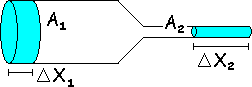
Equations Vcyclinder = A * x; ρ = m / V; V1
= A1 * x1 V2
= A2 * x2 ρ = m1 / V1 ρ = m2 / V2 ρ = m1 / A1 x1 ρ = m2 / A2
x2 Δx1
= v1 Δt Δx2 = v2 Δt ρ = m1 / A1v1t1 ρ = m2 / A2v2t2 Since
density of water is the same in both equations, we can set the two equations
equal to each other m1
/ A1v1t1 = m2 /
A2v2t2 A2v2
(m1/ t1) = A1v1 (m2/ t2) ß Now let’s look at the
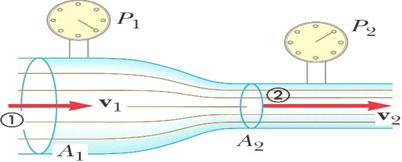
example to the left. The
mass per unit time was constant in either the wide part of the river or when
the river flowed through the gorge. (It was 40,000 kg / min) Since
m/Δt is constant m1/Δt = m2/Δt
and the equation simplified down to A1v1
= A2v2 |
||||||||||||||||||||||||
|
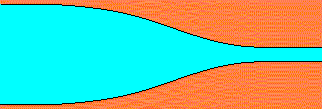
A wide river with a flow rate of 10,000 gallons per minute (gpm) suddenly narrows.
What occurs? ans: the water flows at a much faster velocity Most
everyone already knew this answer from watching TV, movies, or other personal
experience.
Why? The 10,000 gpm still must flow at the same rate to make it through
the gorge. If the 10,000 gpm doesn’t flow at 10,000 gpm,
it backs up and forms a lake behind the gorge. Just
for fun… the mass of 1 gallon of water is approximately 4 kg. So what is the mass of water flowing out of
the gorge? 10,000 gal/min (4 kg/gal) = 40,000 kg/min |
|||||||||||||||||||||||||
|
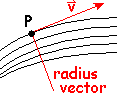
One
last note on a particle in Laminar flow. The
path taken by a fluid under steady flow is called a stream line (block lines), these form curves (parts of multiple circles). Thus the velocity vector is tangent to each
one of these stream lines. I’m showing
one velocity vector at point P. |
|
||||||||||||||||||||||||
|
Bernoulli’s
Equations |
|||||||||||||||||||||||||
|
Let’s
recall your high school chemistry class equation PV = nRT Its
already been established that pressure
is measured in N / m2; and volume is measured in m3 (
P ) ( V )
(N/m2) ( m3) Nm
à the units of Work and energy So
just from the units we expect Work = Δ P V |
Let’s
look at this from another view point Work
= F Δx Work
= F Δx (A / A) multiplying by 1 Work
= F/A * Δx(A) Work
= Δ P V …very similar to above. So
we can conclude that a change in pressure for a constant volume is the amount
of work done on a system. |
||||||||||||||||||||||||
|
|
|||||||||||||||||||||||||
|
So
what is h2? We
will solve this in class. |
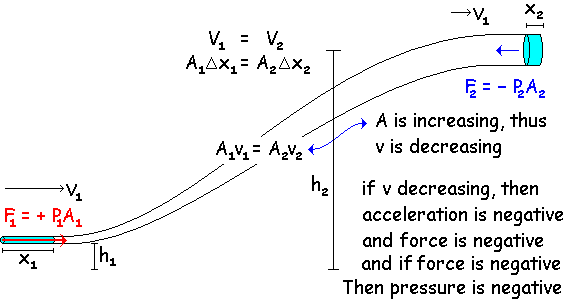
So if you change the
pressure, you do work Work = P1V +
(– P2V) & Work = ΔK But what if the pipe slopes
up or down. Gravity will also do work on
the system. Work = ΔK + ΔU P1V – P2V
= ½mv22 – ½mv12 + mgh2
– mgh1 P1V + ½mv12
+ mgh1 = P2V +
½mv22 + mgh2 So final equals initial…or no
changes…so PV + ½mv2 + mgh = constant Divide through by volume P + ½(m/V)v2 + (m/V)gh =
constant P + ½ρv2 + ρgh =
constant |
||||||||||||||||||||||||
|
A Venturi tube may be used as a fluid
flow meter. If the difference in
pressure is P1 – P2 = 21.0 kPa, find the fluid flow rate in cubic meters per second,
given that the radius of the outlet tube is 1.00 cm, the radius of the inlet
tube is 2.00 cm, and the fluid is gasoline (ρgas = 700 kg/m3).
|
|
P + ½ρv2 + ρgh =
constant Pin
+ ½ρvin2 = Pout + ½ρvout2 Ainvin = Aoutvout ; where Ain
= π(2)2; Aout =
π(1)2 4
vin = 1 vout Pin
- Pout + ½ρvin2 =
½ρ vout2 21,000 + ½ρvin2 =
½ρ(4vin)2 15vin2
= (2/ρ)
21,000 vin = 2 m/s |
|||||||||||||||||||||||
|
Other Apps
of Fluid Dynamics |
|||||||||||||||||||||||||
|
You
are responsible to review material in this section. The
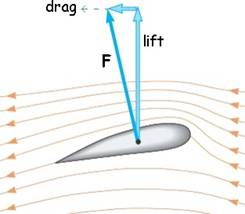
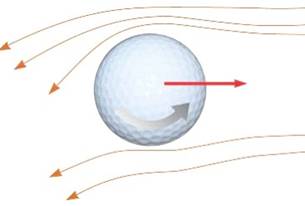
two main examples in this section are
lift on an airplane wing (and drag) And
a golf balls increase friction due to the spin…which in turn applied an
upward force on the golf ball causing it to travel farther.
|
|||||||||||||||||||||||||
|
Extra Sketches |
|||||||||||||||||||||||||
|
|
|||||||||||||||||||||||||
|
|
|
|
|
|
|
|
|
|
|
|
|
|
|
|
|
|
|
||||||||