|
Ch 20 – Wave Motion and
Traveling Waves |
||||||||||||||||||||||||||||||||||||||||
|
Propagation of a
Disturbance |
||||||||||||||||||||||||||||||||||||||||
|
All
mechanical waves require ·
source of disturbance
and ·
a disturbable medium that can
influence itself There
are two type of waves Transverse
Waves:
A traveling wave or pulse that causes the elements of the disturbed medium to
moved perpendicular to the direction of propagation. Longitudinal
Waves:
A traveling wave or pulse that causes the elements of the medium to move
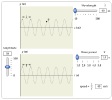
parallel to the direction of the propagation. Longnitudnal & Transverse Waves: OW-B-LT |
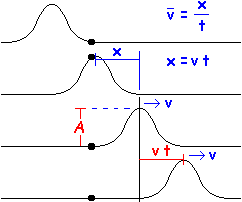
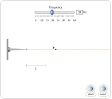
Point
element (the black point) below shows an object in the water where a wave
passes by. The object rises up then
goes back down as the wave passes. As
you can see below…the distance traveled by a wave from a point is Δx which equals vt. We
can say the distance traveled by a wave in a given about of time is, vt. So
the position of any wave is given by the starting position (x) and the
distance traveled after time (vt). Travels
to the right: y(x,t) = f(x – vt) Travels
to the left: y(x,t) = f(x + vt) |
|||||||||||||||||||||||||||||||||||||||
|
Earthquakes
are an example of both types of waves. Primary
(P) waves are the longitude waves which travel faster than the transverse or
Secondary (S) waves. The
longitudinal waves travel about 7.5 km/s near the surface and the transverse
waves travel near the surface through the earth at 4.5 km/s. |
|
|
||||||||||||||||||||||||||||||||||||||
|
|
||||||||||||||||||||||||||||||||||||||||
|
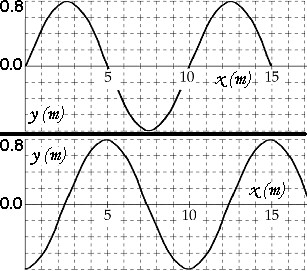
Example: Ocean waves with a crest-to-crest
distance of 10.0 m can be described by the wave function
y(x, t)
= (0.800 m) sin[0.628(x – vt)] where v = 1.20 m/s. (a) Sketch y(x, t) at t
= 0. (b) Sketch y(x, t)
at t = 2.00 s Note how the entire wave form has
shifted 2.40 m in the positive x direction in this time interval. |
|
|||||||||||||||||||||||||||||||||||||||
|
Sinusoidal Waves |
||||||||||||||||||||||||||||||||||||||||
|
A sinusoidal wave is
created by plotting sin θ versus θ. |
||||||||||||||||||||||||||||||||||||||||
|
Crest
(+
max amplitude) Trough
(-
max amplitude) Wavelength
(length
of complete wave, until start of repetition) frequency = 1/T measured
in hertz Amplitude = A Wave
# is k |
In
the form of y(x,
t) = A sin (a x) If
the wave is moving to the right then y(x,
t) = A sin [a (x – vt)] v
= λ / T k = 2π / λ ; ω = 2π / T v
= ω/k and
the wave function is generally expressed as y(x,
t) = A sin [kx
– ωt + φ] |
y(x,
t) = A sin (kx
– ωt) v
= dy/dt dy/dt = A(-ω) cos(kx – ωt) v = -ωAcos(kx
– ωt) a
= dv/dt dv/dt = A(-ω)(-ω)(-cos(kx – ωt)) a = -ω2Asin(kx – ωt) The
greatest that sine or cosine can be…is 1, thus vmax = ωA amax = ω2A |
||||||||||||||||||||||||||||||||||||||
|
Example A sinusoidal wave on a string is
described by y = (0.51 cm) sin(kx – wt) where k =
3.10 rad/cm and w = 9.30 rad/s. How far does a wave crest move in
10.0 s? Does it move in the (+) or (-) x
direction? |
y(x,
t) = A sin [
k x –
ω t + φ] y(x, t) = 0.51 sin [310 x
– 9.30 t] (3.1 rad/cm = 310 rad/m) |
|||||||||||||||||||||||||||||||||||||||
|
v
= ω / k v
= 9.3/310 v = 0.030 m/s |
vave =
∆x / ∆t 0.030
= ∆x / 10.0 ∆x = 0.300 meters (+x-dir) |
|||||||||||||||||||||||||||||||||||||||
|
The Speed of Waves on
Strings |
||||||||||||||||||||||||||||||||||||||||
|
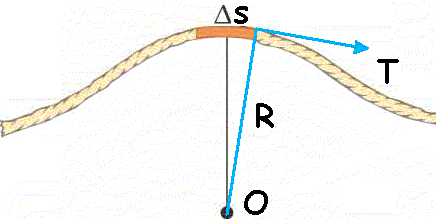
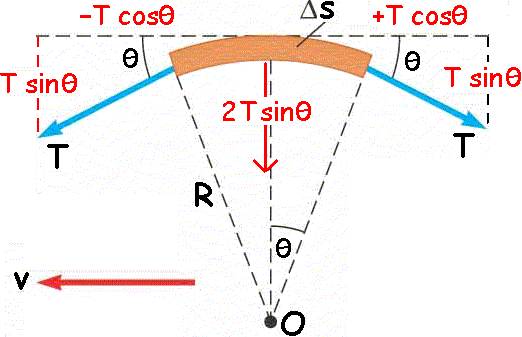
v2 = Ftension / μ; F = ma = m v2/r The
radial (centripetal) force is Tension(sinθ) Fr
= FT sinθ (by one side) The
rope is being pulled on two sides so total radial force is given by Fr = 2 FT sinθ If
θ is small (<10°) then sinθ = θ Fr = 2 FT θ 2
FT θ = (m) v2/r 2
FT θ = (2 μ R θ) v2/r FT =
( μ ) v2 v2 = FT
/ μ Mass
associated with Δs is μΔs
(where
μ is mass per unit length) m =
μ (Δs) Δs = 2(R θ) m =
μ (2 R θ) m = 2 μ R θ |
|
|
||||||||||||||||||||||||||||||||||||||
|
|
||||||||||||||||||||||||||||||||||||||||
|
Example A piano string having a mass per unit length 10.0 ´ 10–3 kg/m is under a tension of 1000
N. Find the speed of a wave traveling
on this string. |
v2
= FT /
μ v2
= 1000 / 0.010 v = 316 m/s |
|||||||||||||||||||||||||||||||||||||||
|
Reflection and Transmission |
||||||||||||||||||||||||||||||||||||||||
|
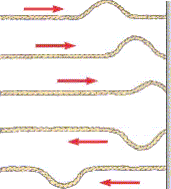
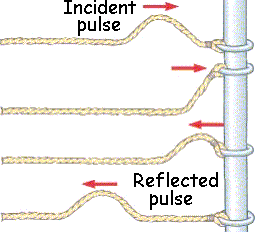
When
a rope fixed to an immoveable object reflects off the object, the wave
reflects off in the opposite direction, with the negative amplitude. |
|
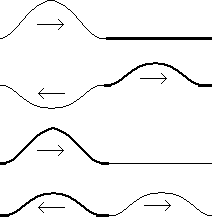
If
the wave continues to another medium, some of the energy will be transmitted
to the new different sized medium, and some of the energy will be reflected. The
total energy will remain the same. (15.3: T = ½kA2) |
|
|||||||||||||||||||||||||||||||||||||
|
|
Why in the case of the high density rope to low density rope is the
reflected wave not inverted? Similar
explanation as the rings…the low density (thin) rope resists change much less
than the high density rope. Thus the
low density rope accelerates up to the new Amplitude, then
the downward tension pulls the rope back down. For
the thin rope to the thick rope…the thick rope resists change similarly to
the rope fixed to the wall. |
|||||||||||||||||||||||||||||||||||||||
|
How
would the above picture be different if instead of being attached to the
wall, it was attached to a freely moving ring (free to move up and down with the same
amplitude as the wave)? |
Ans:
|
|||||||||||||||||||||||||||||||||||||||
|
|
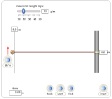
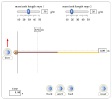
Demo: Waves on a Rope: OW-B-WR Demo:
Wave Machine with Rods: OW-B-WM |
|||||||||||||||||||||||||||||||||||||||
|
Rate of Energy Transfer
by Sinusoidal Waves on Strings |
||||||||||||||||||||||||||||||||||||||||
|
ΔK
= ½ m
v2 ΔK
= ½(μΔx)v2
μ is
mass per unit length v is the
transverse speed dK = ½ μ dx [ v2 ] dK = ½ μ dx [ω2A2
cos2(kx – ωt)] dK = ½ μ ω2A2 cos2(kx – ωt) dx @ t = 0 (ωt just shifts the phase, thus if we’re
attempting to find Total Energy a phase
shift is irrelevant) |
dK = ½ μ ω2A2 cos2(kx) dx ∫dK = ½ μ ω2A2 ∫cos2(kx) dx integrate by
parts K
= ½ μ ω2A2 [x/2+sin(2kx)/4k] from 0 to λ K = ¼ μ ω2A2 λ Using
similar derivation from above, we get our Potential energy function as U = ¼ μ ω2A2 λ |
So
our total energy is TE
= ¼ μ ω2A2 λ + ¼
μ ω2A2 λ TE = ½ μ ω2A2 λ P = Work / time Work = ΔK TE = ΔK for one full period P
= ΔK / T P
= ½ μ ω2A2 λ / T
v = f λ = λ/T P = ½ μ ω2A2 v |
||||||||||||||||||||||||||||||||||||||
|
Example A taut rope has a mass of 0.180 kg and a length of 3.60 m. What
power must be supplied to the rope in order to generate sinusoidal waves having an amplitude of 0.100 m and a wavelength of 0.500 m and traveling with a speed of 30.0 m/s? |
v
= f
λ 30.0 = f (0.500) f =60.0 Hz |
ω
= 2πf ω
= 2π(60) ω = 120π rad/s |
||||||||||||||||||||||||||||||||||||||
|
P
= ½ μ ω2 A2 v P
=½(0.18/3.6)
(120π)2 (0.100)2 30.0 P = 1070 Watts |
||||||||||||||||||||||||||||||||||||||||
|
The Linear Wave
Equations |
||||||||||||||||||||||||||||||||||||||||
|
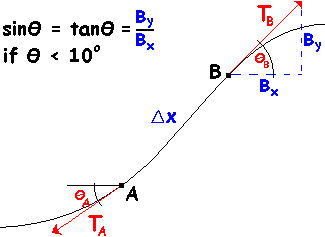
ΣFy
= FT sinθB
– FT sinθA
ΣFy
= FT
(∂y/∂xB) – FT (∂y/∂x A)
(eq 16.23) m ay = FT (∂y/∂xB)
– FT (∂y/∂x
A) (eq 16.24) m
(∂2y/∂t2) = FT (∂y/∂xB)
– FT (∂y/∂x
A) μΔx (∂2y/∂t2) = FT [∂y/∂x B
– ∂y/∂xA] (μ/
FT) ∂2y/∂t2 = [∂y/∂xB
– ∂y/∂xA]
/ Δx (eq 16.25) At this point we need to remember that at some point in time,
tension at B was or will be the same as the tension at A at the current time,
so that Tsin(θB
+ ωt) - TsinθA
= 0 at some time, t. |
|
|||||||||||||||||||||||||||||||||||||||
|
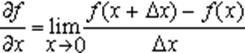
The
partial derivative of any function is Associate
f(x + Δx) with ∂y/∂xB (1st derivative of point B) and f(x) with
∂y/∂xA (1st derivative
of point A) à The derivative of a point is the slope (1st
derivative), and the definition of a partial derivative gives us the 2nd
derivative, thus ∂2y/∂x2 ß (μ/T)
∂2y/∂t2 =
∂2y/∂x2 This
is the linear wave equation for a string. y(x, t) = A sin (kx – ωt) (from 16.2) ∂2y/∂t2 = (FT /μ) ∂2y/∂x2 |
Notes
& explanations T
represents the tension which is a force, we should say FTension. ΣFy = TsinθB
– TsinθA (TB is going up…thus
positive) If θ is
small, θ < 10° we know (always
applicable at small amplitudes)
sin θ = tan
θ; & tan θ = y / x; And since our
infinitesimal displacements (sin θ = dy/dx) are changing with time (&
only concerned with components of “y” that are dependant on “x”) sin θ =
∂y/∂x |
|||||||||||||||||||||||||||||||||||||||
|
∂2y/∂t2 |
∂2y/∂x2 |
|||||||||||||||||||||||||||||||||||||||
|
y(x, t) = A sin (kx – ωt) ∂y/∂t = -ω A cos (kx – ωt)] ∂2y/∂t2
= -ω2
A sin (kx – ωt)] |
y(x, t) =
A sin (kx – ωt) ∂y /
∂x = k A cos (kx – ωt)] ∂2y/∂x2
= -k2 A sin (kx – ωt)] |
|||||||||||||||||||||||||||||||||||||||
|
à
à
à
à
à
à ∂2y/∂t2 = -ω2
A sin(kx – ωt)] = (sinθ)max
= (cosθ)max = 1 -ω2
A = ω2 / k2 = v2 = |
(FT /μ) ∂2y/∂x2 (FT /μ) -k2A sin(kx – ωt)] (FT /μ) -k2A FT / μ FT / μ |
|||||||||||||||||||||||||||||||||||||||
|
à
à
à
à
à
à ∂2y/∂t2
= ∂2y/∂x2
= ∂2y/∂x2
= |
(FT
/μ) ∂2y/∂x2 (μ/ FT) ∂2y/∂t2 (1/v2) ∂2y/∂t2 |
|||||||||||||||||||||||||||||||||||||||
|
|
|
|||||||||||||||||||||||||||||||||||||||
|
Example Show that the wave function y = ln[b(x – vt)] is
a solution to ∂2y/∂x2
= (1/v2)
∂2y/∂t2, where b is
a constant. |
y = ln[b(x
– vt)] ∂y/∂t = -bv
/ b(x-vt) ∂2y/∂t2 = -1(-bv)(bv) / b2(x-vt)2 ∂2y/∂t2 = v2
/ (x-vt)2 |
y = ln[b(x
– vt)] ∂y/∂x = -b / b(x-vt) ∂y/∂x = -1 / (x-vt) ∂2y/∂x2 = -1 /
(x-vt)2 |
||||||||||||||||||||||||||||||||||||||
|
(1/v2) ∂2y/∂t2 = ∂2y/∂x2 Yes, it satisfies the equation |
||||||||||||||||||||||||||||||||||||||||
|
Ch 20 continued – Sound
Waves |
||||||||||||||||||||||||||||||||||||||||
|
Speed of Sound Waves |
||||||||||||||||||||||||||||||||||||||||
|
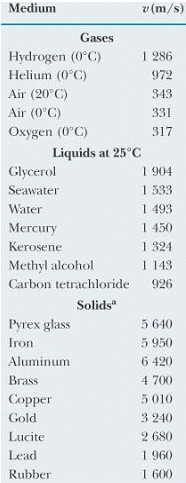
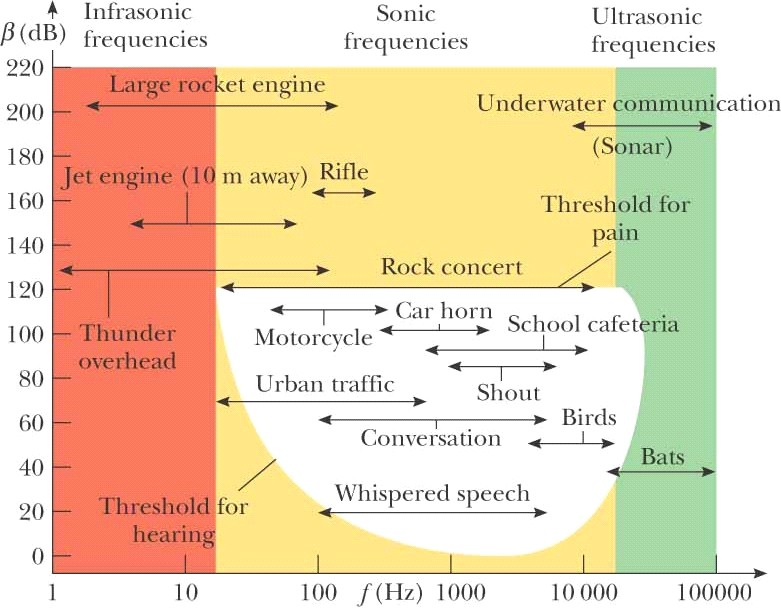
Type
of sound wave: à Audible à Infrasonic à Ultrasonic The
speed of sound is given below. The
first is the speed of sound in air.
The latter is the speed of sound in liquids and solids.
|
|
|||||||||||||||||||||||||||||||||||||||
|
Find vsound in mercury, with
a bulk modulus of about 2.80 ´ 1010
N/m2 and a density of 13600 kg/m3. |
|
|
||||||||||||||||||||||||||||||||||||||
|
Find vsound in an Aluminum
rod, which has a Young’s modulus of about 7.0 ´ 1010
N/m2 and a density of 2700 kg/m3. |
|
|||||||||||||||||||||||||||||||||||||||
|
Demo:
Flaming Standing Waves: OW-D-SF |
||||||||||||||||||||||||||||||||||||||||
|
Periodic Sound Waves |
||||||||||||||||||||||||||||||||||||||||
|
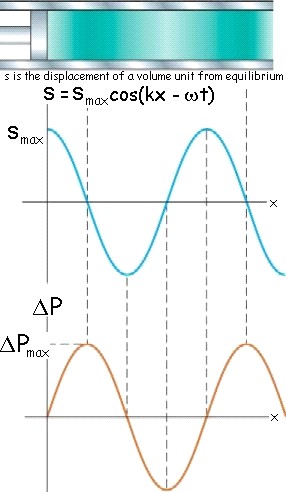
The
harmonic position function is s (x, t) = smax cos (kx – ωt) smax à maximum position from the
equilibrium position or displacement amplitude of the wave Note: some student still believe k is the spring
constant, but no…it’s the wave number Variation
in gas pressure, ΔP, is
also periodic |
To
the right…when x = 0, we are at smax and
pressure density is at equilibrium, so DP = 0
|
|
||||||||||||||||||||||||||||||||||||||
|
ΔP = ΔPmax sin (kx – ωt) ΔPmax is the pressure amplitude ΔPmax = ρvωsmax |
||||||||||||||||||||||||||||||||||||||||
|
P = F/A = ma/A = m
(Dv/t) / A
P = r V
(Dv/t)
/ A P = r(A*smax)(Dv/t) / A P = r smax Dv/t P = r smax Dv w |
|
|||||||||||||||||||||||||||||||||||||||
|
An ultrasonic tape measure uses frequencies above 20 MHz to
determine dimensions of structures such as buildings. It does this by emitting a pulse of
ultrasound into air and then measuring the time for an echo to return from a
reflecting surface whose distance away is to be measured. The distance is
displayed as a digital read-out. For a
tape measure that emits a pulse of ultrasound with a frequency of 22.0 MHz,
(a) what is the distance to an object from which the echo pulse returns after
24.0 ms when the air temperature is 26oC? (b) What should be the
duration of the emitted pulse if it is to include 10 cycles of the ultrasonic
wave? (c) What is the spatial length
of such a pulse? |
||||||||||||||||||||||||||||||||||||||||
|
vsound = 331(1+Tc/273)1/2 vsound = 331(1+26/273)1/2
vsound = 346 m/s (a) vave
= Δx / Δt; d = 2x (echo) 346
= 2d / 0.024 d = 4.15 meters |
vave = Δx
/ Δt vave = 10λ / Δt |
v = f λ v
= 22x106 λ |
(c) L
= 10 ( λ ) L
= 10 (v/f) L
= 10 (346/22x106) L = 0.157 mm |
|||||||||||||||||||||||||||||||||||||
|
(b) 10λ / Δt = 22x106 λ Δt = 4.54 x 10⁻⁷
sec |
||||||||||||||||||||||||||||||||||||||||
|
Intensity of
Periodic Sound Waves |
||||||||||||||||||||||||||||||||||||||||
|
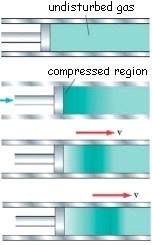
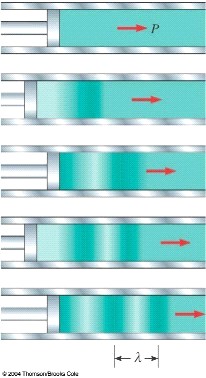
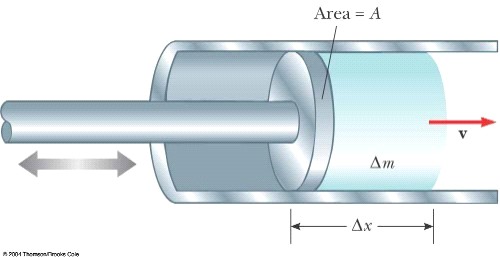
The piston transmits energy to the
element of air in the tube. This
energy is propagated away from the piston by the sound wave. To determine the total kinetic energy in
one wavelength, we must determine the velocity v = dx/dt but position,
s(x,t) = smax cos(kx – ωt); is dependant
upon x & t, so we must take the partial derivative with respect to time. |
|
|||||||||||||||||||||||||||||||||||||||
|
v(x,t) =
∂ s(x,t) / ∂t v(x,t) =
∂ smax cos(kx – ωt) / ∂t v(x,t) =
-ω smaxsin(kx
- ωt) ΔK = Δ½ mv2 ΔK = ½ Δm (ω smax)2sin2(kx - ωt) If t is constant (at a given instant
in time) ΔK = ½ ΔρV(ω smax)2sin2(kx) ΔK = ½ΔρAΔx (ω smax)2sin2(kx) dK = ½ρA (ω smax)2
∫sin2(kx) dx
from 0 to λ K λ = ¼ ρA(ωsmax)2λ As with gravitation
potential energy, the total potential energy for one wavelength is the same
as the kinetic and the total mechanical energy is E λ = K
λ
+U
λ
= ½ ρA(ωsmax)2λ And the rate of energy
transfer is the power of the wave which is the energy that passes by a given
point during one period of oscillation P = Work/time P = E λ / T P = ½ ρA(ωsmax)2 (λ / T) P = ½ ρA(ωsmax)2 (v) P = ½ ρAv(ωsmax)2 |
How would we define
intensity? Suppose you take a large
magnifying glass, go outside on a nice sunny day near June 20th
and play with ants. Would agree the
intensity of the light rays that strike the ants is intense? The intensity I of a
wave is defined as the power per unit area, I = Power / A = Power / 4πr2 This is the rate at which
the energy being transported by the wave transfers through a spherical shell
unit of radius, r, and area, A, perpendicular to the direction of the
wave. The intensity decreases in
proportion to the square of the distance from the source. I = Power / A I = ½ ρAv(ωsmax)2
/ A I = ½ ρv(ωsmax)2
In terms of pressure
amplitude (ΔPmax
= ρvωsmax) I = ΔP2 /
2ρv A logarithmic scale is best used to
determine the intensity level, β = 10 log (I / Io) I0, 1.00 x 10⁻¹²
W/ m2, is the reference intensity also the threshold
of hearing at 1000 Hz
|
|||||||||||||||||||||||||||||||||||||||
|
Example What is the sound level that
corresponds to an intensity of 10 x 10-7 W/m2
? |
β = 10 log ( I /
Io ) β = 10 log (10 x 10-7 W/m2 / 1.0 x 10⁻¹²
W/m2) β = 10 log 106
Rule of thumb: A doubling in the loudness is β = 60 dB approximately
equivalent to an increase of 3 dB |
|||||||||||||||||||||||||||||||||||||||
|
|
||||||||||||||||||||||||||||||||||||||||
|
Example
A
loudspeaker is placed between two observers who are 30 m apart, along the
line connecting them. If one observer records a sound level of 60.0 dB, and
the other records a sound level of 66.0 dB, how far is the speaker from each
observer? Derive
the equation β2 – β1 = 20 log (r1 / r2) from β = 10 log (I / I0) |
β2 – β1 = 20 log (r1 / r2) 66
– 60 = 20 log (r1 / r2) 0.3
= log (r1 / r2) 2
r2 = r1 10 and 20 meters β1 = 10 log (I1 / I0); β2 = 10 log (I2 / I0) |
β2 - β1 = 10 log(I2/I0)
- 10 log(I1/I0) β2 - β1 = 10 [log (I2/I0)
- log(I1/I0)] β2 - β1 = 10 log [ (I2
/ I0) / (I1 / I0)] β2 - β1 = 10 log ( I2 /
I1 ) P2 = P1 β2 - β1 = 10 log (P2/4πr22 / P1/4πr12) β2 - β1 = 10 log ( r1
/ r2) 2 β2 - β1 = 20 log ( r1
/ r2) |
||||||||||||||||||||||||||||||||||||||
|
The Doppler Effect |
||||||||||||||||||||||||||||||||||||||||
|
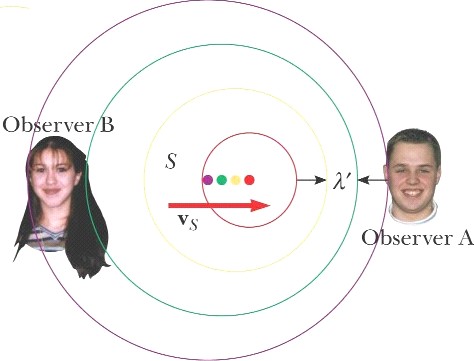
The Doppler effect
is the apparent change in frequency (or wavelength) that occurs (because of motion of the source or observer) of a wave. When the relative
speed of the source and observer is higher than the speed of the wave,
the frequency appears to increase (if lower, then freq appears to decrease) We also call an appearance of
increased frequency, a blue shift or blue-shifted…and decreased frequency, a
red shift. Why? ß low energy, freq high energy, high freq à Radio micro
IR R OYGB IV UV
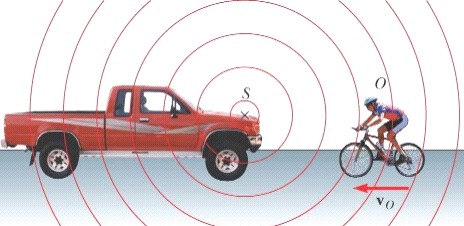
X γ A convenient graphical representation is to use
circular arcs concentric to the source which the fronts of which are called wave
fronts When the observer moves toward the source, the
speed of the waves relative to the observer is |
Actual wavelength doesn’t change so f’ / v’ = f / v f’ = f
(v’/ v) |
|||||||||||||||||||||||||||||||||||||||
|
Toward: v ’ = v + vo vo
is the observer speed The frequency heard by the observer appears
higher when the observer approaches the source f’ = f
( v’
) / v f’
= f (v + vo)/
v |
Away: v ’ = v - vo vo
is the observer speed The frequency heard by the observer appears lower
when the observer moves away from the source f’ = f
( v’
) / v f’
= f (v - vo)/
v |
|||||||||||||||||||||||||||||||||||||||
|
Example At the Winter Olympics, an athlete rides her luge
down the track while a bell just above the wall of the chute rings
continuously. When her sled passes the
bell, she hears the frequency of the bell fall by the musical interval called
a minor third. That is, the frequency
she hears drops to five sixths of its original value. (a) Find the speed of sound in air at the
ambient temperature, 10.0°C. (b) Find the speed of the athlete. |
(a) v = 331 + 0.6*TC v = 331 + 0.6(-10); v = 325 m/s (b) f’’
/ f’ = 5/6 |
|||||||||||||||||||||||||||||||||||||||
|
Approaching bell f’ = f (v
+ vo)/
v |
Leaving bell f’’ = f (v - vo)/ v |
|||||||||||||||||||||||||||||||||||||||
|
5 / 6 = f (v
- vo)/ v / f (v
+ vo)/ v 5 / 6 = (v - vo)
/ (v + vo) 5(v
+ vo)
= 6 (v - vo) vo = 29.5 m/s |
||||||||||||||||||||||||||||||||||||||||
|
|
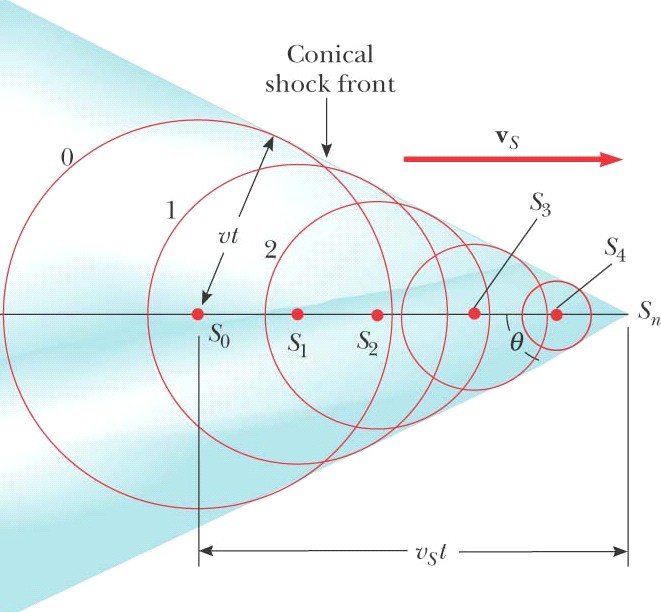
The
speed of the source can exceed the speed of the wave. The
envelope of these wave fronts is a cone whose apex half-angle is given by sin θ = vt / vsourcet θ = sin-1(v / vsource) (θ is the Mach angle) The ratio vsource
/ v is referred to as the Mach number |
|||||||||||||||||||||||||||||||||||||||
|
|
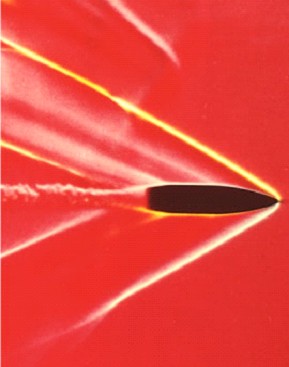
The conical wave front produced when vsource > v is known as a supersonic “shock
wave” The shock wave carries a great deal of energy
concentrated on the surface of the cone There are correspondingly great pressure
variations |
|||||||||||||||||||||||||||||||||||||||
|
Digital Sound Recording |
||||||||||||||||||||||||||||||||||||||||
|
These two last sections are directly from the
publishers power point presentations n Encoding sound waveforms
began as variations in depth of a continuous groove cut in tin foil wrapped
around a cylinder n Sound was then recorded
on cardboard cylinders coated with wax n Next were disks made of
shellac and clay n In 1948, plastic
phonograph disks were introduced n
Disadvantages of phonograph records n
The recording quality diminishes with each playing as small
pieces of the plastic are worn away or broken by the needle n
The natural irregularities in the plastic produce noise n
The noise is particularly noticeable during quiet periods
with high frequencies playing n
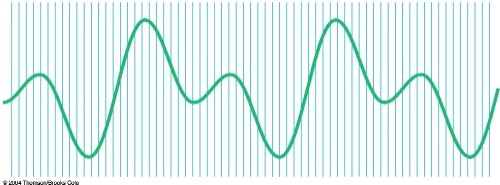
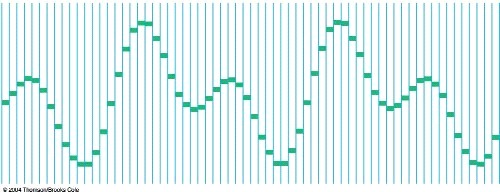
In digital recording of sound, information is converted to
binary code n
The waveforms of the sound are sampled n
During the sampling, the pressure of the wave is sampled and
converted into a voltage n
The graph below shows the sampling process
n
These voltage measurements are then converted to binary
numbers (1’s and 0’s) n
Binary numbers are expressed in base 2 n
Generally, the voltages are recorded in 16-bit “words” n
Each bit is a 1 or a 0
n
The strings of ones and zeroes are recorded on the surface of
the compact disc n
There is a laser playback system that detects lands
and pits n
Lands are the untouched regions n
They are highly reflective n
Pits are areas burned into the surface n
They scatter light instead of reflecting it n
The binary numbers from the CD are converted back into
voltages n
The waveform is reconstructed n
Advantages n
High fidelity of the sound n
There is no mechanical wear on the disc n
The information is extracted optically |
||||||||||||||||||||||||||||||||||||||||
|
|
||||||||||||||||||||||||||||||||||||||||
|
Motion Picture Sound |
||||||||||||||||||||||||||||||||||||||||
|
n
Early movies recorded sound on phonograph records n
They were synchronized with the action on the screen n
Then a variable-area optical soundtrack was
introduced n
The sound was recorded on an optical track on the edge of
the film n
The width of the track varied according to the sound wave n
A photocell detecting light passing through the track
converted the varying light intensity to a sound wave n
Problems n
Dirt or fingerprints on the track can cause fluctuations and
loss of fidelity n
Cinema Digital Sound (CDS) n
First used in 1990 n
No backup n
No longer used n
Introduced the use of 5.1 channels of sound: n
Left, Center, Right, Right Surround, Left Surround and Low
Frequency Effects (LFE) n
Dolby Digital n
5.1 channels stored between sprocket holes on the film n
Has an analog backup n
First used in 1992 n
Digital Theater Sound (DTS) n
5.1 channels stored on a separate CD n
Synchronized to the film by time codes n
Has an analog backup n
First used in 1993 n
Sony Dynamic Digital Sound (SDDS) n
Eight full channels n
Optically stored outside the sprocket holes on both sides of
the film n
Both sides serve as a redundancy n
Analog optical backup n
The extra channels are a full channel LFE plus left center
and right center behind the screen |
||||||||||||||||||||||||||||||||||||||||
|
This problem represents a possible (but not recommended) way to
code instantaneous pressures in a sound wave into 16-bit digital words. Example 17.2 showed that the pressure
amplitude of a 120-dB sound is 28.7 N/m2. Let this pressure variation be represented
by the digital code 65,536. Let zero
pressure variation be represented on the recording by the digital word 0. Let other intermediate pressures be
represented by digital words of intermediate size, in direct proportion to
the pressure. (a) What digital word would represent the maximum pressure in a
40 dB sound? (b) Explain why this scheme works poorly
for soft sounds. (c) Explain
how this coding scheme would clip off half of the waveform of any sound,
ignoring the actual shape of the wave and turning it into a string of
zeros. By introducing sharp corners
into every recorded waveform, this coding scheme would make everything sound
like a buzzer or a kazoo. |
||||||||||||||||||||||||||||||||||||||||
|
For a 40-dB sound, β = 10 log (I / I0) 40 = 10log(I/10-12) I = 10-8 W/m2 ΔPmax2 = 2
ρ v I ΔPmax2 = 2(1.2)343(10-8) ΔPmax = 2.87 x 10⁻³ N/m2 (a) Code = (2.87 x 10⁻³/
28.7)*65536 = 6.5536 Which is a digital word of 7 |
(b) For
sounds of 40 dB or softer, too few digital words are available to represent
the wave form with good fidelity. (c) In a sound wave ΔP is negative half
of the time but this coding scheme has no words available for negative pressure
variations. |
|||||||||||||||||||||||||||||||||||||||