CHAPTER 9 Air Pollution
Part 1 Questions and Problems
1. What is the total force in pounds on the top surface of a box that has been evacuated (perfect vacuum inside), if the top surface is 10inches wide by 20inches long? At sea level? At 50,000ft altitude?
2. Bonus Under normal conditions what is the temperature at the top of a 20,000 ft mountain if it is 70°F at sea level?
3. Bonus Describe the basic differences between the London smog problems in 1952 and the Los Angeles type smog that occurs almost daily.
4. Bonus What are the ways in which sulfur dioxide emissions from coal-burning power plants can be reduced?’
5. As the result of a thermal inversion the prevailing air temperature profile increases 1°C/100m above the ground level. To what maximum height will polluted air rise if it is released at ground level 15°C warmer than the atmosphere? The adiabatic lapse rate is −0.65°C/100m.
6. How many molecules are there in 1m3 of air at standard temperature and pressure?
Part 1 Multiple Choice Questions
1. The adiabatic lapse rate is −1°C/100 meters and the existing temperature profile is −1.5°C/100meters. Under such conditions, which is true?
a. It is a condition of great stability and a thermal inversion will surely result.
b. It is a condition of great stability and thermal inversions will not result.
c. It is an unstable condition conducive to clean air and no thermal inversions.
d. It is a condition of stability and one can expect some thermal inversions.
|
2. Due to a high pressure subsidence a thermal inversion layer is formed above the ground as shown in the following graph. The ALR is −0.65°C/100m. To what height above the ground will polluted air rise if it is released at ground level at a temperature 1.6°C warmer than its surroundings? a. 104m b. 40m c. 200m d. 250m e. 260m f. 280m g. 300m h. ≥300m
|
|
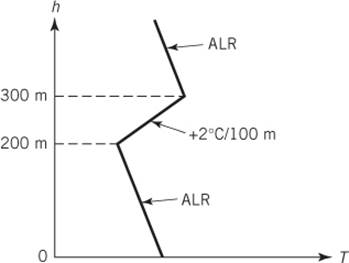
3. Use the same information in problem 2, except polluted air is released at ground level at a temperature of 5°C warmer than surroundings.
a. 104m
b. 40m
c. 200m
d. 250m
e. 260m
f. 280m
g. 300m
h. ≥300m
4. Carbon monoxide is dangerous to human health because _____.
a. suffocation occurs because of its great affinity for hemoglobin in the blood
b. the greenhouse effect will warm up the earth to the point where life will be affected.
c. it will reside in the lungs and induce cancer
d. it is an important ingredient of photochemical smog
5. If you are exposed to an atmosphere containing 100ppm of CO for 10 hours, what will result?
a. death
b. no apparent symptoms
c. coma or violent sickness
d. headache and reduced mental acuity
6. The National Ambient Air Quality Standard for NO2 is 0.05ppm. This corresponds to about _______ μg/m3. Nitrogen has an atomic mass of 14; oxygen has atomic mass of 16.
a. 100
b. 204
c. 160
d. 260
e. 365
7. The two emissions from coal-burning power plants most important to human health and air pollution are _____.
a. CO and SO2
b. NOx and particulates
c. SO2 and particulates
d. CO and NOx
e. CO2 and particulates
f. HC and NOx
g. SO2 and NOx
h. radioactivity and SO2
8. The most environmentally harmful emissions from automobiles are ________.
a. CO, SO2, and particulates
b. hydrocarbons, CO2, and SO2
c. hydrocarbons, CO, and NOx
d. CO, particulates, and NOx
e. CO2, SO2, and NOx
f. CO, SO2, and NOx
g. CO, O3, and NOx
h. hydrocarbons, particulates, and CO
9. Pick the set of answers which best characterizes the major fuel, time of occurrence, principal constituents, and principal effect of photochemical (Los Angeles-type) smog:
a. petroleum, early morning, (CO, SO2), bronchial irritation
b. petroleum, midday, (O3, NO, NO2, CO), eye irritation
c. coal, midday, (O3, NO, NO2, CO), eye irritation
d. petroleum, early morning, (O3, NO, NO2, CO), eye irritation
CHAPTER 9 Air Pollution
Questions and Problems Part 2
7. Bonus A concentration of 1ppm of NO corresponds to how many μg/m3? The atomic weight of nitrogen (N) is 14 and that of oxygen (O) is 16. How many molecules of NO at 1ppm are there in 1m3 of air?
8. The primary standard for SO2 in the atmosphere is 365μg/m3 averaged over a 24-hour period. How many parts per million by number of molecules is this? What is the mass of 1ppm of SO2 in one cubic meter of air?
9. Bonus In the year 2020, it is conceivable that 20gigawatts of electricity could be continuously generated in a single western state by coal-burning power plants.
a. At 38% efficiency for generating the electric power, how many tons of coal would be burned per year?
b. If the sulfur content of the coal averages 1%, how many tons of SO2 would be released per year?
c. If a standard of 0.1 pounds of particulates per million Btu is adhered to, how many tons of particulates would be released per year?
d. How many tons of CO2 would be released per year, assuming that the coal is 100% carbon?
10. Bonus In problem 9b, assume that the correct answer is 1.18×10⁶ tons of SO2 released per year. If a thermal inversion persists for a 24-hour period over the whole state and the released SO2 can rise no higher than 1000m; what concentration of SO2 (μg/m3) will be present in the air? Assume that the state is 500km×500km in area. Will the concentration of SO2 be above the 24-hour standard?
11. Bonus How many pounds of SO2 could be released if 1ton of coal is burned under Phase I of the 1990 Clean Air Act Amendments? Phase II? Assume 2.7×10⁷ Btu/ton for the coal.
12. If the concentration of hydrogen ions (microequivalents per liter) is 300 for a lake in which the pH is 3.5, what is the hydrogen ion concentration when the pH is 4.5?
Multiple Choice Questions Part 2
10. Pick the set of answers which best characterize the major fuel, time of occurrence, (principal constituents), and principal effect of London-type smog:
a. coal and petroleum, late evening, (particulates, CO, sulfur compounds), eye irritation
b. coal and petroleum, early morning, (particulates, CO, sulfur compounds), bronchial irritation
c. natural gas, midday, (O3, NO, CO), bronchial irritation
d. natural gas, early morning, (SO2, CO, NO2), eye irritation
11. The purpose of an automobile's catalytic converter is to ______ .
a. decompose and oxidize pollutants
b. filter out pollutants
c. condense pollutants
d. recycle pollutants
e. trap pollutants
12. The primary source of man-made SO2 is _______, and its basic harm to people, animals, vegetation, and material is through the formation of _______.
a. gasoline burning, HNO3
b. hot springs and geothermal power, H2SO4
c. coal burning, H2SO4
d. coal burning, hydrocarbons
13. If there are 0.28 ppm of SO2 in the air at STP, how many SO2 molecules are there in 1m3? The atomic weight of sulfur is 32; that of oxygen is 16.
a. 0.75×10¹⁸
b. 1.50×10⁹
c. 7.52×10¹⁵
d. 3.01×10²⁰
e. 1.68×10²⁰
f. 7.52×10¹⁸
g. 6.02×10²³
h. 3.01×10¹⁹
14. The pH of normal rain is _______; it contains _______.
a. 4.5, H2SO4
b. 7.0, no acid
c. 5.6, carbonic acid
d. 7.0, carbonic acid
e. 6.5, HNO3
f. 7.5, H2SO4