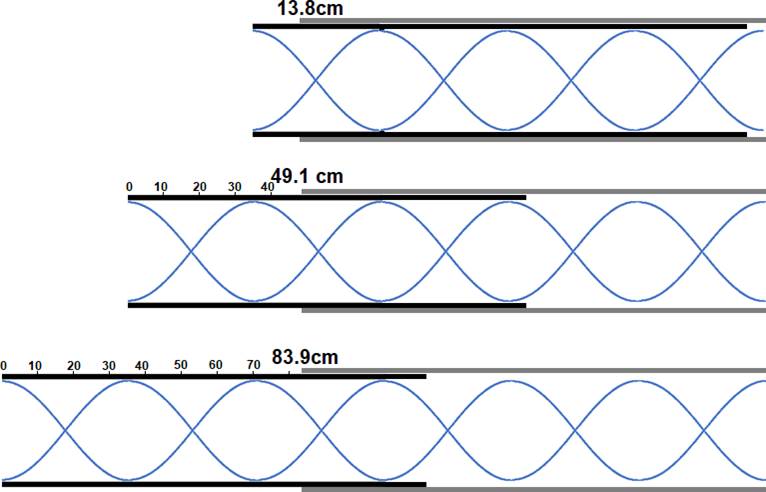
Analogy of Sound Waves with a jump rope
(standing waves)
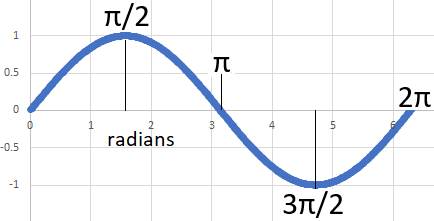
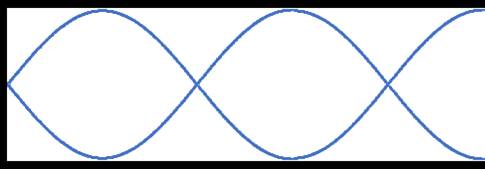
Take a jump rope. Raise and lower the end quickly.
The resulting pattern appears as a sign
wave.
Below appears to be a full wave or 2 pi
radians.
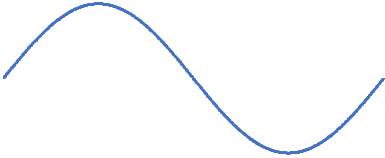 or
or 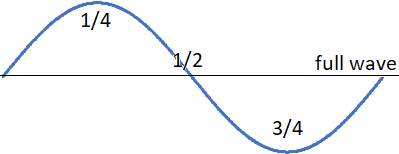
|
Now tie the end of the jump rope to an
opposite point across the room, and continue raising and lowering the end
quickly, at a constant frequency. |
|
Not just any freq,
adjust the freq so that a standing wave appears. |

Question:
If your friend placed
his/her finger at the point that appears to be a point of no movement the standing
wave is not interfered.
Why? It’s actually a
point of no movement.
What if your friend touches
anywhere else?
Ans: The standing wave is destroyed.
Now if you want to mathematically
model pressure (sound) waves, the above standing wave is analogous
Sound Waves
Resonance
in an Air Column
If you have a double opened
tube (most wind instruments), the mathematical pressure wave appears like this.
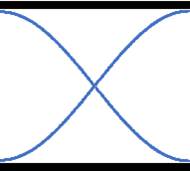 or
or
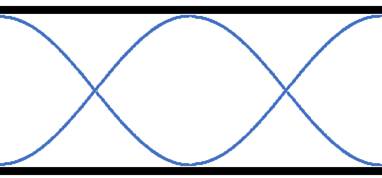
Do you see a pattern yet?
For an instrument closed at
one end (open at other
end)
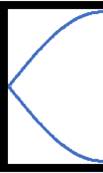 or
or
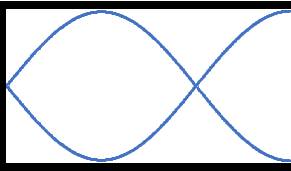 or
or
You should see
a similar pattern
For every
resonance that occurs beyond the first resonance (or fundamental freq), the next resonance occurs at half a
wavelength, λ / 2, beyond the first.



This is an example of the
larger outer tube with the slight smaller inner tube that allows us to expand
the system.