PHY Pre-Lab Analog Galvanometer Name:
|
By placing a
resistor in parallel or series a galvanometer is creates an ammeter or voltmeter. Hint
for below…if your voltmeter or ammeter changes the circuit appreciably, your
values obtained from the meter will have appreciable error. |
|||||
|
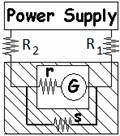
Ammeter 1. The resistance added to
a galvanometer is a. high b. low c. no extra (Figure 3 in lab manual) 2. If resistance is added,
where? a. Series with the part
being measured b. Parallel with the part
being measured c. Series with galvanometer d. Parallel with
galvanometer |
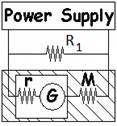
Voltmeter 1b The resistance added to a galvanometer is a.
high b. low c.
no extra (Figure 2 in lab manual) 2b If resistance is added, where?
|
||||
|
3. When used as an ammeter,
if the shunt resistance is ___
than the internal resistance of the galvanometer, the
majority of the current will travel through the galvanometer. a. lower b. higher c. unmatched |
|
||||
|
5. What should be the
approximate current draw of the shunt resistance? a. 10 to 15 % b. 0.1 to 5 % c. 95 to 99.9 % d. 85 to 90 % |
Figure
3 |
6. What is
the voltage drop across “M” compared to the galvanometer? a. 0.1 to 5 % b. 95 to 99.9 % c. 85 to 90 % d. 10 to 15 % |
Figure
2 |
||
|
Bonus: What is the current draw of R1 (% of total)? |
|||||
|
Below values were obtained from an actual lab; please consult the manual procedures if uncertain how to proceed. |
|||||
|
7. Calculate Ig = V/(10000Ω
+ r), where V = 5V and r ≈ 63 Ω |
8. Calculate M = (V / Ig) – r, for a full scale deflection of 3 Volts. |
|
|||