PHY1220/1520 Pre-Lab The Oscilloscope Name:
|
Example Scales for an oscilloscope |
|
|||
|
Voltage |
Time |
|||
|
Smallest |
Largest |
Smallest |
Largest |
|
|
50 mV / division |
5 V / division |
20 ms / division |
1 s / division |
|
|
If a calibration knob is not calibrated (rotated fully clockwise) the displayed value includes a blinking greater than symbol. i.e. > 1 V (more than 1 volts/division, but less than 2 V/div) |
||||
|
1) Typically, the horizontal scale represents time and the vertical scale represents voltage; if not calibrated the scale values displayed on the screen compared to true values will be too a) small b) large c) correct (calibration is only for phase angle.) d) sometimes too small and sometimes too large depending on the axes. e) none of the above
|
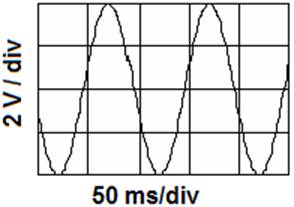
Definitions Period: time required for a complete repetition; (count the horizontal blocks and multiply by the time base in ms/div)
Peak to peak voltage: The voltage from the trough to the crest; (count the vertical blocks and multiply by volts per division) |
|||
|
2) Calculate the peak-to-peak voltage for the above figure. |
3) Calculate the period (SI) of the above figure. |
|||
|
4) Please review your lab manual and calculate the root mean square voltage for the above figure. |
5) If your input voltage is 2 Volts with an output voltage of 5 Volts this transformer is/has a a) Step-up transformer b) Step-down transformer c) Output to input ratio of 0.4 d) None of the above |
|||
|
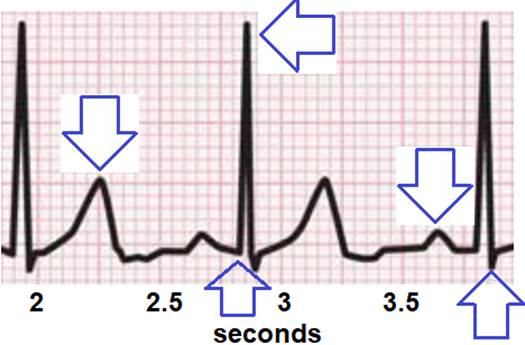
6) 1220 ONLY Label the following: P, T, S, Q, or R
P à P Wave, T à T Wave, S à S segment Q à Q segment, R à R segment
In the lab you will be asked to determine the time of the QRS complex, and many others
|
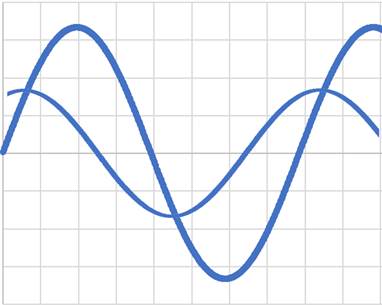
7) 1520 ONLY Calculate the inductance, L, given the following two wave input pattern, with a frequency generator at 1000 Hz, and a resistor of 270 Ohms. Eq 6: tan φ = 2πf L / R
|
|||