PHY Pre-Lab Response of Circuit Elements Name
|
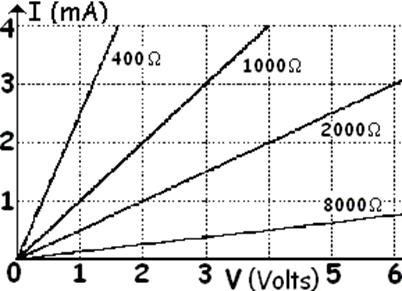
1. (½) Each different line in the graph to the right represents? a. a fixed resistor b. tungsten filament at 1 Hz c. a diode in either direction d. a conductor, standard copper wires. |
|
||||
|
Ohm’s law V = IR or I = (1/R) V |
y = m x + b I = (1/R) V + 0 |
Figure 1 à à Current (mA) vs Voltage (V) |
|||
|
If a part of a graph has a changing slope, that part of the graph is considered to be (a) dynamic (b) static |
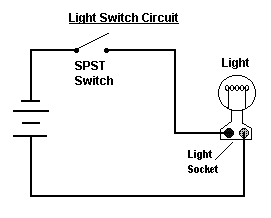
The wire in circuit after the switch is “thrown” is (a) hot or heating up. (b) It remains cold, electrical current doesn’t heat wires. |
||||
|
y = m x + b V = R I + 0 |
|
||||
|
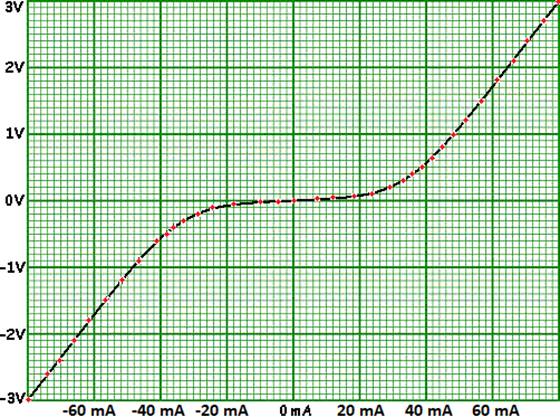
Figure 2 à à Frequency response line of a Tungsten filament Volts vs Current
2. (½) Why is this a curved line? a. The voltage varies when current changes b. The current varies when voltage changes c. The resistance changes as voltage varies d. All of the above
In your lab, you must use either French_curve or hand drawn smooth fit line, as shown to the right |
|||||
|
Part B: Light Bulb, draw Tangent Lines and calculate slope to determine static & dynamic (also part A) resistances. |
|||||
|
3. (½) A high resistance that changes with voltage generally corresponds with a a. cold static resistance b. hot static resistance c. hot dynamic resistance d. small slope e. cold dynamic resistance
|
4. (1) Approximately (within 10%) what is the cold static resistance? a. 106 Ω Tangent Line Example b. 63 Ω c. 8.0 Ω d. 5.2 mΩ e. 600 mΩ f. 3.6 Ω |
||||
|
5. (¼) At 0.1 to 0.3 Volts, the slope corresponds with a. hot static resistance b. hot dynamic resistance c. cold static resistance d. cold dynamic resistance |
6. (1) Approximately, what is the maximum hot resistance a. 63 Ω b. 8.0 Ω c. 5.2 mΩ d. 600 mΩ e. 3.6 Ω f. 106 Ω
|
||||
|
7. (¼) At the lower left hand corner of the oscilloscope the slope represents a. smaller dynamic resistance b. higher dynamic resistance c. cold static resistance d. low static resistance e. hot static resistance |
8. (1) Approximately, what is the cold dynamic resistance a. 63 Ω b. 8.0 Ω c. 5.2 mΩ d. 600 mΩ e. 3.6 Ω f. 106 Ω |
||||