Ray Tracing Pre-Lab Name:
|
Snell’s Law allows the calculation of the refraction angle of a light beam entering a different medium, i.e. air to a glass lens.
|
Not to scale
Note: ALL angles are with respect the drawn normal line. You always must draw a normal at the point of intersection
|
|||
|
n sin θ = n2 sin θ2
|
||||
|
n is index of refraction of free space n = 1.00 |
n2 is index of refraction for the glass lens n2 = 1.5 |
|||
|
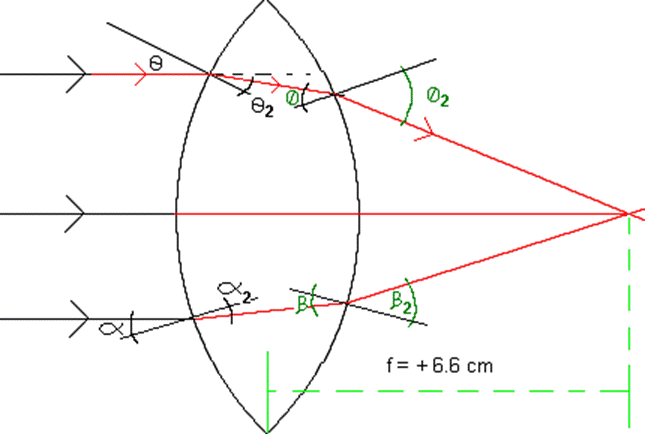
To the right is an example of a ray tracing implementing Snell’s law to calculate the refraction of the rays from air to glass, then glass to air of a double convex lens |
||||
|
air to glass n sin θ = n2 sin θ2 1*sin28° = 1.52 sin θ2 θ2 = 18.0° |
glass to air n sin φ = n2 sin φ2 1.52*sin31° = 1 sin φ 2 φ2 = 51.5° |
|||
|
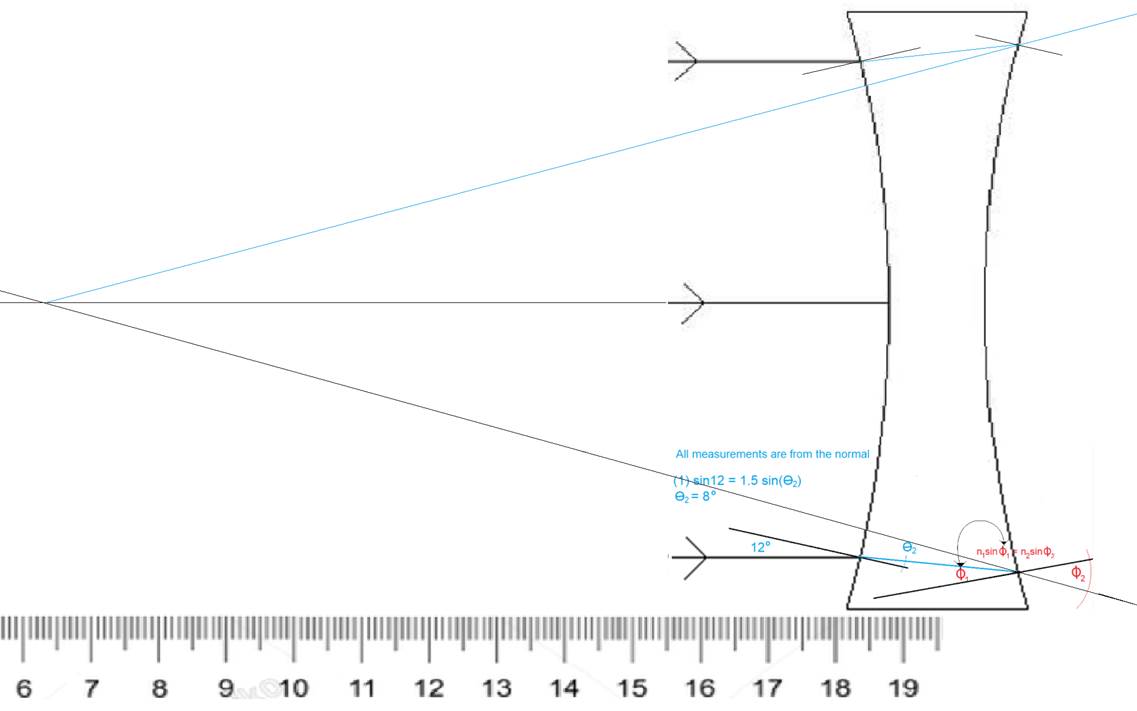
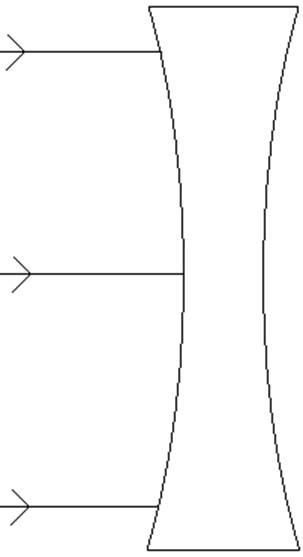
Please complete the ray trace for the below double concave lens. |
||||
|
Hint: you will have to “back” trace to find the focal length. https://www.cpp-csupomona.in/12xx/notes/122ch26.htm, section 26.6 |
Is the focal length positive or negative?
What is the focal length? |
|||
|
If you don’t have access to a protractor to measure your angles, estimate using trig or any other method you prefer. |
|
|||
|
|
||||
Beyond Ray Tracing: lenses and images.
In lenses, any image that appears on the opposite side of the lens is REAL and conversely any image that appears on the same side of the lens as the incoming light rays is VIRTUAL.
|
Real, with positive focal lengths
|
Virtual, with negative focal lengths
|
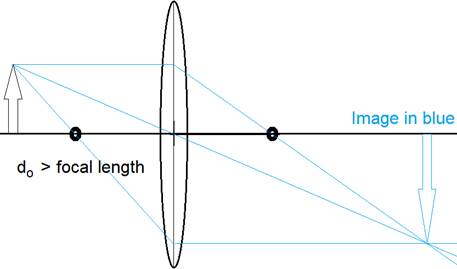
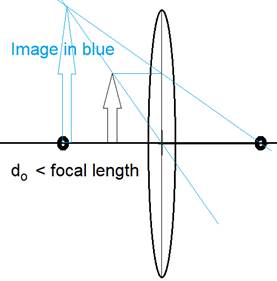
CANVAS pre-lab, this is the last image from the Canvas Pre-lab, for those unable to view this.